

Here’s an unpopular opinion I didn’t say out loud when I was running for office, but I’ll say it now.

Members of Congress do not get paid enough.
Yes, I know the number. The base salary for most Members is $174,000 a year. And yes, compared to the median American household, that is a serious salary. I’m not pretending otherwise. But once you step back and look at what we claim we want out of Congress, who we claim we want to recruit, and what incentives we’ve built into the job, the current pay structure helps produce the exact problems everyone complains about.
This is not a sympathy post for politicians.
This is a post about incentives.
The Competition Problem
If we genuinely want Congress to include more ambitious, capable, working-age professionals, the current salary often functions like a filter that keeps them out.
A lot of the people we say we want in office could earn more in the private sector. Because the market rewards skill, scarcity, and momentum. And Congress does not just pay you. It pulls you out of your career.
If you are a doctor, you are not just stepping away from income. You are stepping away from practice, from staying sharp, from continuing education, from the daily rhythm of your field. If you are an engineer, a founder, an executive, you are stepping away from an industry that moves fast and punishes gaps. “Congress” looks impressive on a resume in a political sense, but it can absolutely be a professional suicide for your actual discipline.
Now add the risk. You can serve two years and be done. You can serve four and lose. You can serve ten and get taken out by redistricting. Then you try to re-enter the market older, behind, and sometimes obsolete compared to the people who kept building while you were gone.
So we say we want younger people. We say we want skilled people. But we structure the job so that anyone with serious earning power has to take a leap that most rational people will not take.
The Two-Homes Reality
They have to maintain a life in the district they represent, and they need housing in Washington, D.C. when Congress is in session. There is no automatic “D.C. apartment allowance” that magically covers this. Yes, technically, a House member can use part of their congressional office budget to reimburse lodging tied to official business.
But that office budget is meant to fund staff, constituent services, travel, district offices, and the actual mechanics of doing the job. It was not designed to function as a personal housing subsidy.
So for most members, the reality is simple: maintaining two households is expensive, and Washington, D.C. is one of the most expensive housing markets in the country.
This is where the flat salary argument becomes lazy. A member from rural Ohio earns the same $174,000 base salary as a member from Manhattan. Those two people do not experience $174,000 the same way. It is not even close. Cost of living, spousal income, outside assets, and existing wealth all change how sustainable that salary is.
In practice, the flat salary quietly favors people who already have money, already have passive income, already have a high-earning spouse, or already have networks that make the lifestyle manageable.
If you want ordinary, talented people to serve, you cannot structure the job as if it is tailored for people who can already afford to serve.
I have said it before and I will say it again. $174,000 should be the base. But cost-of-living adjustments should exist, because the country is not one price.
The Temptation Problem Nobody Likes to Admit
The third issue is uncomfortable.
In Washington, you are surrounded by wealth. Lobbyists. Donors. Venture capitalists. CEOs. People who can make a quarter-million-dollar fundraising dinner feel like a normal affair.
I’m not saying Members should be competing with billionaires. That’s not the point. The point is that the environment creates pressure. It creates comparison. It creates rationalization. It creates a constant whisper in the background that says: you’re doing a high-status job in a high-cost city while everyone around you is swimming in money.
So what do a lot of Members do?
They trade stocks. They chase book deals. They build personal brands. They line up their future. They network for the exit. They start thinking about cable news contracts and corporate boards while they are still in office, because they are already planning how to make the money they believe they are “leaving on the table.”
This is one of the reasons stock trading reform keeps stalling. It is not the only reason, but it is part of the ecosystem. People justify ethically sketchy behavior by telling themselves they have to. They justify it as participating in the free market. They justify it as survival.
I disagree with that justification. But I understand the psychology that produces it.
Why Congress Does Not Fix It
Congress has not meaningfully raised its pay because it is political suicide.
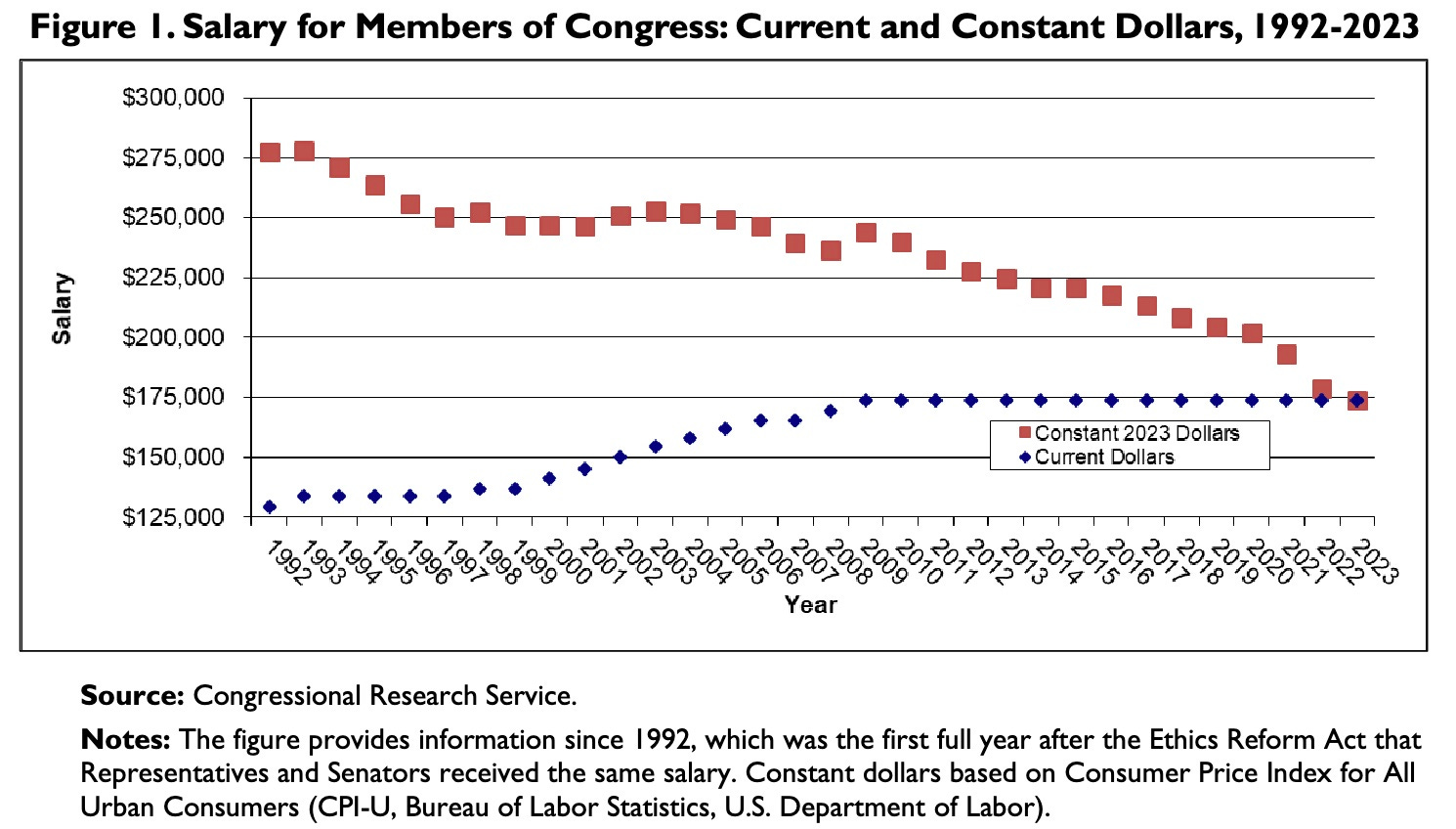
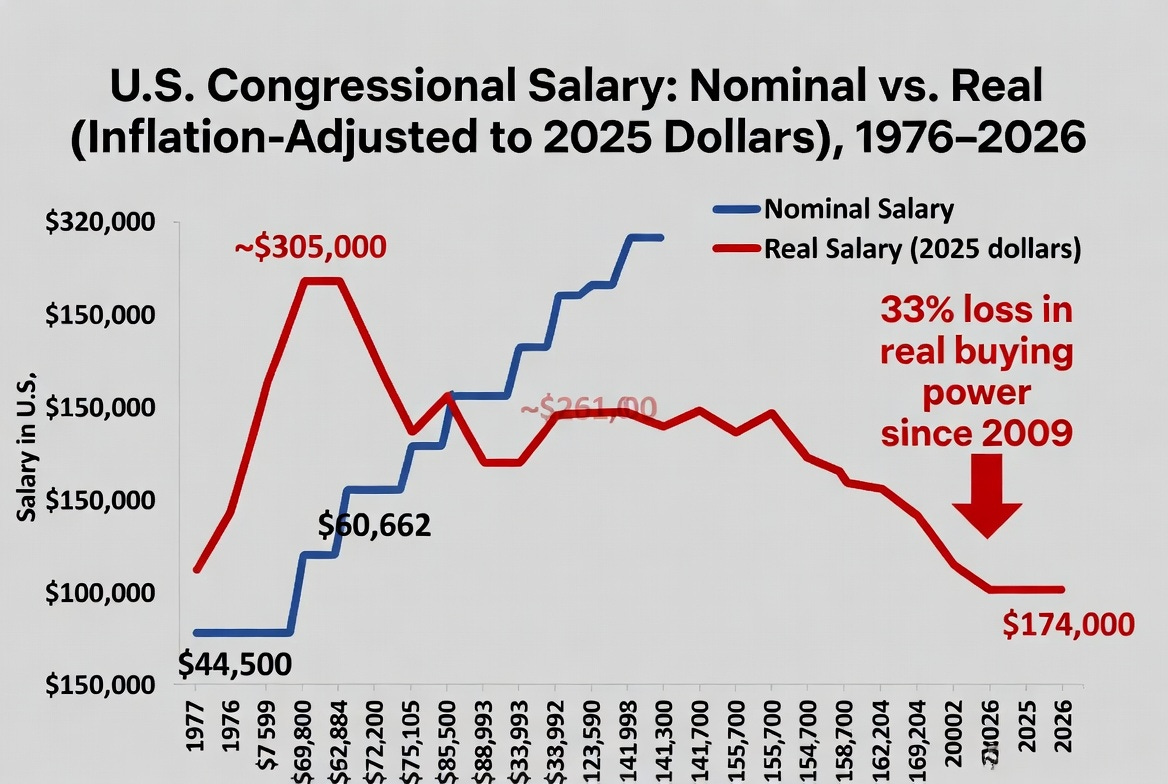
Congressional pay has been frozen at $174,000 since 2009, and while that number sounds large, the reality is that it has quietly lost a massive amount of purchasing power over the last decade and a half.
Adjusted for inflation, $174,000 in 2009 would be roughly $258,000 in 2026 dollars, meaning members of Congress today are operating with about 30 percent less real buying power than when the freeze began.
Stagnant pay does not eliminate money from politics, it increases dependence on outside wealth, donors, lobbyists, and personal fortunes, making Congress less accessible.
If Congress votes itself a raise, people lose their minds. The media loses its mind. Voters lose their minds. It becomes a story about greed, not about incentives, even when incentives are the entire problem.
So instead of fixing the front door, Congress leaves the side doors open.
They do not raise salaries, but they allow the ethical gray zones to persist. And then everyone acts shocked when people find ways to make up the difference.
A Compromise That Actually Makes Sense
Here is the trade I would make.
Pay Members more. Meaningfully more. Keep the base salary structure, but add cost-of-living adjustments. Meaning adjust the base salary to $258,000 a year which would be the same as $174,000 in 2009 adjusted for inflation. Then add a COLA or cost-of-living adjustments depending on the region or district they represent. Meaning that someone in Manhattan should be paid considerably more than somebody in Cleveland. Also, someone in Cleveland should probably make a little bit more than somebody in Mississippi or Alabama.
In exchange, ban stock trading. Full ban. No cute loopholes. No “spouse can trade.” No “just a little.” Require divestment or blind trusts with real enforcement and real penalties.
You want to serve? Fine. Serve. You are paid well enough to do it without justifying self-dealing.
That is a fair trade.
Other Options I Would Consider
One idea is a congressional housing complex. An opt-in residence in Washington, built and maintained by the government, with secure, high-quality apartments. A functional living solution that reduces the pressure of maintaining two residences.
Another idea is a more radical one. Pay Members the median income of their district while in office, plus necessary expenses, while housing is provided in DC. Then escrow the remaining salary and pay it out after they leave office.
For example, the median salary in Medina Ohio is $76,000 a year. A Congress person that represents that area should only be able to make $76,000 a year. However, considering their congressional salary, in my opinion, should be hundreds of thousands of dollars more than that, the rest goes into escrow until they are finished serving. After 10 years that could be a couple million dollars that you would happily give to them upon leaving office.
While you serve, you live like your constituents. When you leave, you are not financially punished for serving.
I’m not saying these are perfect. I’m saying we should be thinking like adults about incentives.
Why I’m Even Talking About This

Because underpayment breeds resentment.
It helps justify unethical behavior. It pushes talented people away. It encourages a Congress built out of wealthy retirees, professional politicians, and people whose real job is fundraising and positioning for their next gig.
If we want Congress to act like public servants, we have to structure public service like we actually value it, and then we have to tighten the ethical rules like we mean it.
What are your thoughts?
This is a great point but one that no party could ever push for publicly given the political climate. Voters are a bit paradoxical. They want their representatives to work for them 24/7 but they also really don't want to pay them.
Great idea. I’ve often thought that we don’t get the best and brightest and the compensation is a significant factor. I’d support a base annual salary of $1 million with the COLA adjustments you suggest but with limitations on other outside income and, hopefully, significant campaign finance reform (repeal Citizens United and limit contributions from individuals to $1,000 adjusted annually to inflation).