


The other day, Laura Rodriguez-Carbone and I published a piece about Congressman Ro Khanna.
Ro Khanna’s Only Fixed Position Is His Portfolio

Ro Khanna wants voters to see the new version of Ro Khanna: anti-oligarch, anti-stock-trading, anti-billionaire, anti-establishment, and suddenly fluent in the language of economic populism.
Our argument was straightforward. Khanna is trying to rebrand himself as an anti-billionaire, anti-oligarch, working-class progressive while positioning himself for a possible presidential campaign. He travels around the country endorsing union workers, democratic socialists, and anti-establishment candidates, collecting the exact political relationships and photographs that help build that image.
Meanwhile, his household continues reporting thousands of stock trades worth tens of millions of dollars while he supports legislation that would prohibit members of Congress, their spouses, and dependent children from trading individual stocks.
That was the article.
Ro Khanna responded with a 2,500-word Substack post claiming that our “real grievance” was his criticism of Israel and his trip to the West Bank.
There is one big fucking problem.
Our article did not mention Israel.
Not one word.

Israel Was a Deflection
Khanna pulled a quote from my 2022 congressional campaign. I told the Cleveland Jewish News that the United States should “uphold and cherish” its relationship with Israel.
Yes, I said that.
Supporting a relationship between two countries does not mean supporting every decision made by either government. More importantly, it had absolutely nothing to do with what Laura and I wrote.
We wrote about stock trading. We wrote about Khanna’s family wealth. We wrote about his national endorsement strategy. We wrote about a politician supporting a congressional stock-trading ban while thousands of trades continue appearing in his household’s financial disclosures.
Khanna came home from the West Bank with a story that was politically useful for his brand. He then attached our article to it and manufactured a fight about Israel that we never started.
That is the grift.
Khanna did not defend his actions. He changed the subject to something he is currently trying to establish himself as a national champion for. He turned our reporting into an attack on his West Bank trip because that was easier than answering questions about his portfolio.
Then he gave us his résumé.
Iraq. Yemen. Bernie Sanders. The CHIPS Act. The Epstein files. Medicare for All. A $25 minimum wage. His books.
None of it answers the question.
It is easy to introduce legislation, support proposals, and talk about what you believe, especially when you know a bill has little chance of becoming law. The real test is whether you are willing to live under the standard you are selling to everyone else.
Just Stop Trading
Khanna says he does not personally buy or sell stocks. He says neither he nor his wife directs the trades. According to him, the investments are held in trusts established by his in-laws and managed by an independent third-party trustee.
The precise description is that Khanna’s congressional disclosures reported thousands of transactions involving his household’s trusts. Common Cause attributed 3,923 trades totaling approximately $55.7 million to Khanna in its 2025.
We are not alleging insider trading. We do not need to prove insider trading to make the ethical argument.
The trades should not be happening at all.
Khanna supports the TRUST in Congress Act, which would prohibit members of Congress, their spouses, and dependent children from trading individual stocks.
Then stop trading.
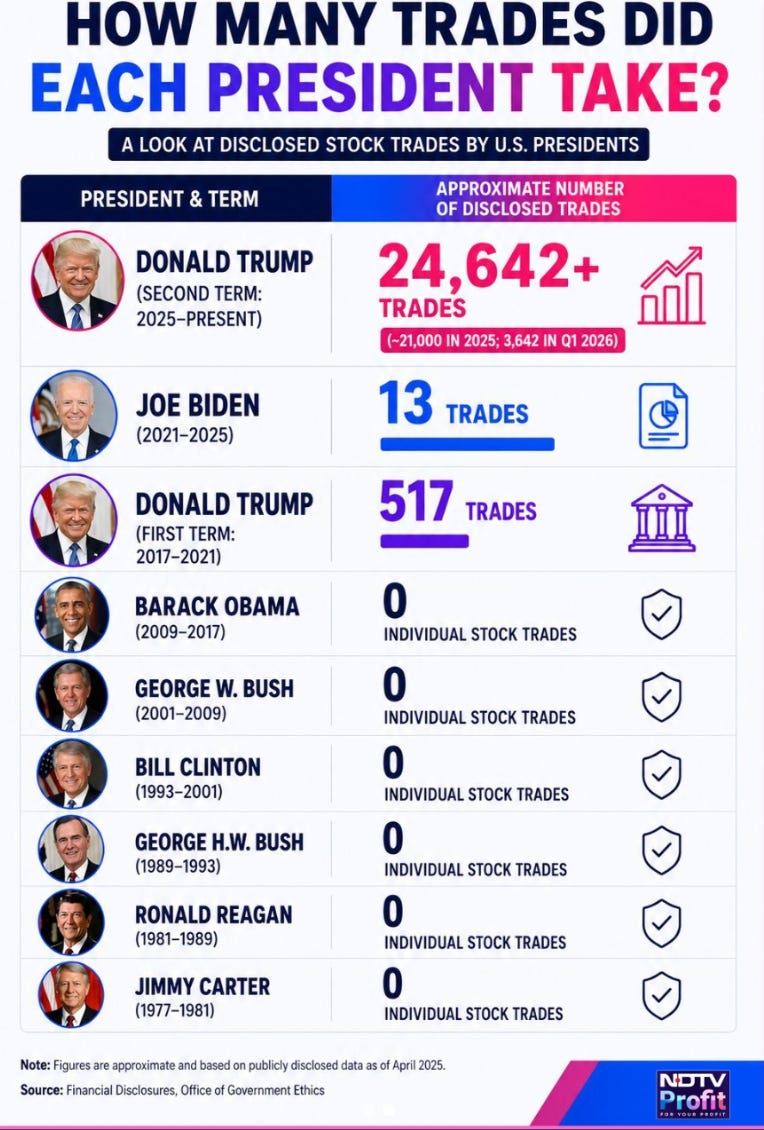
I do not care whether Khanna personally clicks the button, his wife chooses the stocks, or an independent trustee manages the account. His household reported thousands of individual stock trades while he was a sitting member of Congress.
There is no version of that I find ethically acceptable.
Members of Congress receive classified briefings. They regulate industries, approve federal contracts, investigate corporations, and make decisions that can move entire markets. Their households should not be actively trading individual companies while they hold that power.
We should not need hundreds of pages of financial disclosures, trust attorneys, forensic accountants, or explanations about which family member technically owns which asset.
Khanna says the trust underperformed the S&P 500. I do not give a shit. Losing to the market does not make thousands of trades ethical. A conflict or the appearance of a conflict does not disappear because the investment performed poorly.
Khanna does not need to wait for Congress to pass his bill. Sell the individual stocks. Move the money into diversified index funds, Treasury securities, or something that does not require thousands of individual trades while he serves in Congress.
Stand on business.
Live under the standard you are selling to everyone else.
Apparently Losing Only Counts When We Do It
Instead of answering that argument, Khanna looked up our election histories.
Laura ran against Brian Poindexter in the May 5 Democratic primary for Ohio’s 7th Congressional District and lost. I ran for the same congressional seat in 2022 and 2024 and lost.
Those are facts.
What Khanna left out is that Ohio’s 7th District was deliberately drawn to favor Republicans. It is difficult to run there as a Democrat, but somebody still has to stand up and do it. Candidates in difficult districts build local organizations, engage voters, recruit volunteers, raise money, and make sure Democrats have somebody on the ballot.
Khanna should understand that.
He lost his first two congressional campaigns. In his response, he presented his failed 2004 primary campaign as proof that he had the courage to challenge an entrenched incumbent.
Apparently, losing demonstrated courage when Ro Khanna did it. When Laura and I did it, our losses became opposition research.
Laura also brought more to her campaign than the one sentence Khanna gave her. She served for more than two decades across multiple federal agencies, working on healthcare, civil rights, emergency response, and public service. She ran for Congress using approximately $12,000 of her savings and rejected corporate PAC money.
Brian Poindexter benefited from at least $570,204 in outside spending from Jobs and Democracy PAC, according to FEC-based tracking. That super PAC operates within a political network heavily funded by interests connected to the artificial intelligence industry.
Khanna did not call Laura before endorsing. He did not examine her record or ask why outside money was pouring into an eight-person Democratic primary.
Khanna can endorse whoever he wants. But he cannot spend years criticizing the Democratic establishment for putting its thumb on the scale, enter an Ohio primary and add his thumb to the pile, and then dismiss Laura as a sore loser when she questions his hypocrisy.

Do Not Use Brian Poindexter as a Shield
Our original article was not an attack on Brian Poindexter.
It was about what Khanna receives from endorsing candidates like him.
Brian gives Khanna a union ironworker in working-class Ohio. Other endorsements give him democratic socialists, rural candidates, Midwestern relationships, and access to local political networks far outside Silicon Valley.
Khanna receives photographs, relationships, fundraising opportunities, labor credibility, email lists, and a national story about how a wealthy congressman from Silicon Valley understands working people across America.
That is extremely useful for somebody thinking about running for president.
Instead of addressing that strategy, Khanna placed Brian between himself and our criticism. He turned questions about his own political ambition into an alleged attack on a union worker.
Do not borrow a worker’s credibility and then hide behind him when somebody asks what you are getting from the relationship.
And do not use Brian’s biography to protect Ro Khanna’s portfolio.
Why Did He Choose Us?
Khanna has faced questions about his household’s trading from researchers, national publications, political opponents, and people with audiences numbering in the millions.
But he chose to write 2,500 words about two former congressional candidates publishing a small newsletter in Ohio.
Maybe we looked like the easiest targets.
Khanna could point to our election losses and dismiss us as bitter. He could use my four-year-old quote about Israel to invent a secret motive. He could make himself look like a fighter without directly engaging the people filing complaints or publishing detailed financial analyses.
He could not make the financial disclosures disappear.
But maybe he thought he could discredit us.
So, genuinely, thank you for the attention, Congressman Khanna. Thank you for tagging The Angry Democrats and putting our criticism in front of your audience.
But next time, respond to the article we actually wrote.
A Warning to Candidates
Candidates receiving Khanna’s attention should understand that the relationship is not one-sided.
Maybe Khanna sincerely believes in you. We hope he does.
But he is also using your campaign to build his political image. Your background gives him credibility. Your supporters become part of his network. Your campaign becomes evidence that a wealthy Silicon Valley congressman understands labor, rural America, democratic socialism, or whatever political lane he is trying to enter that week.
Do not confuse national attention with friendship.
Do not allow your biography, campaign, or working-class credibility to become somebody else’s political costume.
And pay attention to what Khanna did when his own record was questioned. He placed Brian Poindexter between himself and criticism that had nothing to do with Brian.
Ro Khanna knows how to use people.
Make sure you are not next.
Stay Angry.
Every dollar funds coverage you can read and the worked needed to curate the stories, strategy, and analysis to bring you the information you need to know.
Give once. Then hold us to it.
Boom!