


Ro Khanna wants voters to see the new version of Ro Khanna: anti-oligarch, anti-stock-trading, anti-billionaire, anti-establishment, and suddenly fluent in the language of economic populism.
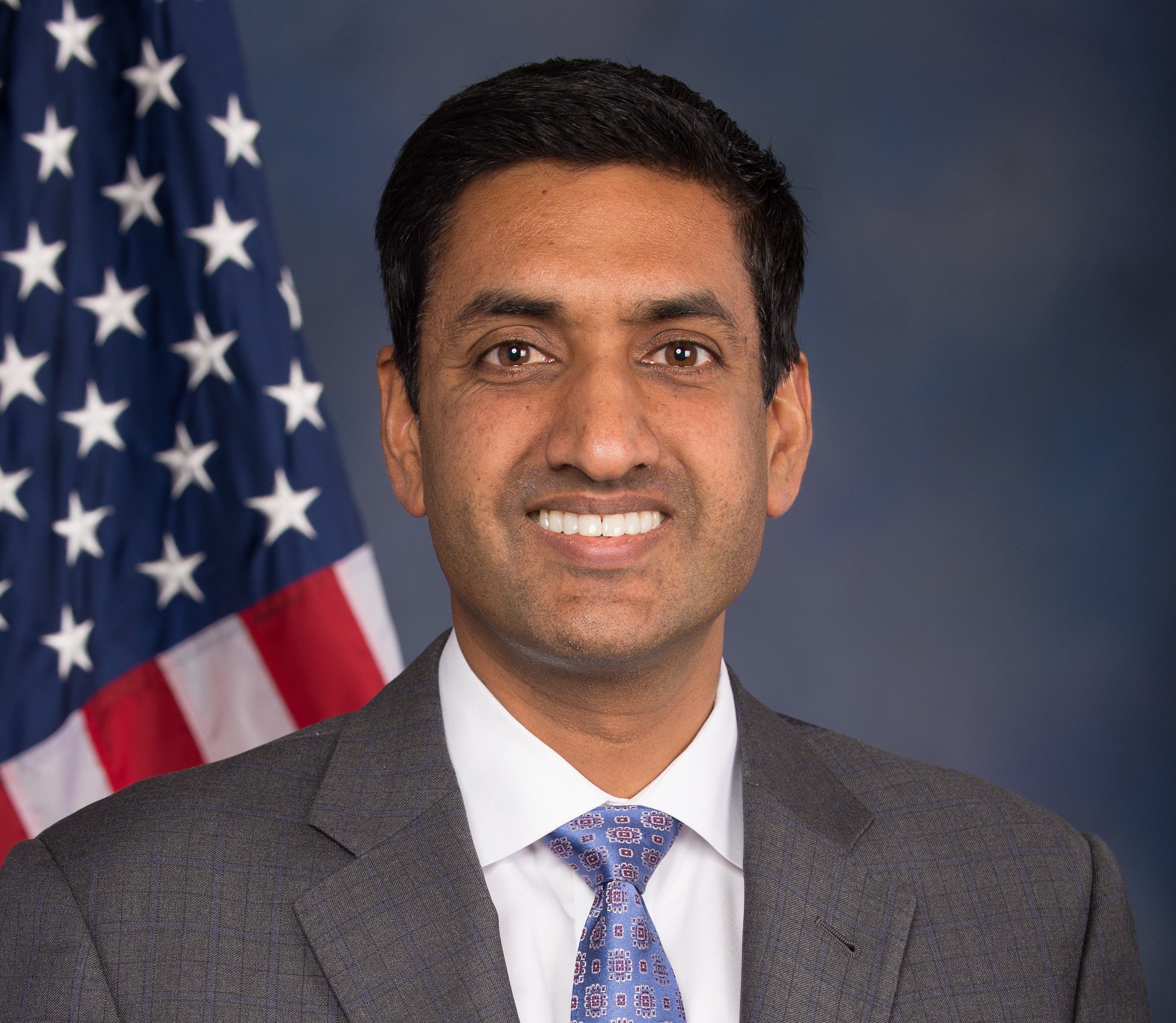
That is the version Ro Khanna is selling now. I do not buy it. This does not look like conviction. It looks like a wealthy Silicon Valley politician trying on working-class rage because he figured out that is the uniform for 2028.
Khanna did not come out of nowhere as some working-class revolt against Silicon Valley power. He came up as a Silicon Valley Democrat, backed by the tech world, representing one of the richest and most powerful districts in America. Business Insider described his 2016 victory as a win for the tech industry and said he had been a favorite of the tech industry since his 2014 run against Mike Honda.
Now he wants to sound like the man who will save the Democratic Party from billionaires. That is the part Democrats should examine before they start treating him like the answer for 2028 and before we welcome him into our state and congressional races.
Who Is Ro Khanna
Ro Khanna, full name Rohit Khanna, was born on September 13, 1976, in Philadelphia, Pennsylvania. He is 49 years old. His parents immigrated to the United States from Punjab, India, in 1968. His father was a chemical engineer, and his mother was a former schoolteacher. Khanna grew up in Bucks County, Pennsylvania, before going on to the University of Chicago, where he earned a degree in economics, and Yale Law School, where he earned his law degree.
Before Congress, Khanna worked as an attorney, taught at Stanford, Santa Clara University School of Law, and San Francisco State University, and served in the Obama administration as deputy assistant secretary at the U.S. Department of Commerce from 2009 to 2011. After leaving the Commerce Department, he joined Wilson Sonsini, a Silicon Valley law firm, and later worked as vice president of strategic initiatives at Smart Utility Systems.
Politically, Khanna first ran for Congress in 2004 and lost. He later challenged Democratic incumbent Mike Honda in California’s 17th Congressional District in 2014 and lost again, though his campaign was heavily backed by major names in the tech industry. In 2016, he ran again, defeated Honda, and has represented California’s 17th District since January 2017. The district includes a major part of Silicon Valley, which is central to understanding both his rise and the criticism of his current populist rebrand
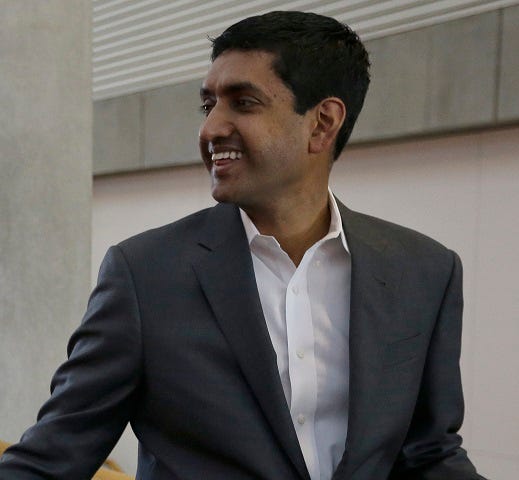
Khanna now describes himself as a “progressive capitalist.” He endorsed Bernie Sanders in 2016, co-chaired Sanders’ 2020 presidential campaign, sits in the Congressional Progressive Caucus, and has built a national profile around antitrust, technology, manufacturing, foreign policy restraint, campaign finance reform, and economic populism. He is married to Ritu Ahuja Khanna, and they have two children.
Before the Populist Rebrand
Khanna’s political origin was not anti-tech populism. He was Silicon Valley all day. The tech bros of bros!
He represented the tech district. He raised from the tech ecosystem. He built the profile of the polished, pro-innovation, Silicon Valley Democrat who could speak the language of startups, global competition, and the new economy.
But now the language has changed.
Now Khanna talks about economic patriotism, steel towns, manufacturing, workers left behind, and the failure of both parties to build an economy that reaches beyond the coasts. His own “New Economic Patriotism” pitch opens with steelworkers in Chicago, shuttered mills, lower-paying warehouse jobs, and the decline of opportunity for working-class communities. He relaunched the whole vision in an April 2026 National Press Club speech that pivots from "the Epstein class" of untouchable elites straight to "we need a billionaire tax."
That is a real issue. The problem is not that Ro Khanna is talking about it. The problem is that every version of Ro Khanna seems to arrive exactly when that version becomes useful. The grifter that knows the right time to change the grift and use people to shape his brand and perception.
Ro Khanna Is Borrowing Other People’s Working-Class Credibility
Khanna’s endorsements are not random. They are a map. He is attaching himself to the exact kinds of candidates who signal where the Democratic base is moving: democratic socialists, labor candidates, anti-establishment candidates, and working-class messengers outside his Silicon Valley lane. ABC News reported that Khanna has backed more than 30 candidates this cycle, with national attention on his endorsement strategy as he is widely viewed as a possible 2028 contender.
The old Ro Khanna was the Silicon Valley Democrat. The new Ro Khanna wants to be seen standing next to socialists, union workers, and populists. So who is he endorsing?
Zohran Mamdani, New York City mayor
Mamdani gives Khanna the DSA lane. NYC-DSA endorsed Mamdani, and his campaign became a national symbol of movement from the left before he won City Hall. For Khanna, standing with Mamdani is a way to look aligned with the socialist energy inside the Democratic base without having to actually be from that world.Omar Fateh, Minneapolis mayoral candidate
Fateh gives Khanna another democratic socialist signal, this time in Minneapolis. The Progressive described Fateh’s rise as part of a “Mamdani Moment” in Minneapolis, with democratic socialist candidates making gains against Democratic establishment resistance. Fateh, a Minnesota state senator, won the DFL endorsement but lost the November 2025 race to incumbent Jacob Frey. Winning was never the point for Khanna. That is exactly the kind of fight Khanna wants to be photographed near now.Brian Poindexter, Ohio’s 7th Congressional District
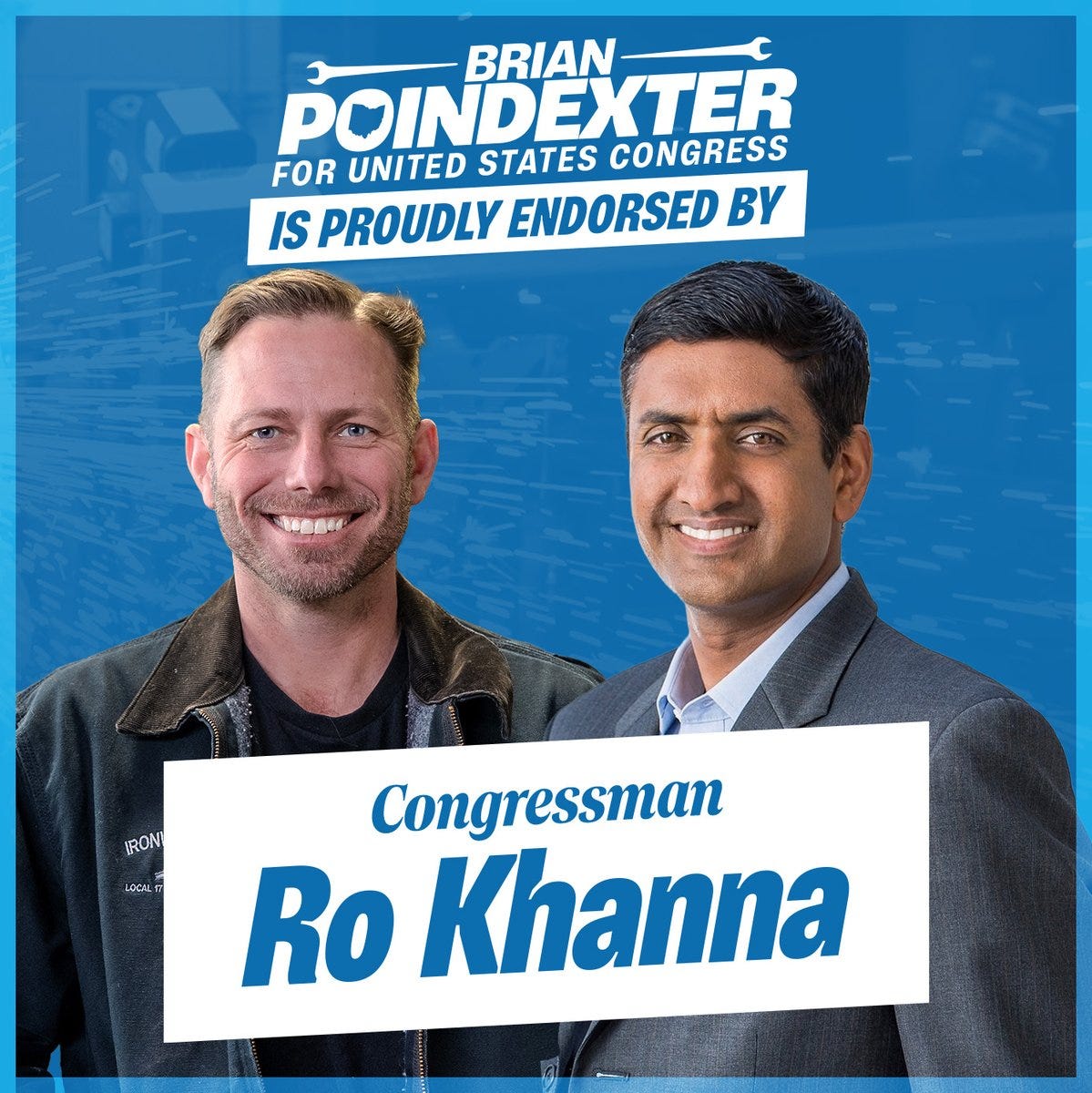
Poindexter gives Khanna the labor lane. Poindexter is a union ironworker, organizer, Brook Park city councilman, and Democrat running against Max Miller in Ohio’s 7th. Working Families Party endorsed him as a working-class candidate, and America’s Work Force Union Podcast described him as an Ironworkers Local 17 member campaigning on wages, health care, and retirement security. Khanna endorsing him is not just about Ohio. It lets Khanna borrow the credibility from labor in a working-class district far from Silicon Valley.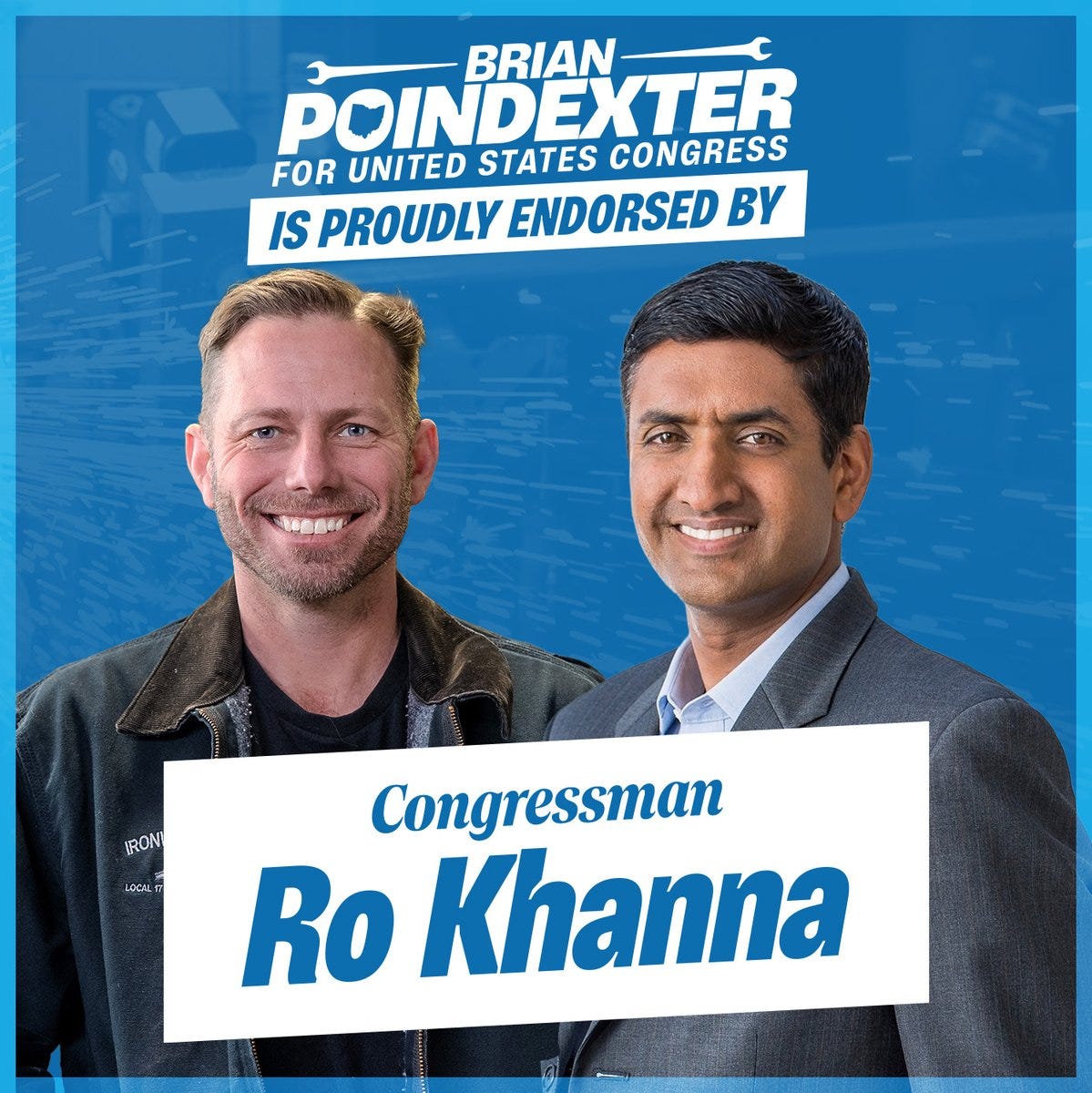
Abdul El-Sayed, Michigan U.S. Senate
El-Sayed gives Khanna the Bernie-left, anti-corporate Senate lane. El-Sayed is running on taxing billionaires, Medicare for All, and breaking up corporate power, and he oversaw an effort to erase hundreds of millions in medical debt as Wayne County's health director (Time, July 8, 2026). That fits perfectly with Khanna’s new anti-billionaire language. Maybe he is just jealous he isn’t a billionaire yet. More on that later. Believe that.Graham Platner, Maine U.S. Senate
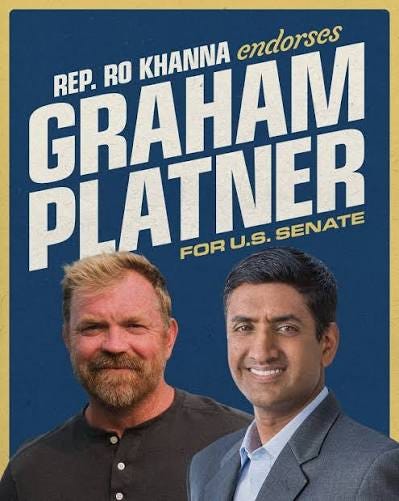
Platner gave Khanna the rural anti-establishment lane before the campaign blew up. ABC listed Platner among Khanna’s Senate endorsements. After a serious sexual-assault allegation surfaced, Khanna rescinded his endorsement and publicly called on Platner to drop out (Fox News, July 6, 2026). That does not erase the original political calculation: Platner was part of the tough guy working man image.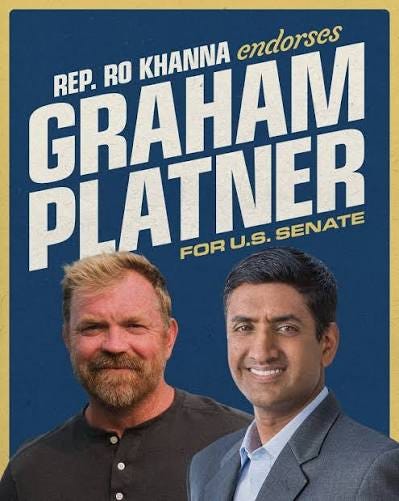
Josh Turek, Iowa U.S. Senate
Turek gives Khanna a Midwestern Senate lane. He fits the broader pattern of Khanna trying to build relationships outside California in states that matter for Senate control and presidential politics. ABC listed Turek among Khanna’s Senate endorsements.Roy Cooper, North Carolina U.S. Senate
Cooper gives Khanna a more establishment-friendly lane. This is important because Khanna cannot be seen as not only endorsing DSA and Labor. He is also covering himself with electability and swing-state credibility.
His New Script
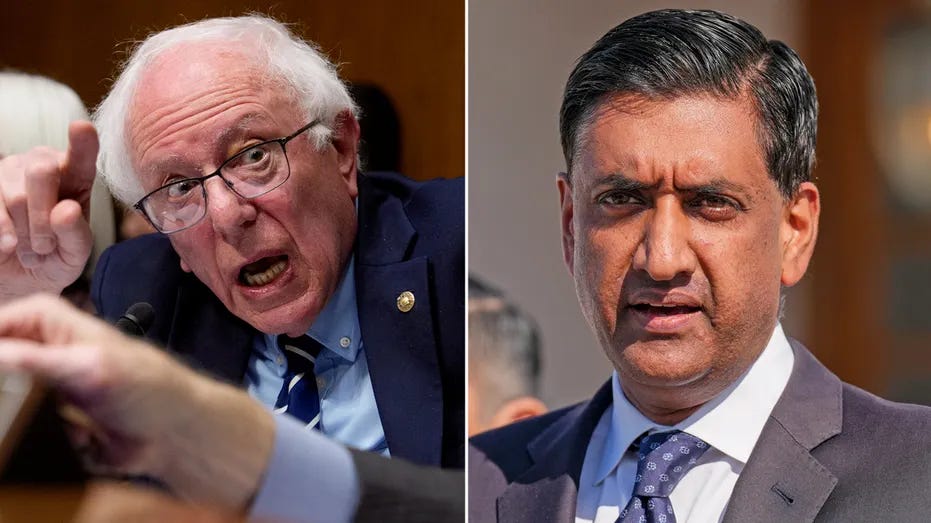
Khanna is now teaming with Bernie Sanders on a billionaire wealth tax. Their bill, the Make Billionaires Pay Their Fair Share Act, would place a 5% annual tax on the roughly 938 billionaires in America and use the revenue for $3,000 direct payments to working- and middle-income households and other working-family priorities.
But then let’s stop pretending the obvious question is off the table. If Ro Khanna believes concentrated wealth is such a moral and political emergency, why is his own family wealth structured like the exact thing he is supposedly running against?
A Free Beacon review of his financial disclosures estimated family assets ranging from $103 million to more than $340 million across Khanna, his wife, and his children. His children reportedly hold tens of millions of dollars in irrevocable trusts. His wife and children’s trusts are tied to thousands of stock trades. His children’s trusts reportedly hold interests in private golf clubs in Ohio that generate millions of dollars.
So…umm… wtaf?
Wealth is a problem when billionaires have it, but when it is Ro Khanna’s family, it is just estate planning? Stock trading is a problem when members of Congress do it, but when the trades run through spouse and child trusts, suddenly we are all supposed to be ok with nearly $56 million in trades? Hoarded wealth is bad, but golf course interests tucked into children’s trusts are just normal family business? Good?
Khanna is full of shit.
If Khanna believes this much wealth should be redirected toward working families, why is he waiting for Congress to force him into that position? Why not move first?
Why not put a serious chunk of that family wealth into housing, medical debt relief, labor organizing, local journalism, rural hospitals, or worker-owned businesses? Why not build the kind of public-serving foundation he says the ultra-rich should be forced to fund?
Instead, voters are looking at trusts, private investments, real estate, stock activity, and golf club interests.
That is not working-class politics. That is a rich-guy pandering.
The issue is not whether Ro Khanna has technically violated the law. The issue is that he wants to campaign as the guy fighting concentrated wealth while his own household looks like a fucking case study in how concentrated wealth protects itself.
So How Much Does Ro Have?
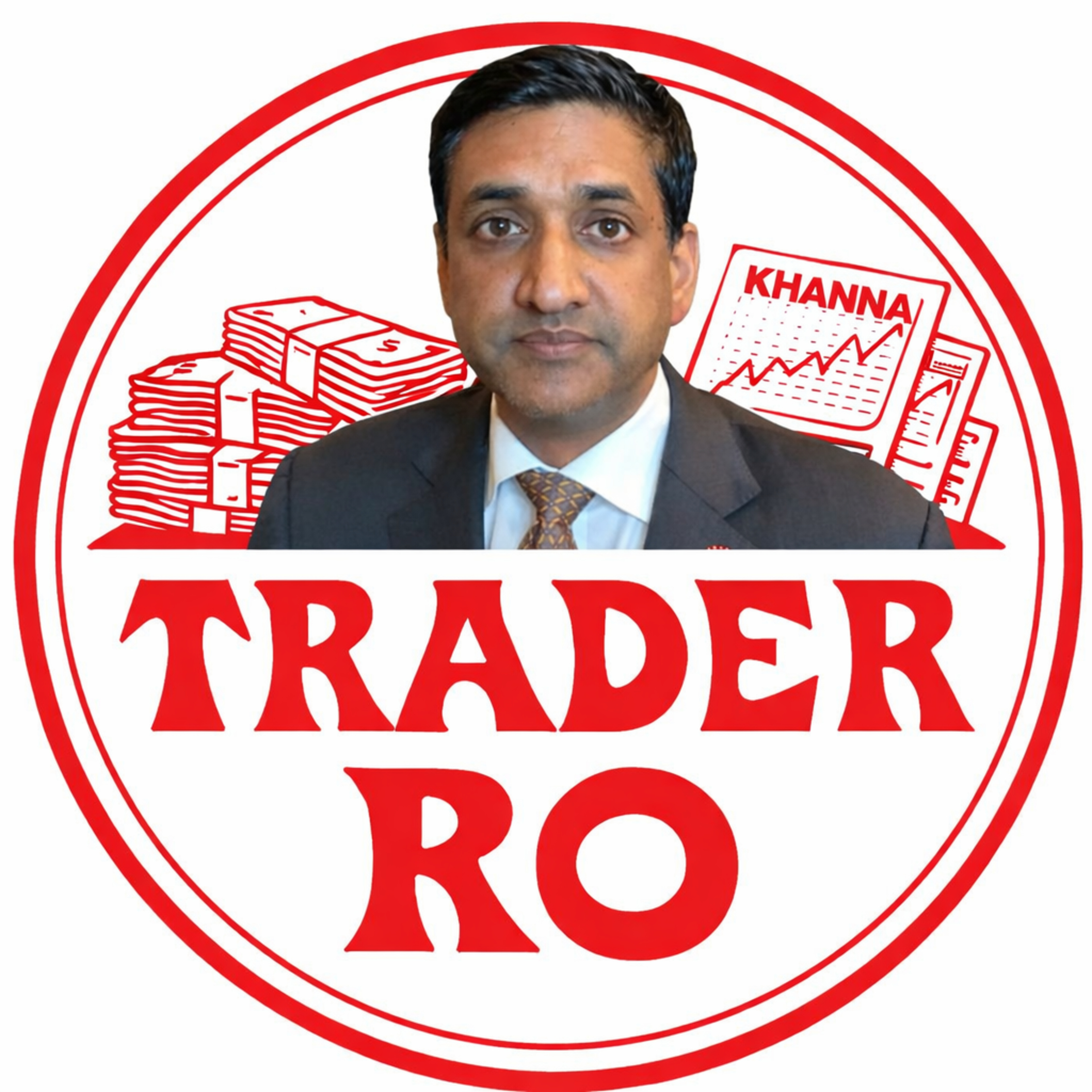
Common Cause reported that members of Congress made 13,324 trades totaling $635.57 million over the trailing year. In that same report, Khanna was listed third by volume, with 3,923 trades and $55.7 million in volume.
Khanna’s defense is also part of the record. He says he does not personally own or trade stocks. He says the household investments are in a trust his in-laws set up before marriage, managed independently by a third-party trustee. He says neither he nor his wife directs the trades. He also points out that he supports the TRUST in Congress Act, which would bar members of Congress, their spouses, and their dependent children from trading individual stocks while in office.
Here’s the obvious question. If spouses and dependent children belong inside the ban, why are voters supposed to pretend spousal and child trusts are irrelevant right now?
That’s the contradiction. Not that there’s proven insider trading. There is no public evidence proving that. The contradiction is that Khanna wants credit for supporting a ban that recognizes the household as part of the ethical problem, while asking voters to treat his own household as some separate universe.
That IS the Democratic hypocrisy.
It is all searchable at: https://www.rokhanna.money/
Give Him the Credit He Earned
Khanna does have a real anti-PAC record.
He launched the NO PAC Caucus in 2017, aimed at limiting PAC influence and prohibiting PAC contributions to members of Congress. He also joined Summer Lee, Pramila Jayapal, Rashida Tlaib, and others on the Abolish Super PACs Act in 2025.
This is not an argument that Ro Khanna has never done anything right. This is an argument that Democrats should stop confusing a well-timed rebrand with conviction.
Matt’s Take:
Ro Khanna is somebody I have been following for many years. I have seen him many times on Breaking Points and other podcasts. In the beginning, Ro Khanna was honestly refreshing. He seemed authentic. He seemed like a congressman who had his positions pretty much locked down and was advocating for them.
Then something changed.
He changed. Politics changed. And he saw opportunity.
Then he started pandering.
The problem is that his pandering feels inauthentic and hypocritical compared to the life he lives and the politician he used to be. If he is a rich tech bro, be a rich tech bro. But you cant be Mamdani in politics with a rich tech bro life. It doesn’t make sense.
Ro is hanging out with union workers like he is friends with them, Like he even knows any laboror, that isn’t cleaning his house, in real life. It is like when Mark Zuckerburg was BBQ’ing and told everyone he loves Sweet Baby Ray’s BBQ sauce. Like he was trying to convince us he was a real person that does real things. Like Mark, you are not fooling anyone. Go sit down and just be rich.
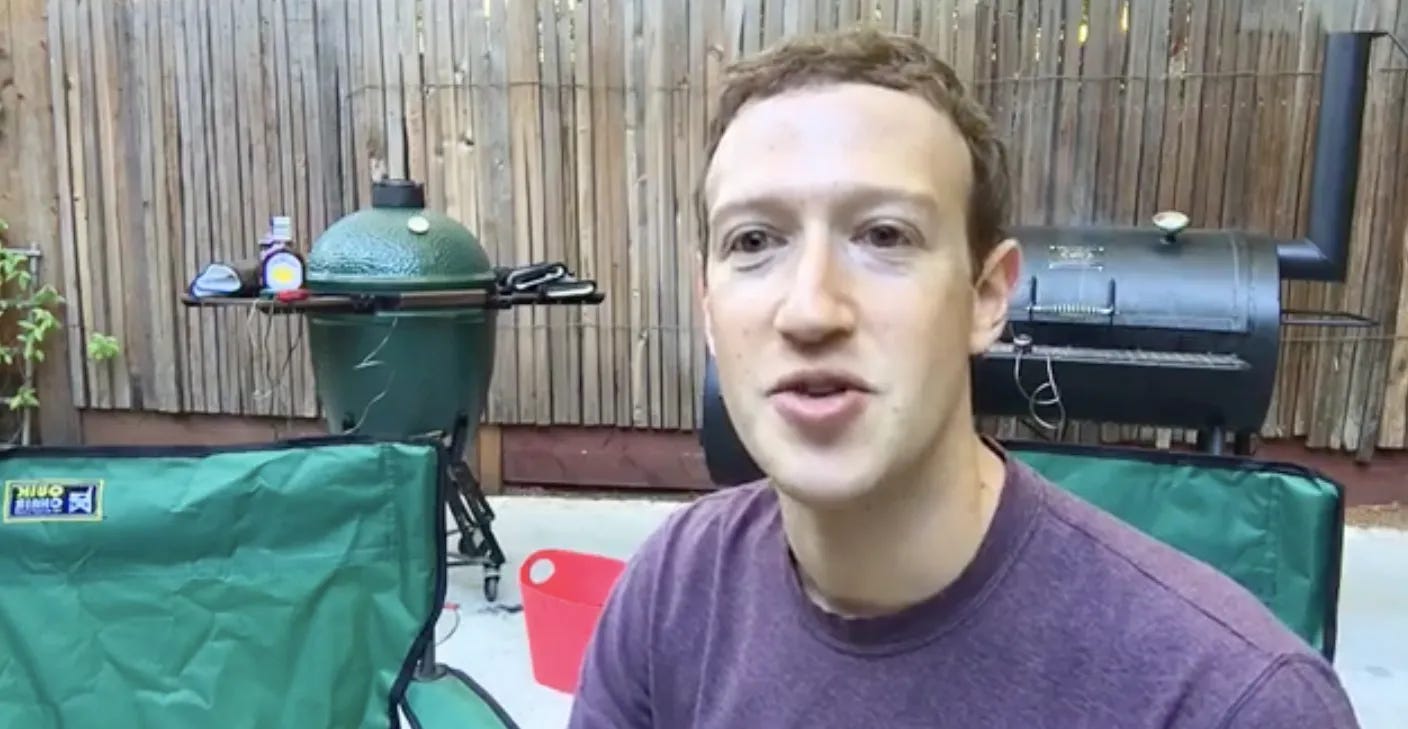
It is obvious that he is trying to build some sort of robust coalition that is outside of who he actually is. He is trying to speak the language, and he is convincing a lot of people. But to be perfectly honest… I do not buy it.
The hypocrisy around his accounts and trading is what really bothers me too.
It’s okay if you have money. It’s okay if you are doing well for yourself and your family. I have no problem with that.
But actively trading while in Congress, whether it is in a trust or not, and doing very, very well for yourself while in office does not sit right with me. Especially when he is preaching there should be not stock trading in congress and is the author of the TRUST in Congress Act.
To me, it sounds like virtue signaling. It gets people to stop looking at him while he stock trades, makes a lot of money, panders, and makes inroads for some sort of power grab with inauthentic positioning. Another Thiel Trojan Horse?
Laura’s Take
Ro Khanna is an opportunist. He takes whichever position is selling that year and leaves his money exactly where it is.
In 2016 he ran as Silicon Valley’s candidate, funded by the tech industry that had backed him since his first run at Mike Honda in 2014. In 2026 he is co-writing a billionaire wealth tax with Bernie Sanders. He is still the third-heaviest stock trader in Congress, $55.7 million across nearly 4,000 trades, while carrying his own bill to ban members of Congress from trading stocks. I believe Khanna does things like this because he knows the value of performative politics and understands it will never pass. Again, he is buying good will without doing any actual work. Ro Khanna is no better than Donald Trump in this category. Trump continues to use public office to grow his own fortune, and Khanna, no doubt, relies on insider-trading of some sort to do the same.
He has no working-class record, so he buys proximity to one. He endorsed Brian Poindexter, an ironworker in Ohio, Zohran Mamdani, a democratic socialist in New York, and Senate candidates in Maine, Michigan, Iowa, and North Carolina, none of them his home state. Not one of those endorsements changed a line in his own financial disclosures. They changed his photographs and his personal brand marketing.
Khanna represents Silicon Valley, by many measures the wealthiest congressional district in the country. The ironworkers, steel towns, and warehouse workers he now stands beside are not his constituents, but they now serve as his backdrop. The real Ro Khanna is “wet-fingered” (see the show Veep and its definition of the politics of Qataris) and if it became trendy to jump off bridges tomorrow, he’d be the first one to go. Who is Ro Khanna? Nobody has any actual idea.
Stay Angry.
Sources:
https://khanna.house.gov/media/press-releases/beyond-epstein-class-new-economic-patriotism
https://khanna.house.gov/media/press-releases/release-house-members-start-no-pac-money-caucus
https://abcnews.com/Politics/democratic-rep-khanna-biden-made-mistake-running/story?id=121913712
https://workingfamilies.org/2026/04/wfp-endorses-brian-poindexter-for-oh-07/
https://www.theguardian.com/us-news/2025/oct/30/omar-fateh-minneapolis-mayor-race
https://www.tomsteyer.com/press/representative-ro-khanna-endorses-tom-steyer-for-governor
https://newjerseyglobe.com/local/mussab-gets-backing-of-prominent-national-political-leaders/
https://newjerseyglobe.com/congress/ro-khanna-endorses-analilia-mejia-in-nj-11/
Oh this data center/ tech oriented business gave me a million dollars and I don’t know why, great…
Spot on! As my grandmother would say “they are frauds clothed as sheep.” I still cannot get over