

This is a thought I’ve been with. It’s not meant to diminish the very real trauma experienced by people, countries, cultures, religions, or communities that have endured war and violence far beyond anything Americans have faced. This is simply an observation about the American experience that I’ve been thinking about.
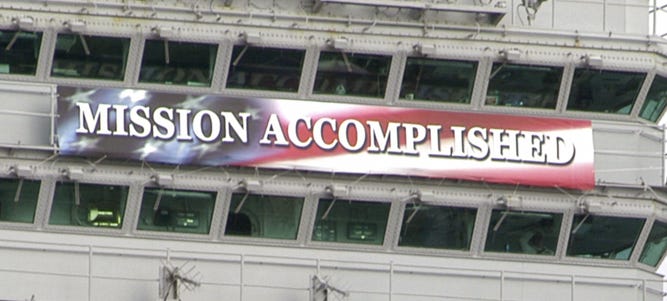
The first Iraq war happened when I was 11 or 12.
9/11 hit when I was 21. I remember exactly where I was. Everybody does.
Then we were told we had to go into Iraq because of weapons of mass destruction. That was the justification. That was the urgency. That was the moral frame.
They never existed.
I protested that war in college. I remember standing there and being told I wasn’t patriotic. That I didn’t support the troops. That questioning the mission meant questioning America itself. On the other side were people saying no more foreign wars.
That tension? That was democracy. That was freedom of speech. I appreciate that part.
But fast forward years later, and the facts start to unravel. The WMD narrative collapses. The intelligence was wrong. Fabricated. However you want to describe it. The result was the same.
Millions of Iraqis dead.
Trillions of taxpayer dollars spent.
More trillions in Afghanistan.
Twenty years of “war on” whatever slogan we needed to justify the next deployment.
And here we are decades later still asking: what exactly were we doing there?
Now I’m at the age where my age group is retiring after 20 - 30 years in the military. I meet more and more people who served in both Iraq and Afghanistan. If you work in healthcare, if you run for office, if you talk to veterans groups, VFW halls, disabled vet caucuses, you meet the people.
Some came back fine. Some didn’t.
Some came back with skills.
Some came back with chronic back pain.
Some wake up in cold sweats.
Some drink too much.
Some can’t maintain relationships.
Some never came home.
And let’s be honest about who signs up.
It’s not the elite class. It’s not the politicians’ kids. It’s not hedge fund families. It’s 18-year-olds from working-class neighborhoods staring at a $100,000 a year college bill, knowing they can’t afford it, not wanting to drown in debt, and deciding the military is their only real shot at upward mobility.
They roll the dice with their lives because they feel they are too damn poor to have another option.
And then we sit here and tell ourselves this is just how it works.
We could fund affordable college.
We could build a stronger safety net.
We could create real opportunity without asking someone to risk PTSD or death for it.
Instead, we find the money for $100 million fighter jets. Every time.
(p.s. I just heard bathrooms are leaking into the cafeteria at some of our Clevleand public schools that we cant fund so they have to eat in the gym). Whats the fix? 1/16th a jet? I digress.
This is what I call a scar on the national psyche.
Now, people say, “Why are Americans so anti-war? Why are they so reluctant? Why don’t they support protecting America?”
Let’s be clear. America has not had bombs falling on our cities in modern times. We haven’t had neighborhoods flattened. We haven’t watched our currency collapse because a foreign army rolled through our streets. My Russian friend has said that to me more than once. He says Americans really don’t understand war because we haven’t experienced it at home.
He’s right about that part. We’ve been fortunate. Extremely fortunate. Privileged even. And I don’t say that as an insult. I think everyone in the world deserves that level of security and comfort.
And it's very hard to make the case that it isn't because of our military actions.
But here’s what we do have.
We have the moral weight of knowing what our taxpayer dollars fund overseas.
We don’t approve of bombs hitting schools.
We don’t approve of toppling governments without clear justification tied directly to protecting American lives.
We don’t approve of watching our brothers and sisters come home broken.
And we definitely don’t approve of being told one thing during a campaign and shown another once power is secured.
This repetition leaves a mark.
Money in.
War out.
Veterans return changed.
Debt climbs.
The justification shifts.
That’s not isolationism. That’s pattern recognition.
There’s a psychological tension in this country. We know we’re powerful. We know we’re wealthy. We know we’re comfortable compared to much of the world. And at the same time, we know what our power projects abroad.
That tension creates guilt.
My stepfather worked for the same company for 42 years. It was employee-owned. The year he retired, it sold. His shares made him a millionaire overnight. He told me the guilt ate at him. His siblings were struggling. His kids were grinding. He didn’t understand why he got lucky while others didn’t.
I’ve heard similar stories from wealthy investors. They talk about guilt. About responsibility. About trying to give back not just out of generosity but out of discomfort.
Scale that up to a country.
We know we have it good.
We know we have power.
And we know that power has consequences.
We also know millions have died in conflicts funded by our taxes. Even if it sits in the back of our minds. Even if it’s uncomfortable to say out loud.
That’s collective trauma.
Not trauma from bombs on our soil.
Trauma from repetition.
From promises broken.
From trillions spent.
From watching the same cycle play out again and again.
People wonder why we don’t have the same patriotic enthusiasm for military action that we had in World War II.
Because for decades what we’ve seen is not a clear existential fight on our shores. What we’ve seen is a rich country repeatedly spending billions — tens of billions — sometimes trillions — projecting force into countries that cannot realistically fight back.
I’m not in intelligence briefings. I don’t see classified memos. Maybe there are decisions made in back rooms that are more complex than we understand.
But I know what happens in living rooms.
People remember.
They remember Iraq.
They remember Afghanistan.
They remember being called crazy for opposing it.
They remember being proven right years later.
And until our leaders acknowledge that history and not spin it or rebrand it, they will continue to misread American reluctance.