

Yesterday was a good day.
Not only did Artemis II launch its first manned mission to the moon in 54 years, inspiring the world while millions tuned in live to watch something that felt bigger than politics, bigger than day-to-day noise, but it also reminded people of what coordinated effort can actually produce. It fostered a sense of hope that we do not get often anymore. It made people stop and think, even briefly, that this is what humanity can do when we choose to build instead of destroy.
At the same time, the Cleveland Guardians beat the Los Angeles Dodgers 4–1, taking two out of three on the road and coming back for our home opener with a strong start to the season.
And in a very different setting, but one that matters just as much for how our future is shaped, I attended the League of Women Voters OH-7 Congressional District forum with one of my favorite people, Sarah.
This is my report on that event.
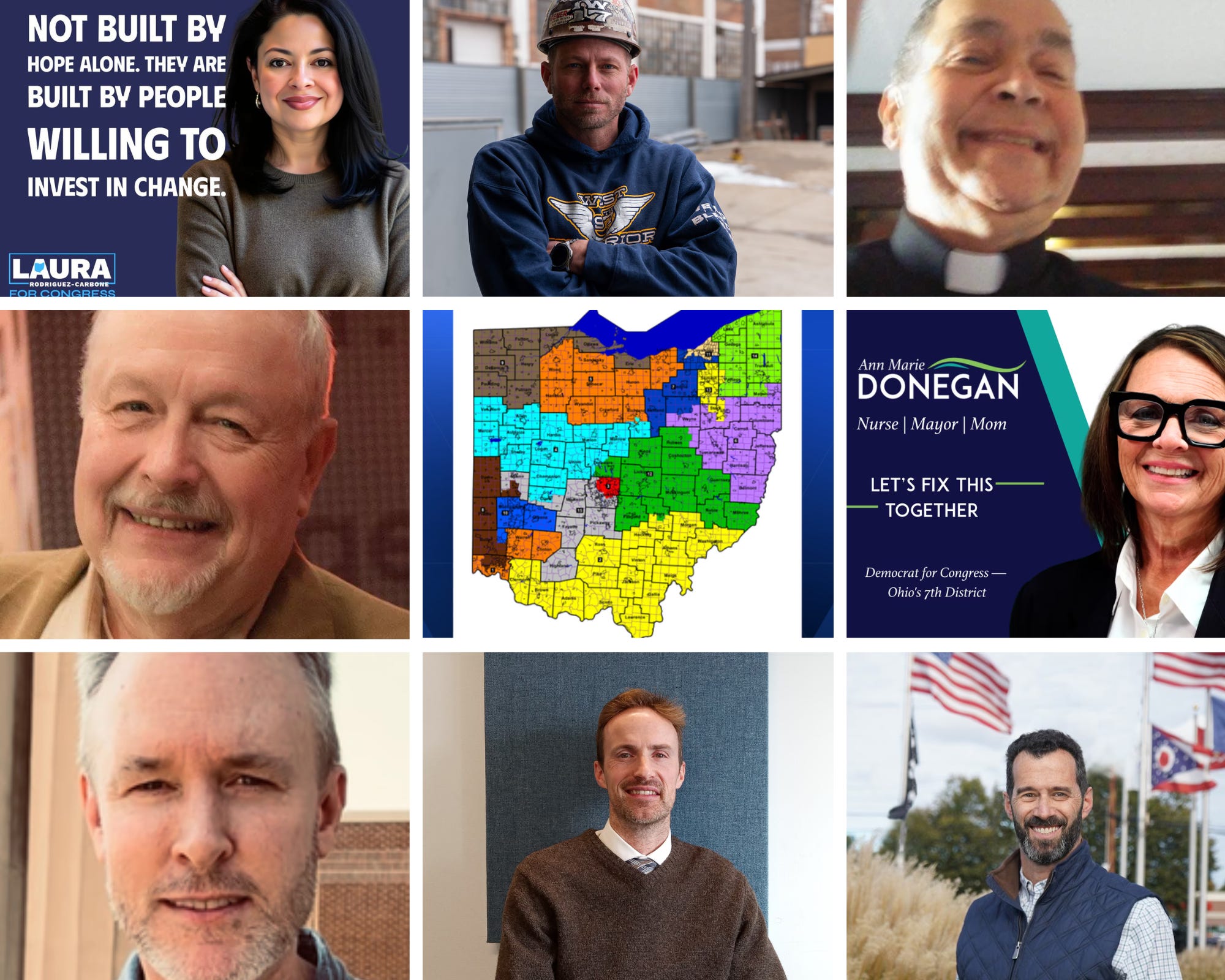
Purpose of This Breakdown
First, I want to acknowledge the League of Women Voters.
Through the years I ran for Congress, and even now, they consistently show up. They create space for engagement, for dialogue, for people to hear directly from candidates. Whether it is three people in a room or hundreds, they do the work. That consistency matters in a system where participation is often declining.
But with eight candidates on a stage and limited time, there is only so much substance you can realistically extract. You are not getting depth. You are getting snapshots.
So after the event, Sarah and I tried to impose some structure on what we saw.
We built a simple evaluation framework:
Presentation
Who actually looked and sounded like someone ready to represent the district? Who controlled the room, understood pacing, and communicated clearly?
Policy
Who demonstrated a real understanding of the issues? Not just talking points, but actual comprehension and clarity.
Execution
We split this into two parts:
Who is going to fight in Congress?
Who actually understands how Congress works and how to get something done?
This matters because those are not always the same person.
Important note: I am not naming favorites.
If you watch the forum with this framework in mind, you will likely arrive at similar conclusions. I am intentionally avoiding endorsements. I live in the district, I ran in the district, and I am currently interviewing these candidates. Once you publicly choose a side, everything you say afterward becomes suspect. I do not want to compromise the integrity of what I am presenting.

Pre-Event Observations (Arrival and Engagement)
Before anyone even took the stage, there were already signals.
Some candidates were positioned at the entrance, greeting people as they walked in. That matters more than people think. It shows preparation, awareness, and a willingness to engage before the spotlight is on.
When I arrived, Scott Schulz, Ann Marie Donegan, John Butchko, and Michael Eisner were already there. Scott Schulz, in particular, had set up cookies, campaign materials, and signs people could take. It was small, but it was intentional. It created an immediate point of interaction.
Inside the venue, other candidates were working the room, shaking hands as people sat down. I noticed Ed Fitzgerald and Brian Poindexter doing this.
Laura Rodriguez Carbone arrived roughly ten minutes before the start. Keith Mundy arrived late. But context matters.
This was a weekday, 6:30 PM start time, with heavy traffic, construction on I-90, and the aftermath of a significant storm that had caused flooding, downed trees, and power outages. Even the host acknowledged she was almost late. I was 15 minutes behind because of backups on the freeway.
So I recommend not penalizing anyone for timing.
On-Stage Presence
Once the forum began, the differences became more pronounced.
Presence mattered immediately.
Some candidates clearly understood that this was not just about answering questions. It was about delivering under constraints. They were dressed sharply, maintained posture, controlled their tone, and used the microphone effectively. They understood how to compress an idea into a short window without losing clarity.
Others did not.
You could see the difference between people who had practiced this exact scenario and those who had not. It showed in pacing, in word choice, in how they handled transitions between ideas.
There were candidates who spoke with confidence and precision, and others who either rushed, rambled, or lost their structure mid-answer.
With only 30 to 60 seconds per response, there is no room to recover. That is what made the contrast so obvious.
Policy Clarity
This is where the gap widened even more.
Some candidates came in with clearly defined positions. They understood the questions being asked, and more importantly, they understood how to translate their policy positions into something digestible in a short format.
They were concise without being vague.
Others struggled.
Some answers became overly complex, filled with qualifiers and nuance that did not land in the time allowed. Others felt like they were being constructed in real time, which led to disjointed delivery.
Again, people noticed.
The person sitting in front of me, someone I later recognized as a supporter from my previous campaigns, was actively scoring candidates. He had names written down, was jotting notes, and placing checkmarks next to answers that met his expectations.
That is what voters are doing in real time. They are not just listening. They are evaluating.
And it became clear, very quickly, who had done the work beforehand and who had not.
Strength vs. Execution
Then the evaluation shifts to something more nuanced.
Who is going to fight, and who is going to be effective?
These are not interchangeable.
There were candidates who projected force. But visibility is not the same as effectiveness. So the real question becomes:
Do you want someone who goes to Congress and makes noise, or someone who understands how to move policy through a system that is deliberately slow and complex?
From what I observed, candidates fell into three general categories:
Those who would go to Congress and be loud and visible
Those who had a clear understanding of what they wanted to accomplish for the district
Those who would likely need time to figure things out once they got there
And again, in a format where each answer is constrained to under a minute, voters are forced to rely on these signals. Tone, confidence, clarity, and structure become proxies for deeper capability.
The Limits of This Format
This leads to the core issue.
Forums like this are useful, but they are limited.
They are good for exposure. They are good for initial impressions. They are good for seeing how candidates perform under pressure.
They are not good for understanding how someone thinks.
You cannot meaningfully evaluate policy depth, decision-making frameworks, or real-world competence in 30-second answers.
That is why long-form content is becoming more important.
Podcasts, extended interviews, and direct conversations allow candidates to explain not just what they believe, but how they arrived there. You can see the candidates have in-depth conversations about policies in the link below.
A Better Model for Future Forums
The forum itself was well run. The organization was clear, and the effort was evident.
But with eight candidates, the format is working against depth.
I would strongly suggest a different model, one I saw used by the Wayne County League of Women Voters.
Instead of one stage, they used multiple rooms:
Attendees were divided into small groups
Each group had their own room
Candidates rotated room to room every 15 minutes
This creates:
Direct interaction instead of passive listening
Unfiltered questions instead of curated ones
More accountability, because candidates cannot rely on rehearsed soundbites
A more accurate sense of how each candidate actually engages
In that environment, candidates either sink or swim very quickly.
Closing Thoughts
If you are trying to decide who to support based solely on this forum, you are missing too much information.
Use it as a starting point, not a conclusion.
Watch the forum. Observe the presentation, the clarity, the confidence.
Then go a little deeper.
Listen to long-form interviews. That is where you will actually understand who these candidates are and how they think.
You can find those longer conversations on The Angry Ohioan , where I sit down with each candidate individually.
I know this analysis is somewhat restrained. That is intentional.
I am trying to give you a framework, not a conclusion.
