

Hey everyone, Matt the Angry Democrat here.
Trump just made a deal with Russia over diesel, and it has a lot of people confused. Democrats and Republicans are asking what we have been doing.
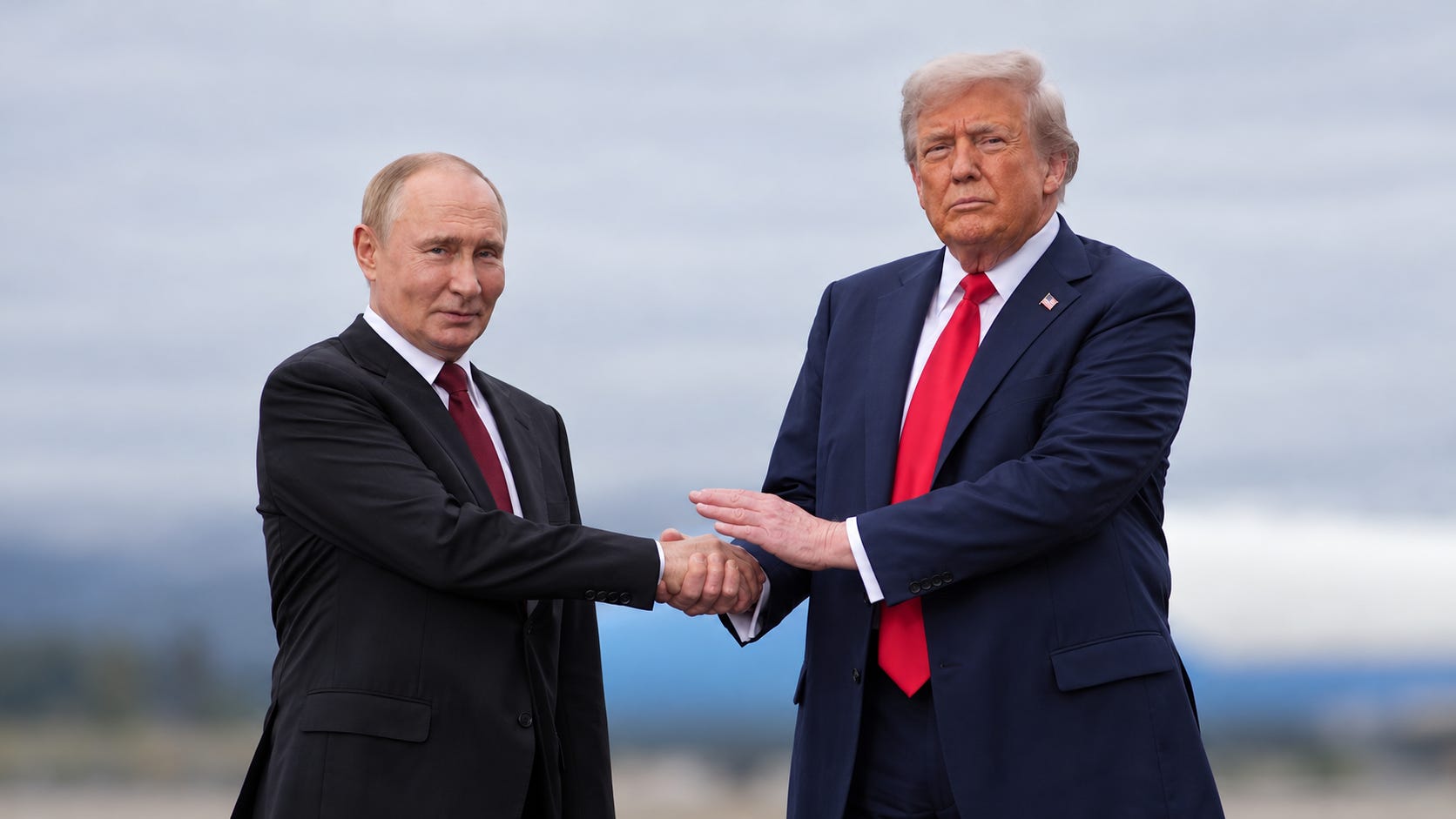
Russia invaded Ukraine. The United States and the European Union have been arming Ukraine to defend itself. We have sanctions on Russia. But now we’re opening the door to Russian diesel to try to lower our fuel prices.
Buying that fuel gives Russia more money while it continues its war against the country we have been helping defend.
And the initial amount? A little more than half a day’s worth of U.S. consumption.
So what is the strategy? Is this supposed to provide lasting relief, create a temporary price drop before the midterms, or pressure Zelenskyy into accepting a deal because we’re now helping both sides?
Those are the possibilities I want to talk about, because the amount of fuel alone does not explain this decision.
Understand the Scale of This War
Russia annexed Crimea in 2014. On February 24, 2022, it launched its full-scale invasion of Ukraine. That invasion is now in its fifth year, and we still do not have peace.
Russian strikes are hitting Ukrainian cities and infrastructure. Ukraine is striking Russian refineries and energy supply chains. We know this is happening, but I do not think enough people understand the scale.
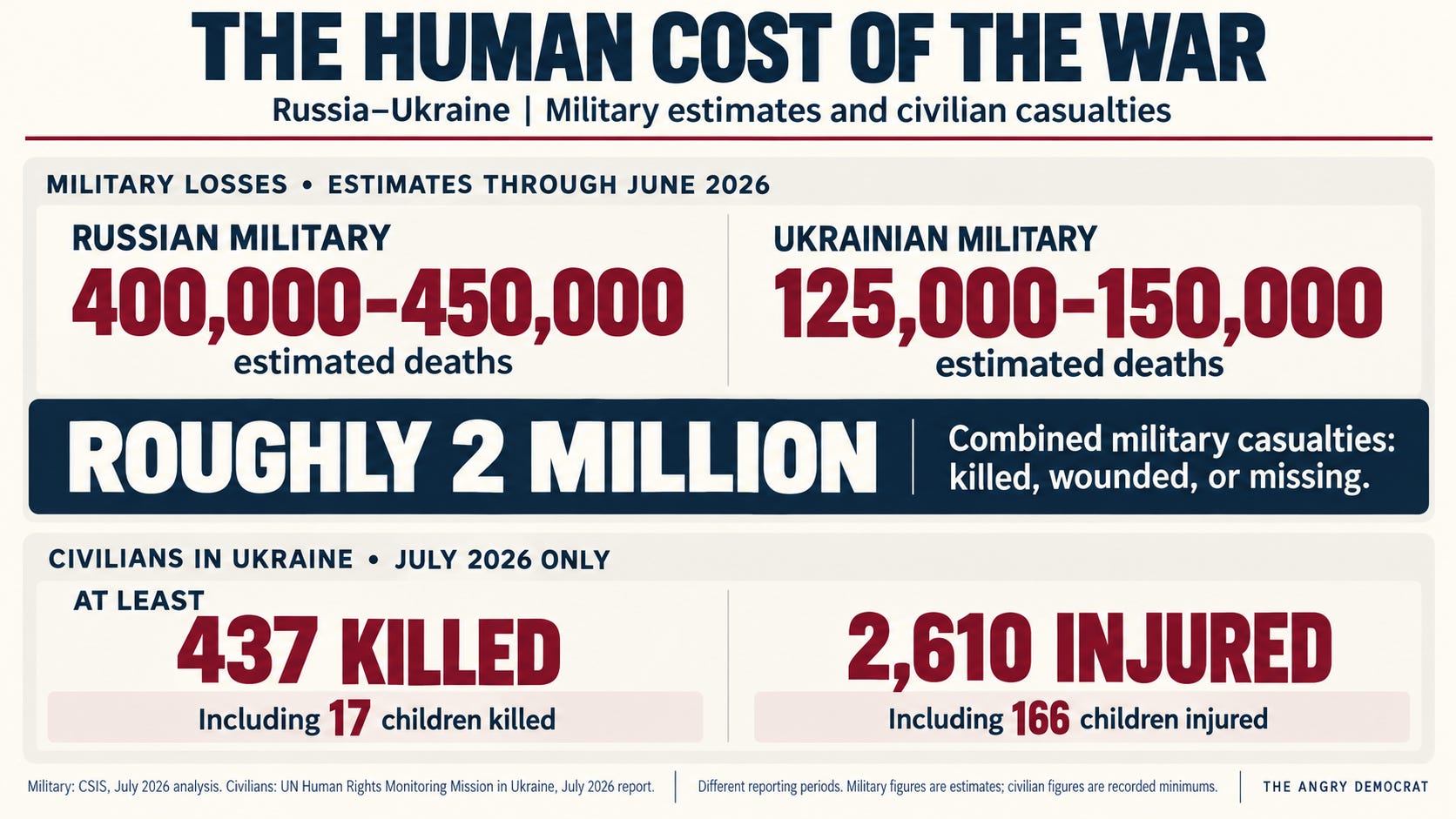
The military death estimates are approximately 400,000 to 450,000 Russians and 125,000 to 150,000 Ukrainians. Combined military casualties, including those killed, wounded, or missing, were roughly two million.
That is more than half a million military deaths between the two countries.
And that does not include civilians. In Ukraine, July 2026 alone saw at least 437 civilians killed and 2,610 injured.
These are human beings. And when I think about the soldiers being sent into this, I think about ordinary people, poor people, people without the money or connections to insulate themselves from what their governments are doing.
The financial cost is astronomical, too. Russia’s military spending in 2025 was approximately $190 billion. Ukraine’s was about $84 billion. That is one year of military spending, not the entire cost of this war.
This is the scale we need to keep in mind when we talk about giving Russia another opportunity to earn money.
North Korea Is Trading Human Lives for Money

One part of this conflict that I do not think gets enough attention is North Korea’s involvement.
North Korea has been supplying Russia with troops, munitions, and missiles. I understand buying weapons from an ally. But the troops are what bother me.
In my opinion, this is an immoral trade of human life for money.
Russia needs more people to keep fighting. Another major mobilization carries the risk of unrest at home. North Korea can provide troops, and its government receives benefits for doing so.
To me, that amounts to treating people as a commodity. The government gets paid, and the soldiers get sent into a war.
North Korea’s economy has benefited from its relationship with Russia. But I cannot look at those benefits without thinking about the people being shipped off to fight and whether they have any meaningful choice in the matter.
There is also the military experience. Having a large military and having a military tested in modern combat are different things. These deployments give North Korea experience it can take home.
So there are consequences here that extend beyond Russia and Ukraine. Money is changing hands, people are dying, and militaries are learning.
The First Shipment Is Barely Half a Day’s Worth
Now look at what Trump announced.
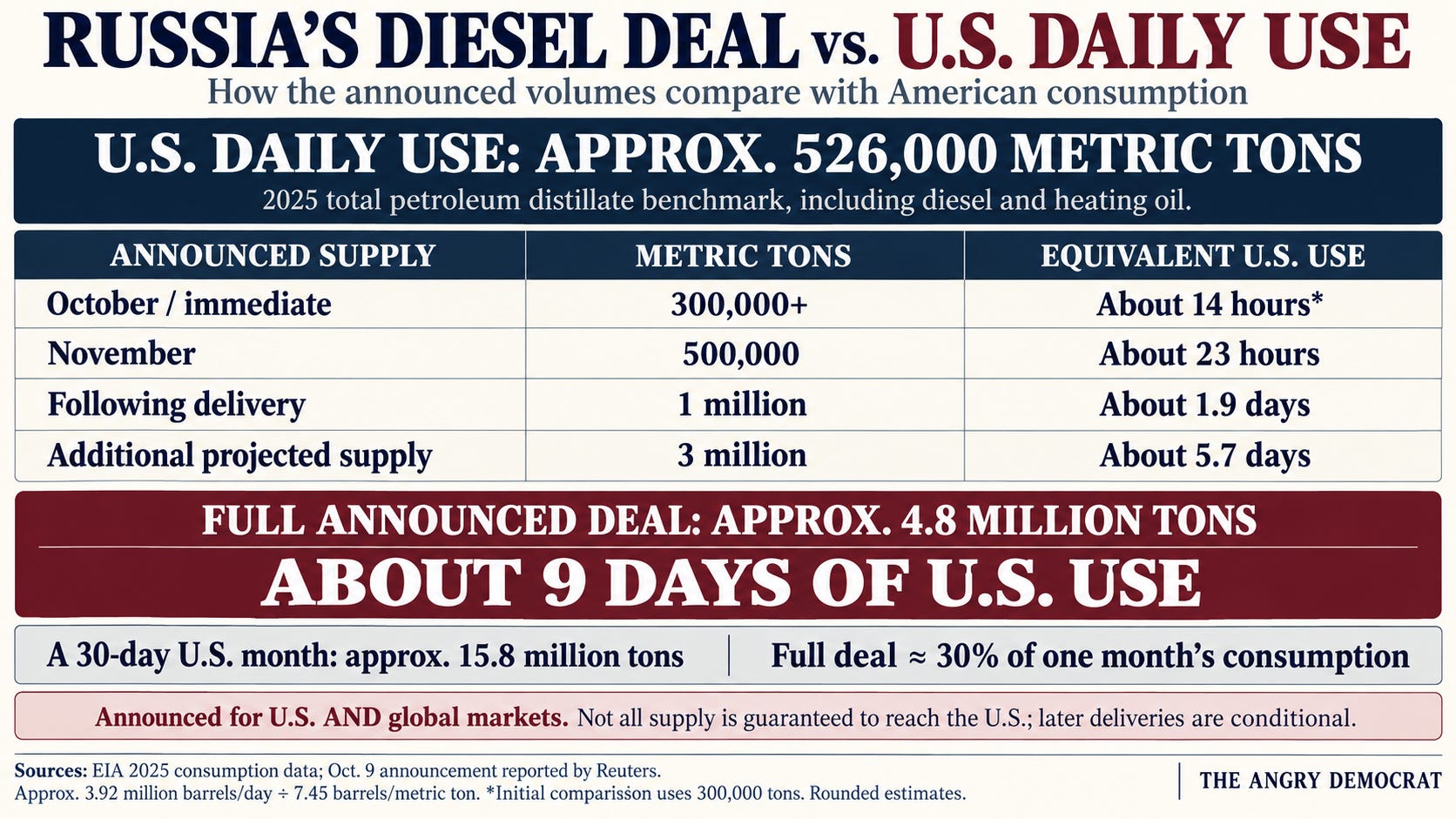
The immediate supply is more than 300,000 metric tons of diesel. Then 500,000 tons in November, another million tons afterward, and an additional projected three million tons. The full announcement comes to approximately 4.8 million metric tons.
That sounds like a lot until you compare it with consumption.
Using a rounded U.S. consumption benchmark of about 526,000 metric tons per day for petroleum distillates, including diesel and heating oil:
The initial 300,000 tons: About 14 hours of U.S. use.
November’s 500,000 tons: About one day.
The following million tons: About two days.
The entire 4.8 million tons: About nine days.
And these announcements concern supply for U.S. and global markets. We cannot assume every ton is coming here.
This is why I keep coming back to the amount. We are easing restrictions on Russia for an initial shipment equivalent to a little more than half a day of American consumption.
Is that going to make a meaningful difference in our day-to-day lives? Is it going to provide lasting relief for fuel costs?
I am skeptical. The volume alone does not tell us exactly what prices will do, but it certainly makes me question the size of the benefit being promised.
Russia gets revenue from selling the fuel. What do we get, and for how long?
Is the Plan to Dump It Into the Market Before the Midterms?
Here is one possibility: Maybe lasting relief is not the point.
Maybe the point is to get as much of this fuel into the market as possible right before the midterms and hope prices fall long enough to help Republicans.
Think about the timing. The initial 300,000 tons plus November’s 500,000 tons would be approximately 800,000 tons. If those supplies became available before Election Day, could the administration try to concentrate the benefit into a very short window?
Could the goal be to push prices down for a few days, claim a victory, and get through the election?
I do not know whether that is the plan. But that is the strategy I am questioning.
There is a difference between fixing a supply problem and trying to produce a politically useful price drop at exactly the right moment. With quantities this limited, I can see why the timing might matter more to the administration than the long-term effect.
I am not claiming that releasing this amount would guarantee a dollar or two off the price. I am asking whether a short-lived reduction before people vote is what they are actually trying to achieve.
Is This About Making Zelenskyy Capitulate?
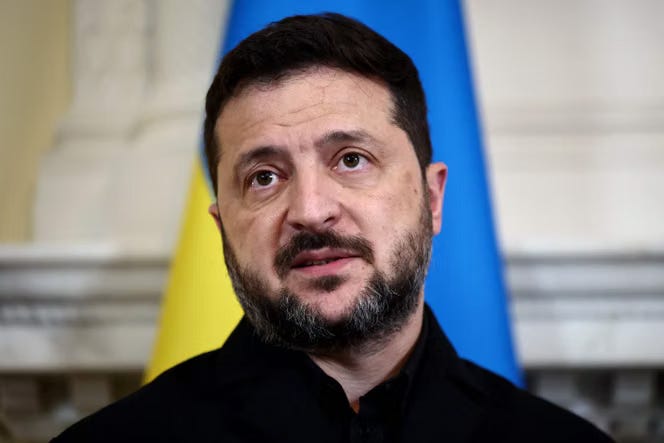
The other possibility is that this is about pressuring Zelenskyy into accepting a deal.
We have been helping Ukraine defend itself against Russia. Now we are making it easier for Russia to earn money that can help sustain the war.
Imagine looking at that from Ukraine’s position. You are already facing a larger country, years of destruction, and enormous losses. Now a country that has helped you defend yourself is opening another source of revenue for the country invading you.
Does that send the message that this could go on indefinitely unless you accept the terms being offered?
The message, as I see it, could be: We are going to help them, too. Give up the land they have taken, cut a deal, and call it a day.
That is my interpretation of a possible pressure tactic. I do not know that it is the administration’s actual plan. But it is one way to understand a decision that otherwise seems to contradict what we have been supporting.
Maybe Trump thinks a stalemate is the only realistic outcome and wants to force Zelenskyy to the table. If so, is the method to make Ukraine’s position worse until it capitulates?
That is a very different argument from telling Americans we are simply buying fuel to lower their costs.
The Sanctions Exception Makes the Contradiction Clear
On October 9, the Treasury Department issued General License 135, temporarily permitting specified Russian diesel transactions through April 7, 2027.
So restrictions that were supposed to limit Russia’s access to revenue are now being relaxed for this fuel.
Meanwhile, Ukraine has been attacking Russian refineries. Trump has pressed Ukraine to stop those attacks, and Zelenskyy has said Washington threatened consequences for intelligence sharing.
Russia continues attacking Ukraine’s energy infrastructure, but we are trying to protect the flow of Russian diesel while helping Ukraine defend itself.
How does all of that fit together?
We also need clear answers about the transactions themselves. Who is buying the fuel? What is the price? How are payments being handled? How much will actually arrive, and when?
Who Is Winning Here?
American taxpayers have funded military assistance. When we send weapons from our stockpiles, we also have to consider the cost of replenishing them. European allies have committed money and weapons, too.
Russia is spending enormous sums. Ukraine is fighting for its survival. North Korea is benefiting from supplying weapons and troops.
And now we are creating another opportunity for Russia to sell fuel.
So who is winning in this situation?
Trump said he would end this war on day one. We are approaching two years into his term, and instead of an end to the fighting, we are discussing a diesel deal with the country that launched the invasion.
The war itself is also changing how militaries fight. Drones, AI integration, fiber-optic controls, and satellite communications are all part of that conversation. The consequences will last far beyond whatever happens to fuel prices this month.
That is why I want people to understand the scale. If we do not understand the scale, we cannot understand the importance of these decisions.
My concern is that we are being sold a fuel-price explanation for something that may really be about election timing, pressure on Ukraine, or both.
Do you agree with this deal?
Is a shipment equivalent to roughly half a day’s consumption worth easing restrictions on Russia?
And do you think the real goal is cheaper fuel, a political win before the midterms, or forcing Zelenskyy to accept a settlement?
Right now, it looks like we are playing both sides. I want to know what the strategy is.
Ya, we don’t need a President with his head up his ass.