

The Browns are building a stadium in Brook Park and expanding their headquarters in Berea. In neighboring Middleburg Heights, the mayor is asking what game-day traffic will mean for roads that already back up, and who will pay for any extra police and fire coverage.
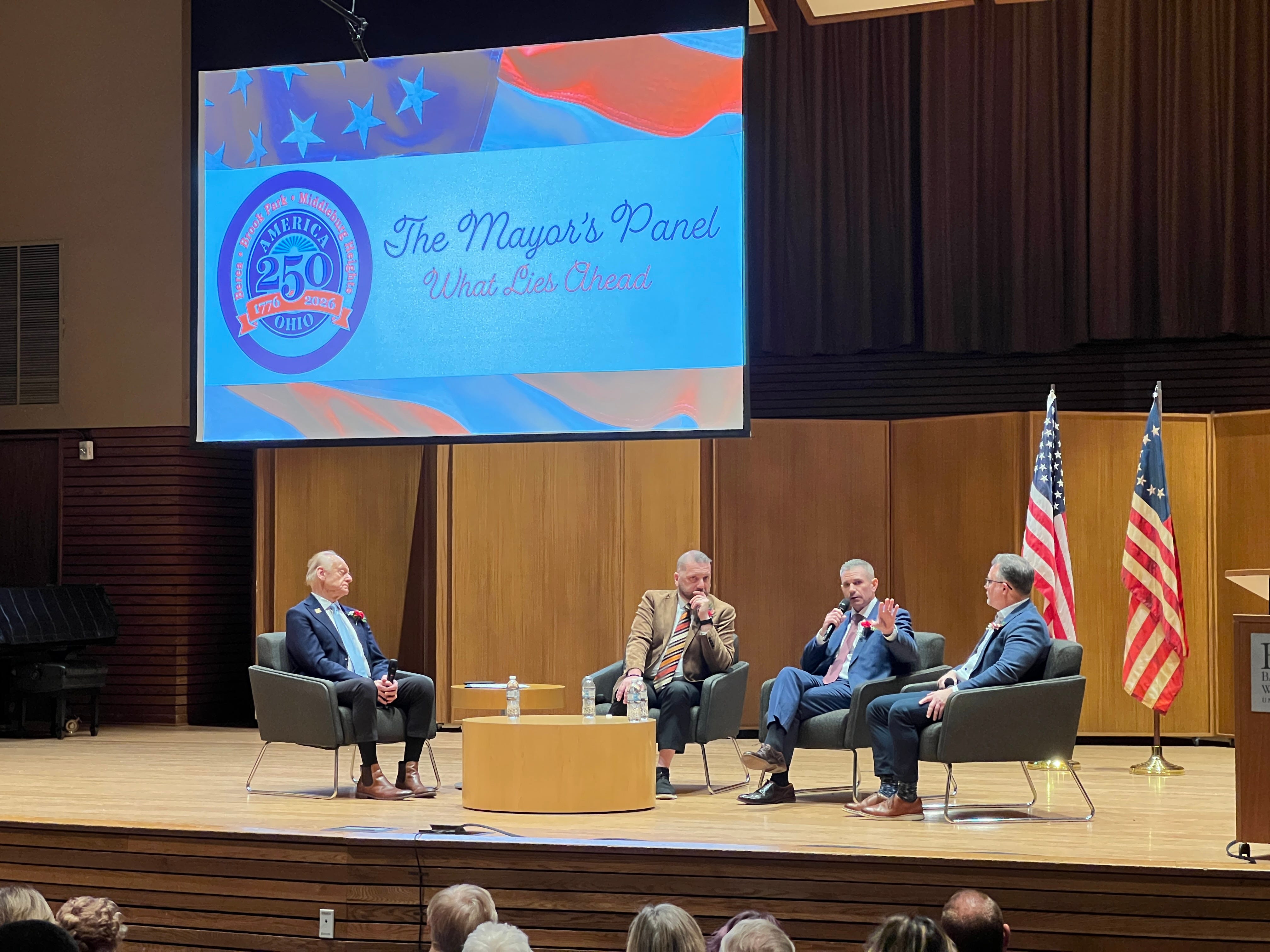
Those were among the questions at the Nov. 18 America 250 mayors’ panel at Baldwin Wallace University. University President Lee Fisher moderated the discussion with Berea Mayor Cyril Kleem, Brook Park Mayor Edward Orcutt and Middleburg Heights Mayor Matt Castelli. bereachamberofcommerce.wildapricot.org
The panel discussion has been condensed and paraphrased for clarity.
See full transcript here (note: I have recording issues so a bit of the beginning and end is cut off)
Lee Fisher: As we celebrate the country’s 250th anniversary, what part of your city’s history helps explain the place it is today?
Cyril Kleem, Berea: John Baldwin is the link between the university and the city. After farming didn’t work out for him, he developed the sandstone industry. People came here from different countries to work in it, and that helped make Berea a diverse community. A lot of Berea was already built before World War II, earlier than many suburbs. We have historic neighborhoods people love, and we also have streets and infrastructure that cost more to maintain because they’re that old.
Edward Orcutt, Brook Park: Ford brought thousands of jobs here after World War II. Homes went up, other industries came in to support Ford, and families stayed for generations. What the city did with that industrial tax base was important, too. It invested in recreation and parks where people could come together. My oldest son is buying a house across the street from us. I think he likes his mom’s cooking.
Matt Castelli, Middleburg Heights: There’s an onion in the middle of our city seal. The soil around Lake Abram was rich enough to grow onions and garlic, and growers shipped onions across the country. Later, Ford helped drive residential growth here, and Southland became a major shopping district. It’s still going today. We’ve been working to keep it viable for another generation, including bringing Meijer to the former Sears site.
Lee Fisher: What’s your biggest challenge as mayor, and where do you see the most opportunity?
Matt Castelli: Municipal income tax is our main source of revenue, so attracting investment is how we keep paying for services. In a built-up city, you have to figure out what to do with land that’s already been used for something else. At Southland, we had multiple owners going in different directions. We had people proposing self-storage or a lumberyard. The city had to lay out what it wanted for the district. Before redevelopment, the properties I’m talking about brought in about $48,000. We expect more than $600,000 a year afterward. That kind of change helps pay for things like stormwater improvements that older suburbs need.
Edward Orcutt: Infrastructure is a big one. So is explaining to people why something is a priority. On social media, the first person to post can set the narrative. By the time you come back with facts, people may have made up their minds. We have to listen to residents, tell them what we can afford and explain how we decided what comes first.
Cyril Kleem: Redevelopment is difficult when you’re trying to maintain the character of an older city. Political division also makes it harder to get things done. And the three of us recently met about mental health. Our police, fire and social services departments are dealing with it firsthand. We’re trying to work together with the hospital and other local resources because we’re seeing more people become isolated.
Lee Fisher: The Browns are moving their stadium to Brook Park. What made the city think it could handle a project that big?
Edward Orcutt: We had 177 acres we’d been looking to redevelop for years. We looked at the roads, the interstates, the turnpike and the RTA station. Ford used to bring thousands of workers in and out of that area, so we knew what the site had handled before. The stadium gives us a chance to bring in year-round activity, with events, apartments, hotels, restaurants and retail. When you look at what the Browns are doing in Berea, what’s happening at the airport and what could happen at the I-X Center, you can see how those projects connect.
Lee Fisher: What’s happening with the Browns’ development in Berea?
Cyril Kleem: I first approached the Browns in 2009 about whether they wanted to stay and whether they wanted a new facility. Years later, they came back with an interest in expanding around their existing location. We committed to acquiring those properties without eminent domain. The Browns had to make individual offers, and that took time.
The project includes an expansion of the training facility, a hotel, apartments, sports medicine and a community football field where our high school team can play. The city didn’t put money into the project upfront, and we were paid for city-owned property. Keeping the Browns here is important because they’re our largest income taxpayer.
Lee Fisher: How does the new stadium affect Middleburg Heights?
Matt Castelli: We get the traffic (joke). We’ve had good conversations with Brook Park and the Browns, and we asked the regional planning agency, NOACA, to look beyond the improvements around Snow Road. What happens at Bagley and Engle? What happens in Berea, Parma and Fairview Park? The additional studies identified six other areas where we should look at improvements.
There’s going to be congestion. We need to figure out how to limit it, what road improvements will be needed and how we’ll pay for any additional police and fire coverage. Those are conversations I want to have with the state, because the effects cross city lines.
Lee Fisher: How do you bring in investment while protecting the neighborhoods people moved there for?
Cyril Kleem: The Browns wanted a street connection left open for access. We decided it should close once construction is finished because of what traffic could do to the neighborhood. On a separate townhouse project, we could have built about 40 percent more units. We kept it smaller to preserve green space and limit the impact on neighbors and city services. We also turned down a proposed annexation twice because of traffic and sewer concerns. More tax revenue is one part of the decision. You have to look at what the public will have to live with and pay for.
Edward Orcutt: We’re looking at traffic signals that can adjust based on how many cars are coming through. On major event days, that could help keep cars moving where traffic is backing up. And if the development brings in the revenue we expect, I want to put it back into things residents already use, like parks and playgrounds.
Matt Castelli: We’ve set aside more than 80 acres for green space over the last five years. Our goal is for every home to be within a 10-minute walk of a park or green space. We’ve gotten more than halfway there. When a piece of property becomes available, sometimes the best use is to preserve it.
Lee Fisher: What do you hope your city looks like 15 years from now?
Cyril Kleem: I want Baldwin Wallace here and healthy, and I expect the Browns will still be here. I can see cities doing more purchasing together and sharing information more easily. I don’t expect us to merge. I also think policing will keep changing. Recruiting officers has gotten harder, and we’re doing more with technology, community policing, mental health response and de-escalation.
Edward Orcutt: I’d like to see a Super Bowl in Ohio. And I hope whoever is running Brook Park then manages the city’s money well and keeps public safety first. I’ve lived here for 30 years. I want to keep living in a place where people feel safe.
Matt Castelli: I think Lake Erie and our Metroparks will become more valuable to people deciding where to live. We have freshwater and a trail system we can keep connecting across communities. I’d also like people to put down their phones a little more and check in on the neighbor who lives alone.
Audience member: How are the three cities handling AI?
Cyril Kleem: My biggest technology concern is security, particularly because Berea operates its own water plant. We’ve trained staff and discussed cybersecurity with council. Some of those discussions happen in executive session because we don’t want to make the details of our defenses public.
Matt Castelli: AI could make city operations more efficient, but if employers use it to replace workers, cities stand to lose income tax revenue. I’d like to see a discussion about whether companies should pay a tax when they use AI to eliminate jobs. Otherwise, the people who lose their jobs could end up paying more for local services. With data centers, we also need to think about where they go and what their environmental impact will be.
Edward Orcutt: If a company wants to build a data center, ask how it will cool the facility and who will pay for the electrical upgrades. Depending on the design, closed-loop cooling can reduce the need to draw water from local supplies. And I’d tell companies they have to pay for the infrastructure they need. A developer can walk in with a sweet deal on paper, and you can have a ribbon cutting. The question is what the town is left with ten years later.
Thank you to Berea Mayor Cyril Kleem, Brook Park Mayor Edward Orcutt and Middleburg Heights Mayor Matt Castelli for taking the time to talk about what’s ahead for their cities. Thanks also to Baldwin Wallace University President Lee Fisher for moderating the panel and to Berea Ward 4 Councilwoman Erika Coble for putting the event together and taking questions from the audience.