What’s up, everybody? Matt Diemer, the Angry Democrat here.
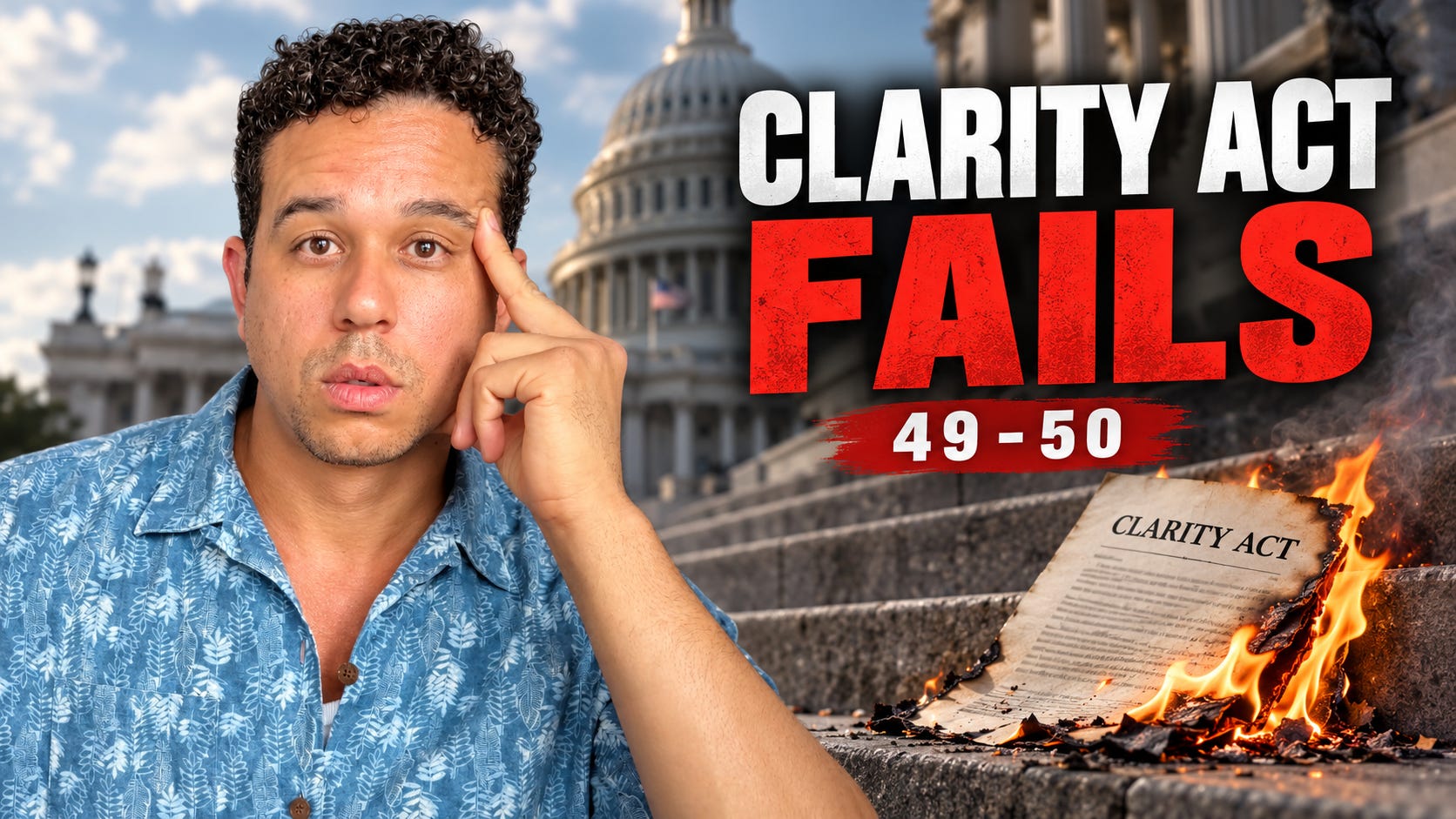
The Senate failed to advance the CLARITY Act, and Trump is the reason. The bill failed a Senate cloture vote, 49–50, with one senator not voting. It needed 60 votes to advance to the floor for debate, and it did not even come close.
The crypto industry was looking forward to this bill because it would have created rules of the road for cryptocurrency. It would have established which digital assets, tokens, commodities and securities fell under the authority of the Commodity Futures Trading Commission and which fell under the Securities and Exchange Commission.
Instead, the bill did not move. For now, it is dead, and we need to talk about why.
TL:DR: The Democrats brilliantly maneuvered to make the Republicans admit Trump administration is corrupt. And they did it through the Clarity Act.
What the CLARITY Act Was Supposed to Do
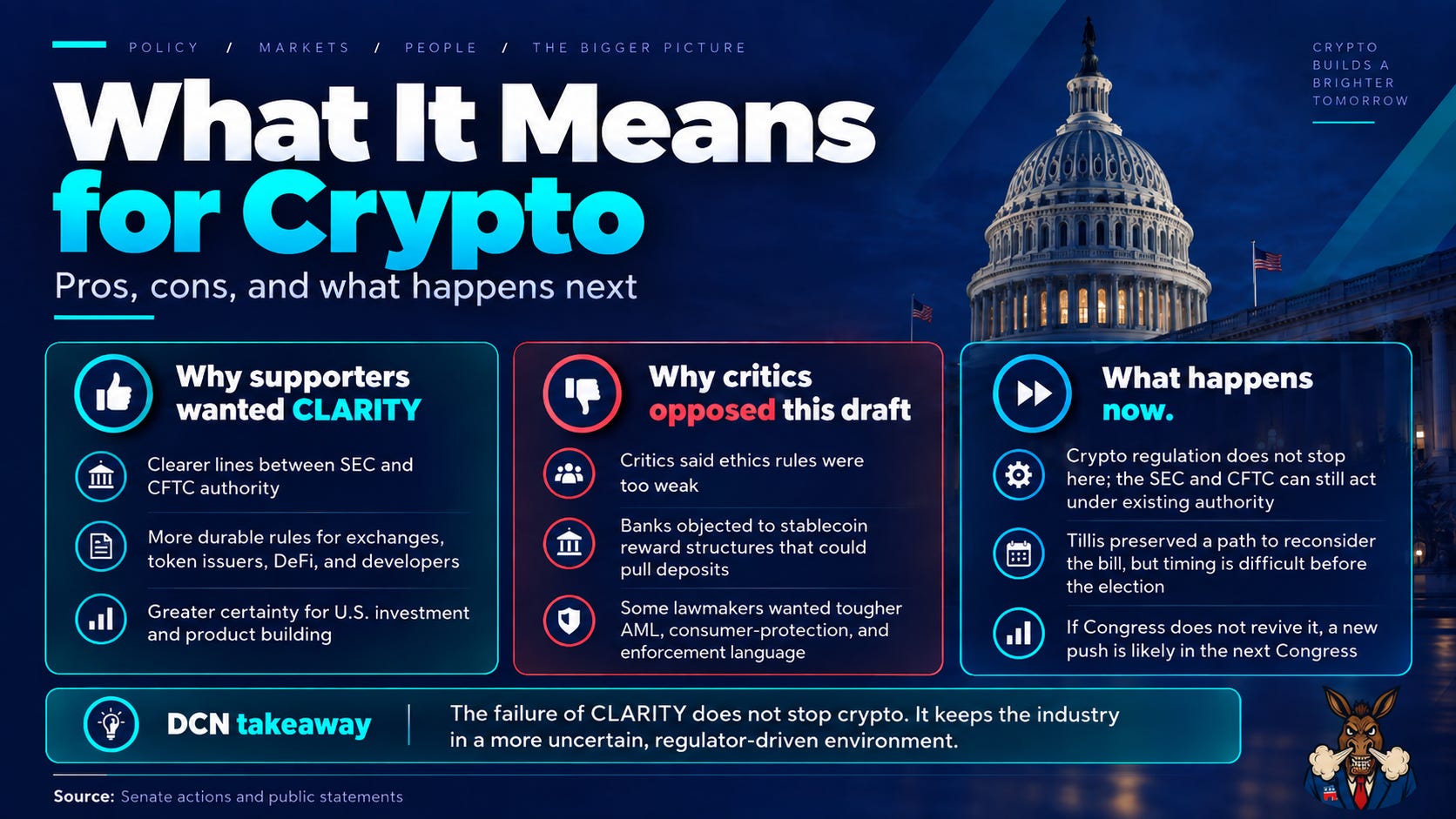
The CLARITY Act was supposed to create clearer divisions between the SEC and CFTC.
If you remember what happened in 2017, 2018 and 2019, as well as throughout the Biden administration, Gary Gensler and the SEC fought with crypto companies over which agency had jurisdiction. The SEC was essentially regulating through enforcement actions.
Companies would argue that they fell under the CFTC for one reason or another, and the SEC would come in and say, “No, no, no. We are the ones who are supposed to regulate you.”
We needed a clear division.
We needed more durable rules for exchanges, tokens, token issuers, decentralized finance, developers and American investment products. Companies need to know the rules before they build products, not after the SEC files a lawsuit against them.
Critics opposed the Senate draft for several reasons. Some lawmakers said the ethics provisions were too weak. That had everything to do with Trump and his crypto businesses, including World Liberty Financial, USD1, the Trump token and the Melania token.
Banks also objected to stablecoin reward structures because they were worried those rewards could pull deposits away from traditional banks.
If you hold a stablecoin instead of dollars in a bank, Coinbase, Kraken, Gemini or another company holding those tokens could pay you a yield. The banks looked at that and said, “Whoa, whoa, whoa. We cannot let people take their dollars, put them somewhere else and make money from them. We have to keep that money here.”
They created all kinds of rules and excuses for why that was supposedly necessary.
Some lawmakers also wanted tougher anti-money-laundering rules, consumer protections and enforcement language.
The Vote
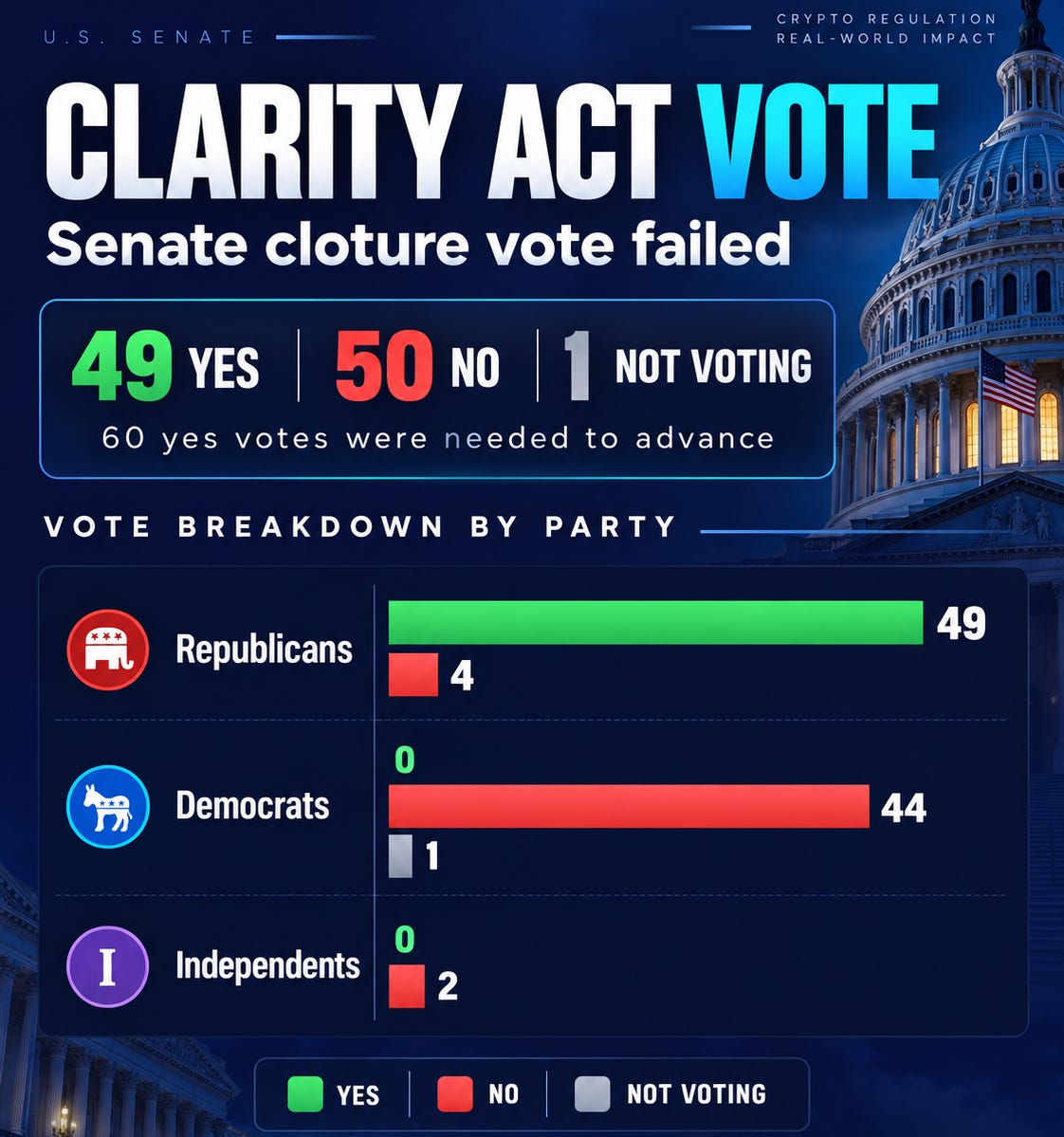
The cloture vote failed, 49–50, with one senator not voting. The legislation needed 60 votes to advance to the floor for debate.
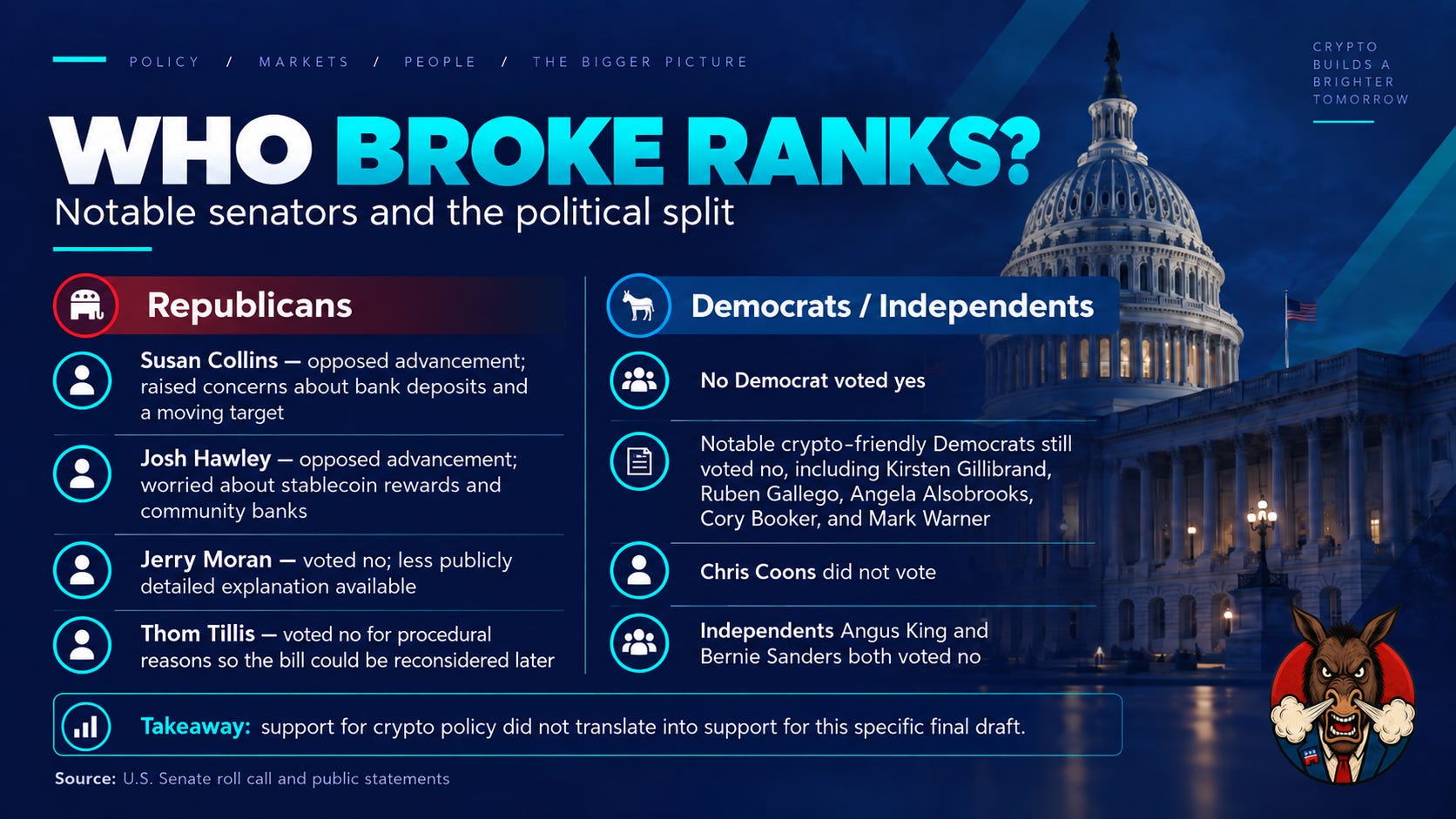
Forty-nine Republicans voted yes. Forty-four Democrats and both independents voted no. Several Republicans also voted no, including Susan Collins, Josh Hawley, Jerry Moran and Thom Tillis.
Collins opposed advancing the bill and raised concerns about bank deposits and what she described as a moving target. Hawley raised similar concerns about stablecoin rewards and the possibility that deposits could move from traditional banks into stablecoins held through companies such as Coinbase and Kraken.
The argument was that banks might not have enough deposits available for lending, potentially creating a serious problem for community banks.
There was also concern that the legislation had changed too many times. Just days before the vote, Republicans said they had accepted 126 Democratic additions or changes, including provisions governing ethics within the cryptocurrency industry and restrictions involving the president, his family and their companies.
Questions about whether Trump should divest, use a blind trust or face restrictions involving his family’s businesses were all part of the negotiations led by Republican Senator Thom Tillis and Democratic Senator Ruben Gallego.
Tillis voted no for procedural reasons so the bill could potentially be reconsidered later. Moran’s reasoning was less public, so I am going to assume there were political calculations involved there as well.
Independents Angus King and Bernie Sanders both voted no. Chris Coons did not vote.
Trump Killed the CLARITY Act
Why did the CLARITY Act fail?
The biggest reason was Trump.
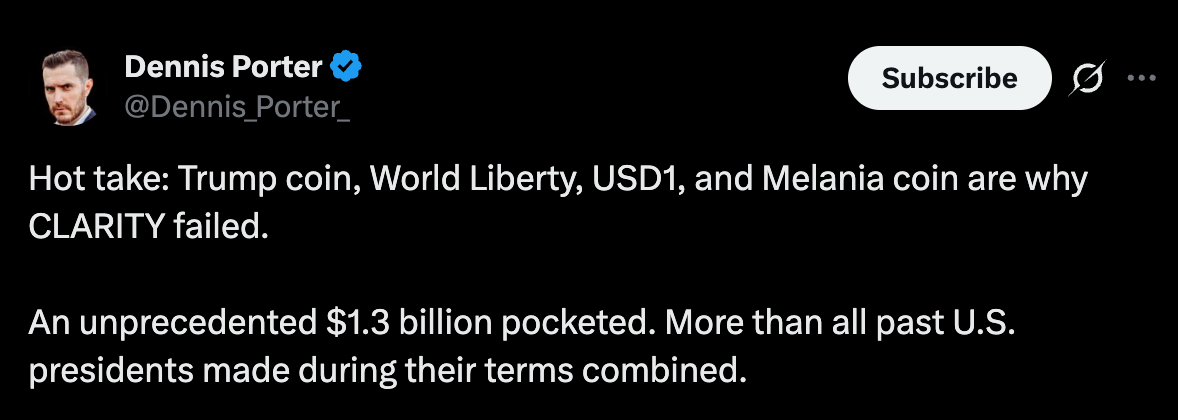
Dennis Porter put it best:
“Hot take: Trump coin, World Liberty, USD1 and Melania coin are why CLARITY failed.”
Trump and his family have reportedly made approximately $1.3 billion from their cryptocurrency businesses.That is more than all previous United States presidents made during their terms combined.
Here is what happened: Republicans handed Democrats a hammer to use against the Trump administration.
When Trump returned to office, his sons already had World Liberty Financial. Trump could say it was a separate company and had nothing to do with him, but his family was making money from it.
Trump launched his own token. Melania launched a token. Trump’s family also has a stablecoin through which people around the world can exchange dollars for a digital representation of those dollars.
Yes, holders can theoretically exchange that digital representation back into dollars. But they are still giving Trump’s organization cash in exchange for the digital token. That is what is happening.
When the ethics issue came up, Democrats pointed to the corruption, bribery concerns, potential extortion and the broader monetization of the White House for Trump’s personal benefit and his family’s gain.
Republicans initially responded by saying none of that was happening.
Democrats then said they were not passing the bill without ethics provisions.
During the final negotiations, Republicans accepted 126 Democratic changes or additions. Basically, Democrats forced Republicans to acknowledge that there might be ethical problems involving Trump’s crypto interests.
It is difficult to argue that there is no problem while the president and his family are making approximately $1.3 billion from crypto businesses and his administration is writing the rules governing those businesses.
Republicans then turned around and said, “Maybe we do have a problem here. Maybe we need provisions requiring divestment. Maybe we need restrictions involving the president, his family and his children.”
Now Democrats can respond, “Wait a minute. We thought you said there was no problem. It looks like there is an ethics and corruption problem inside the White House. You just admitted it by agreeing to put restrictions into the legislation.”
Republicans Handed Democrats the Evidence
Senator Cynthia Lummis said Democrats did not negotiate in good faith and never intended to pass the bill.
Of course they didn’t.
Republicans gave Democrats a complete rubber stamp of approval for the argument that there is corruption inside the White House. It is absolutely amazing what happened here.
Ethics concerns involving Trump’s crypto ties dominated the final negotiations. Democrats said the talks ended before those concerns were fully resolved.
I do not think that is what happened.
I think the talks ended when Democrats had enough of an admission from Republicans, written directly into the bill, that there were serious ethical problems involving the Trump administration.
The Democrats were handed a hammer to beat the hell out of Trump’s administration.
If I were in the Senate, I would look at this and say it is political gold. Trump is exploiting the White House for personal and family gain, and Democrats just got Republicans to acknowledge the problem by negotiating ethics restrictions.
This is how you do it.
Now Democrats can beat Republicans over the head with it through November. If Democrats win the House and Senate, they can continue beating them over the head with it until 2028.
This is a political gift from the Trump administration.
The Banks Do Not Want Competition
Banks and some Republicans are also worried that stablecoin rewards could drain deposits from community banks.
I think that is fearmongering.
The banks need competition. If a stablecoin company is properly regulated and required to maintain one-to-one reserves, meaning one dollar goes in and one digital representation of that dollar goes out, then that should be enough.
Those companies should be able to pay interest or yield on the money they are holding.
Most people with traditional bank savings accounts receive almost no interest. Some banks pay practically zero. If you do not maintain enough money in your account, the bank may start charging you simply for having the account.
That is completely messed up, and I think it should be illegal.
The stablecoin industry, along with exchanges such as Coinbase and Kraken, has created a system in which companies can hold that money, earn interest from it and pay customers for providing the capital.
Banks make a lot of money from the money sitting in your account. They do not want to pay you more because doing so cuts into their bottom line.
That is what we should be focused on here.
The bill had other sticking points, including illicit-finance rules, the treatment of DeFi, enforcement authority and consumer protections. But none of those issues changes the central political story surrounding this vote.
The Crypto Industry Has a Lot of Money
The other part of this story is the money behind the crypto industry.
Billionaires run cryptocurrency exchanges, token projects, DeFi protocols and other companies throughout the industry. They created super PACs to support crypto-friendly candidates.
Those organizations used to operate in a more bipartisan way. If you were a Republican or Democrat and said you supported cryptocurrency, they were willing to support you.
Senator Kirsten Gillibrand was a major proponent of this legislation. She worked alongside Cynthia Lummis to push it forward, but she ultimately voted no. From the Republican perspective, she pulled the rug out from under them.
Fairshake and other crypto groups are now looking at this as a Republican-versus-Democratic issue. They are threatening to stop donating to Democrats because Democrats opposed what the industry considered its bill.
In August, crypto executives met with Trump in the Oval Office. My interpretation is that the meeting was basically a shakedown.
Imagine the conversation:
“Mr. President, we created a PAC. We spent a lot of money helping your candidates get into office because we wanted rules of the road that would allow our businesses to flourish. Now the midterms are approaching. If Democrats take control and this bill does not pass, we are not going to get what we thought we paid for.”
Trump reassured them that the bill would reach the floor, with a vote scheduled for September 15.
That did not solve the problem because Democrats were still raising ethics concerns behind the scenes. Republicans eventually handed Democrats a political gift by accepting changes that effectively said, “You are right. We may have a serious corruption problem here.”
Stand With Crypto and Fairshake have said the CLARITY Act votes will be included in their public scorecards.
That means they will be looking at individual races and deciding where to spend money against candidates who voted no.
I do not know whether that targeting will happen during the 2026 midterms or continue into 2028, but Fairshake has approximately $112 million in cash available. It would not surprise me to see some of that money used in contentious races.
Susan Collins voted no in Maine. Could she face $10 million or $20 million in negative advertising because of it? Maybe. The Democratic candidate might not be any better for the crypto industry, but Fairshake could still decide to hurt Collins simply to punish her and send a signal to the Democrat.
If there are races where outside spending could determine whether a Democrat or Republican wins, I could see this money being used there. I could also see renewed investment from crypto executives and companies that want Fairshake to target the senators who voted no.
The big strategic question is whether these crypto groups punish every no vote or distinguish between opposition based on ethics concerns and opposition to cryptocurrency itself.
I do not think they will make that distinction.
They wanted this bill. They spent money trying to buy this legislation two years ago, and it still did not pass. They are angry, and they have a lot of money.
Expect more targeted spending from crypto PACs.
Where This Leaves the CLARITY Act
That is the CLARITY Act in a nutshell.
The crypto industry wanted clarity. It wanted to know whether the SEC or CFTC controlled particular assets. It wanted clear rules for DeFi, stablecoins, yields, exchanges and token issuers.
Democrats wanted stronger ethics provisions and pointed directly at the president of the United States, who reportedly made approximately $1.3 billion from his crypto businesses over the past two years.
I believe Trump made more profit from crypto than Coinbase, which is literally a registered cryptocurrency company that does not sit inside the White House.
The bill failed, but the political consequences are just beginning.
The midterms are coming, and we are going to see the fallout.
What do you think? How do you think this is going to play out? What are your thoughts about the CLARITY Act and the Senate vote?
Put your thoughts in the comments. I would love to read what you have to say.
What about Vivek? He's up to his a$$ in crypto, including wanting to put ohio pensions in crypto, after he finishes destroying our public education system. Take away crypto funding from Vivek's campaign and his ads could get even more stupid and intentionally false. Please do a deep dive on Vivek and crypto. Husted, Miller and Joyce could not be too far behind.



What about Vivek? He's up to his a$$ in crypto, including wanting to put ohio pensions in crypto, after he finishes destroying our public education system. Take away crypto funding from Vivek's campaign and his ads could get even more stupid and intentionally false. Please do a deep dive on Vivek and crypto. Husted, Miller and Joyce could not be too far behind.