

Hey, Angry Patriots!
Welcome to another week of The Angry Files, where we take the stories and ideas that have been on our minds throughout the week and put them together in one place.
This feels like the first week when the midterm elections are actually beginning to ramp up. We are now fewer than 100 days from Election Day. I do not think the real crunch begins until the end of August or sometime in September, but the direction of these races is starting to become clearer.
Here is what has been on my mind this week.
Amy Acton and a Primary Process That Failed Ohio Democrats

The first story is Amy Acton and the growing conflict between her campaign and Ohio’s LGBTQIA+ community. What interests me most about this controversy is what it reveals about our broken political process.
I have been ranting about this for a long time: Democrats do not seem to like democracy nearly as much as they claim.
Amy Acton became the Democratic nominee for governor without having to survive a real primary. Other people considered running. Potential candidates were pushed aside. Party leaders, donors, elected officials, and political organizations put their thumbs on the scale because they decided Acton should be the nominee.
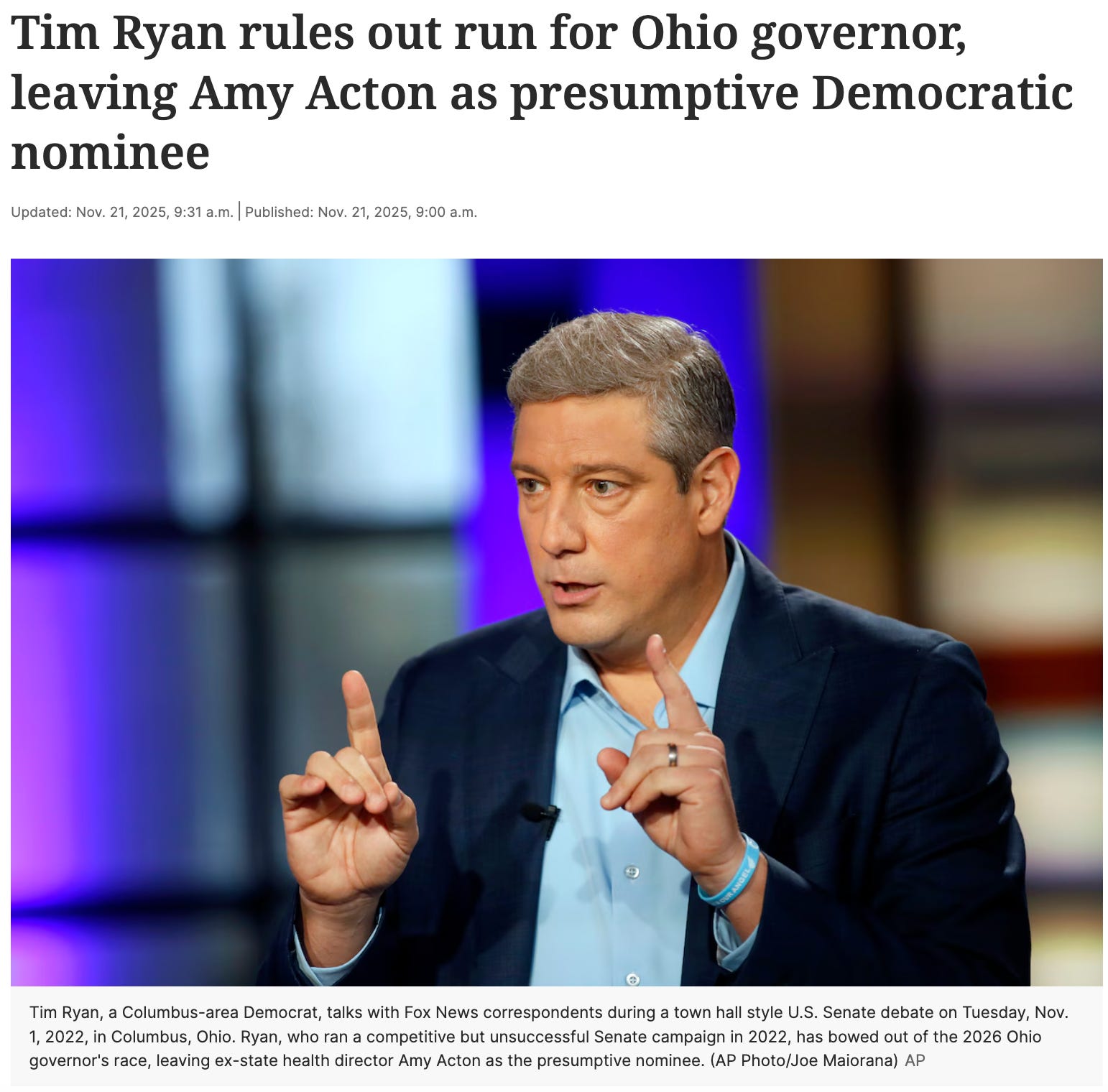
That meant Democratic voters never got a meaningful campaign in which candidates were forced to explain their ideas, defend their records, show their character, and tell Ohioans what they would actually do as governor.
Now, fewer than 100 days before the general election, we are still learning basic things about both candidates.
Vivek Ramaswamy flying around in a private jet, spending substantial time outside Ohio, saying crazy things, and blaming ordinary people for their failures while he lives as a multi-billionaire is ridiculous. But Ramaswamy being ridiculous does not take responsibility from Amy Acton.
Acton’s short, pithy plans and lack of detailed policy have already frustrated some voters and members of the media. Her recent comments about transgender athletes have now created a much deeper problem.
Acton endorsed restrictions on transgender participation in sports and referred to transgender girls as “boys.” Members of Ohio’s LGBTQIA+ community wanted an apology, a clarification, or some indication that she understood why they were angry. Her campaign scheduled what was presented as a listening session with LGBTQIA+ advocates.
Acton did not attend.
According to reporting by Erin Reed, the situation became worse from there. Arienne Childrey, vice chair of the Ohio Democratic Party Pride Caucus, a transgender candidate for the Ohio House, and Ohio’s first openly transgender city council member, was reportedly barred from entering the Zoom meeting. Advocate Ciara Keeton was removed after asking why Childrey had been excluded. Kim McCarthy, chair of the Progressive Caucus, was reportedly left in the waiting room for the entire session.
Childrey said she was eventually able to speak only because Pride Caucus Chair Kyle Herman called her personal phone and put her on speakerphone inside the meeting.
The meeting opened with Equality Ohio rescinding Acton’s “A” rating on its LGBTQIA+ candidate scorecard. When participants pressed campaign manager Philip Stein about why certain advocates had been excluded, he reportedly said the event was “mostly a space we want to listen to the folks that we picked here.” At the end, the campaign offered no retraction, no specific next step, and no commitment that Acton would meet directly with the people who had been excluded.
Here is the point: this may simply be what Amy Acton believes.
People are demanding that she make amends or say something different, but she may genuinely believe transgender athletes should not compete in sports associated with their gender identity. I am not making a value judgment on that position in this article. I am saying Democratic voters should have learned about it during a competitive primary, when Acton could have been questioned, challenged, and compared with other candidates.
Instead, party leaders avoided that debate. Now the ideological disagreement is exploding fewer than 100 days before an election that Democrats describe as an existential fight for democracy.
Ideas should have been fleshed out. Candidates should have debated. Democratic voters should have been allowed to decide whether Amy Acton represented them before the party effectively handed her the nomination.
This should never have gotten this far.
“Daddy’s House Is Scary” and the Allegations Against Max Miller
The second story is the continuing implosion of Rep. Max Miller’s personal life.
As of Friday, July 31, the allegations involving Miller and his ex-wife, Emily Moreno Miller, had not been proven in court. Photographs reportedly showing red skin on her stomach do not, by themselves, prove her allegation that Miller threw boiling water on her. The involvement of child-services agencies or other authorities also does not establish that abuse occurred.
We should not pretend otherwise.
But we also should not ignore the pattern of accusations surrounding Miller. His ex-wife has alleged that he threw boiling water at her, assaulted and bruised her, held a gun to her head, pushed her against a wall, and slapped her. Their daughter reportedly suffered a broken collarbone and allegedly told her mother, “Daddy’s house is scary.” Miller has denied allegations of abuse.
These are not the first accusations involving his behavior. Former White House press secretary Stephanie Grisham wrote that Miller slapped her during their relationship. A former college classmate accused him of assaulting her during what she described as one of the most traumatic nights of her life. Other allegations about aggressive behavior have followed him since he was young.
Again, none of that means every allegation is true. But when accusations involving similar behavior emerge from multiple people across more than a decade, voters are allowed to take the pattern seriously.
Maybe the correct response is for Max Miller to step away, deal with his personal life, and get his shit together while somebody else represents Ohio’s 7th District in Congress.
The district’s Republican lean does not require voters to give Miller a safe seat. Character still counts. Voters show their own character through the behavior they are willing to accept from the people they elect.
If the accusations are false and Miller is ultimately exonerated, he can make that case publicly and run again. But while allegations this serious remain unresolved, Ohioans are not obligated to act as if nothing happened.
America Is Losing Its Greatest Minds
Another thing on my mind this week was a video from Neil deGrasse Tyson’s StarTalk about America losing some of its greatest minds.
The argument itself is not new. The United States has weakened the incentives for young people to enter science, technology, engineering, mathematics, and research. We have reduced funding, attacked the credibility of scientists, and forgotten how discoveries in one field can transform industries that appear completely unrelated.
Cuts to scientific and medical research do not remain isolated inside a university or government agency. Work supported through the National Institutes of Health, the Centers for Disease Control and Prevention, NASA, and other institutions feeds into medicine, manufacturing, national security, technology, communications, and the broader economy.
We often seem willing to invest in science only when the government wants to flex American power. We fund a race to the Moon, a military objective, or some high-profile national goal. What we have failed to maintain is the larger ecosystem that allows researchers to pursue ideas before anyone knows exactly where those ideas will lead.
This is becoming more than a research problem. It is a cultural problem.
The United States increasingly imports instead of creates. We manufacture abroad and import the goods. We weaken our own scientific pipeline and then rely on researchers and scientists trained in other countries to fill the gaps here.
Bringing talented people to the United States is not the problem. America has always benefited from attracting smart, ambitious people from around the world. The problem is that we are failing to cultivate enough of that talent ourselves.
If we keep moving in this direction, the only thing Americans will be expected to do is scroll, consume, and purchase while other countries innovate, research, create, and manufacture.
That is not an economy capable of leading the world.
The DNC Is Mortgaging Its Future
Laura Rodriguez-Carbone wrote this week about the Democratic National Committee mortgaging its headquarters while trying to pay for elections. Her article examines the growing financial gap between the DNC, the Republican National Committee, and Donald Trump’s MAGA Inc. super PAC as we approach the midterms.

Democratic leaders continue to tell us this election is all or nothing. If Democrats lose, they warn, American democracy itself may not survive.
If that is true, it seems strange that the Democratic Party is entering the fight millions of dollars in debt.
But this is not new. Democratic organizations have repeatedly operated in the hole and managed their money poorly. We see versions of the same problem in county parties, state parties, and the DNC.
Read Laura’s full article for the details. But the basic question is simple: if party leaders genuinely believe democracy is on the line, why have they managed the institution responsible for defending it so badly?
Chris Ronayne, Courtney Scheff, and an Obvious Conflict
Moving closer to home, a conflict has emerged in the Cuyahoga County Council District 5 race between Democrat Courtney Scheff and Republican incumbent Michael Gallagher.
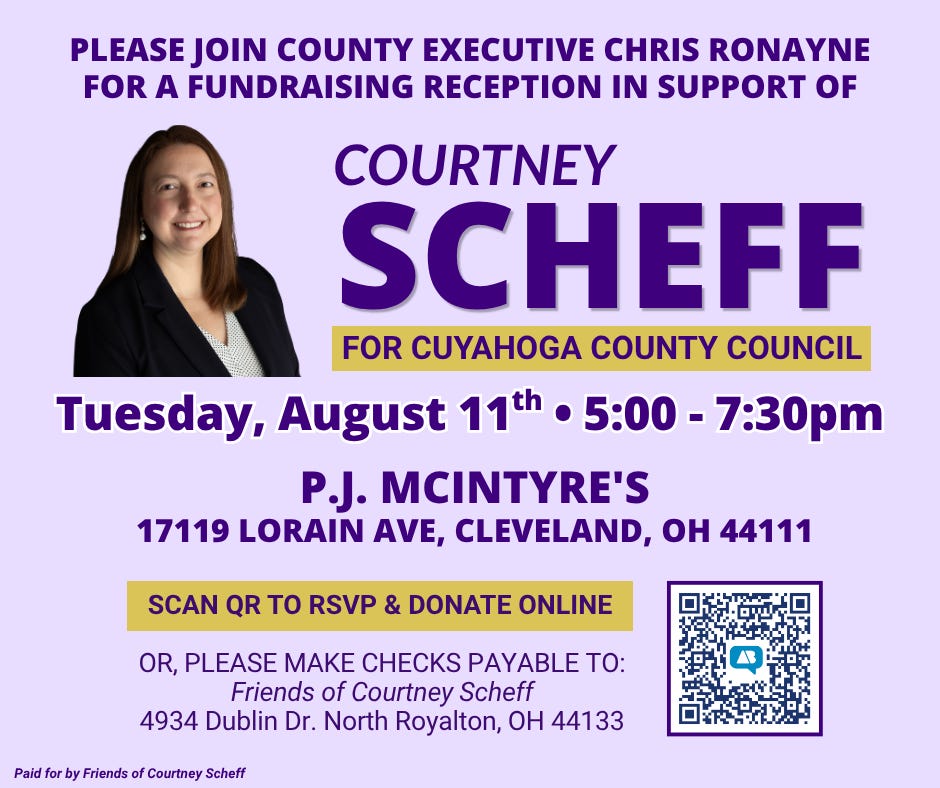
County Executive Chris Ronayne’s campaign committee contributed $5,000 to Scheff’s campaign. Ronayne is also hosting a fundraiser for her that could bring in thousands more.
None of this appears to be illegal. Elected officials routinely use campaign funds to support other candidates. But legality is not the only standard we should apply to political conduct.
I have written about this race multiple times and said many positive things about Courtney. She is intelligent, accomplished, and has an impressive background. I have spoken with her several times. I have also said positive things about Gallagher’s role as a check on the county executive.

That check is exactly what concerns me.
The county executive is helping finance the campaign of someone who, if elected, will sit on the council responsible for overseeing his administration. Ronayne may call it coalition building. I see an executive helping elect a potential rubber stamp.
If Ronayne’s money and political network help Scheff win, how much meaningful pushback will she be willing to give him once she is on council? That does not mean she will vote with him on everything. It means voters have a legitimate reason to question the relationship.
I think Scheff is favored to win. Strongsville remains Gallagher’s strongest Republican base, while Democratic turnout across the rest of the district could carry her comfortably.
But I am bothered by the conflict, and I am more bothered that so few people appear willing to acknowledge it. A county council member should provide oversight of the executive branch, not owe her election to it.
East Cleveland Will Not Tell the Public How Many Police Officers It Has
The final political story on my mind is East Cleveland.
Online reports claimed the city was down to four active patrol officers and one detective. East Cleveland officials denied those numbers, but then refused to tell the public how many officers the department actually employs.
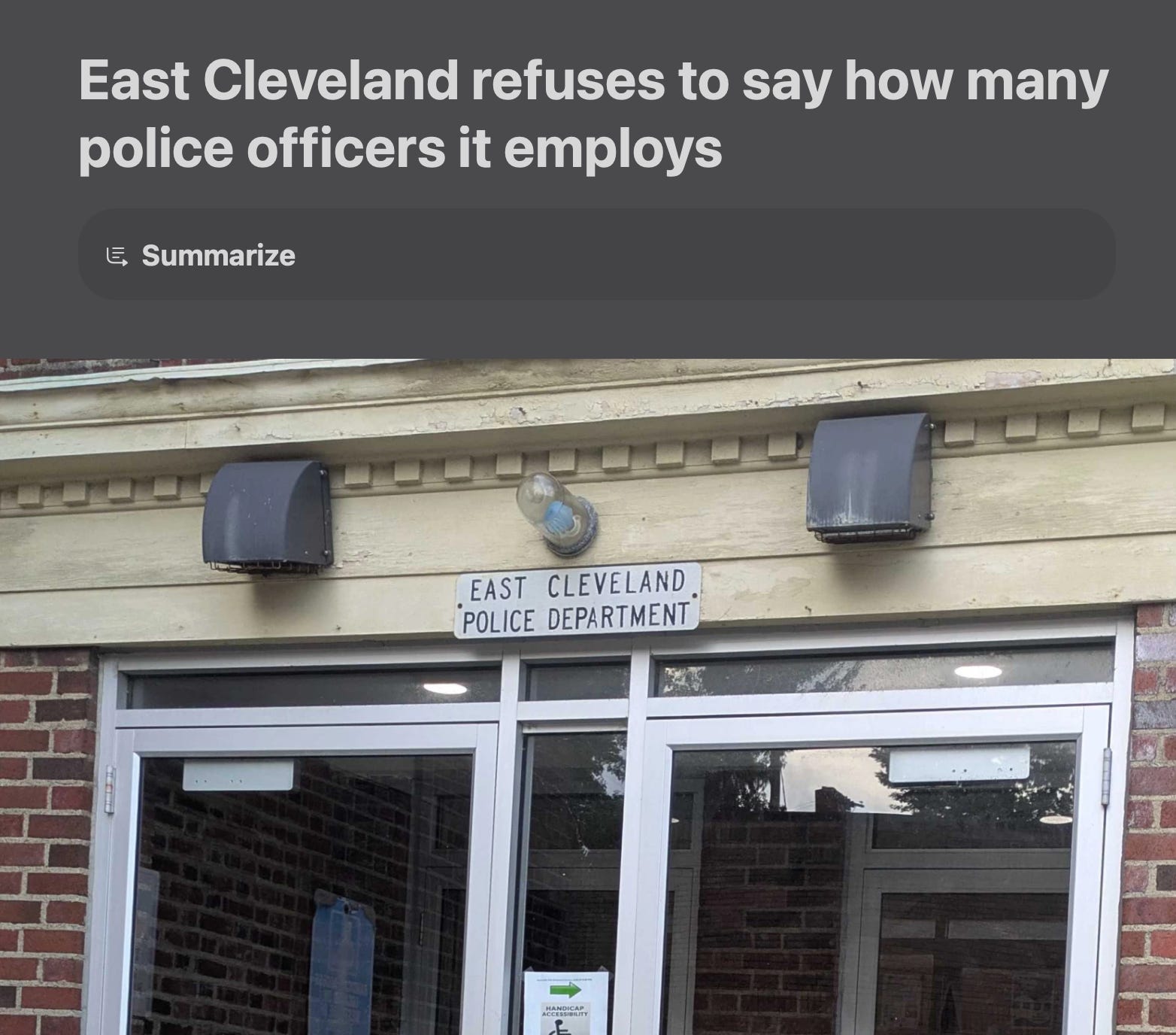
Mayor Sandra Morgan and Law Director Ken Myers said the city could not disclose “specific tactical staffing numbers” for security reasons. But according to the Ohio Attorney General’s 2026 Sunshine Laws Manual, public offices are required to maintain a public database or list containing the names of their officials and employees.
Officials cannot dismiss public reporting as false while refusing to provide the number they claim is correct.
Ideastream reported that News 5 Cleveland had identified six active-duty patrol officers, which would amount to roughly two officers per shift. Ideastream said one of its own sources had heard the same number. The Cuyahoga County Sheriff’s Department is providing limited weekend support, but the county says its deputies are not the primary agency responding to 911 calls and do not replace East Cleveland’s patrol function.
The mayor later reportedly said the department had 16 officers. Even if that number is accurate, two were reportedly on sick leave and another was involved in a legal matter, leaving approximately 13 available. That is still an alarmingly small force for a city that requires coverage 24 hours a day, seven days a week.
The administration’s response has been deflection followed by non-transparency. First, officials said the online numbers were wrong. Then they refused to release the actual number. Then a larger number was offered without acknowledging that even this staffing level appears dangerously inadequate.
You can find the discussion in the below podcast by Cleveland dot com. Around the 31 minute mark.
This comes after years of scandal inside the department. More than a dozen East Cleveland officers have been convicted of crimes including bribery, assault, and robbery during the past five years. Former Police Chief Kenneth Lundy is facing 31 criminal charges. The city’s finances are under state control through receivership, and the state auditor previously cited East Cleveland’s failure to produce records needed to complete audits.
This is not one isolated staffing shortage inherited by a new administration. It is a systemic collapse in governance, accountability, public safety, and trust.
When officials refuse to provide basic information, people will speculate. That is not the public’s fault. It is the predictable result of a government that demands trust while refusing transparency.
Shame on you, Mayor Morgan. Shame on you.
What I Watched This Week
As you know, I love movies. I try to watch two or three each week, although I usually watch them the way most people watch television. I stop after an hour, go to bed, and finish them over the next day or two.
The first movie this week was Mortal Kombat II.

As someone who grew up in the 1980s and 1990s, Mortal Kombat is legendary. The video game is a classic, but we have still never received a truly great movie adaptation. The previous movie was decent and finally put some of our favorite characters on screen. The sequel gives us even more of that.
It is hokey. It is bad. But if you want to see the characters you remember from the games, it does a decent job.
I give it a 5 out of 10…. uuuhhhhgggg maybe 4.5/10.
I also watched Masters of the Universe, another piece of 1980s nostalgia.

Again, it was horrible. The dialogue was bad. The action was bad. The jokes and the entire script was a script and formula we has seen 100 times already.
But it had the nostalgia. It included the characters, and from what I remember of the cartoon, many of them looked pretty good. I wish they had included Man-E-Faces, the character whose face rotates among different identities. He always reminded of the Face Dancers from Dune.
Jared Leto was also fun as Skeletor. He played him as a quirky, narcissistic egomaniac, which worked better than most of the movie around him.
Still, I give it a 5 out of 10. Maybe less.
Both movies sucked, but I powered through them. Took me about 2 days each.
Those are the stories and ideas that were on my mind this week. Leave your thoughts below and tell us what you believed was the most important story of the week.
Believing that people born male do not belong in women’s sports does not make someone unelectable. Many Democrats believe that. The DNC may be running out of money because the party allowed far left activists to take over. They have abandoned a group of constituents who have supported them financially in the past: the Jews.. who have a right to exist just like LGBTQ people do and who have been subjected to hate violence and intimidation from the LGBTQ community worldwide. Every one must be accepted except Jews. Thats nonsense and people see right through it. The far left movement has morphed into a hate machine just like MAGA.
We are falling into the Republican trap of division. We are weaker if they can find a wedge issue.
1.Here is Amy's position on LGBTQ rights:
All Ohioans deserve to be treated fairly and equally under the law. As governor, I am committed to standing up against discrimination and ensuring that every Ohioan — including members of the LGBT community — receives equal protection under the law.
I will push for anti-discrimination laws so Ohioans aren’t unjustly fired from their job or denied housing, other public accommodations, or equal pay because of their race, gender, sexual orientation, or religion. As governor, I will be focused on bringing our communities together, not on sowing hatred and division; every Ohioan deserves to live freely and be treated with dignity.
2. I searched Amy's position on gay marriage. This website came up on the search.
https://www.isidewith.com/candidates/amy-acton/policies
The reality is that division only helps the Republicans. Working to bring balance back to Ohio requires a unified effort.
The only way to change “settled law”, a law in place because the Republican super majority overrode the governors veto, is to make gains the state legislature and statewide offices.