

This should not be controversial.
Democratic candidates should be running on healthcare for all. Not dancing around it. Not soft-pedaling it. Not hiding behind consultant language. Running on it.
The fact that this has somehow become a risky position inside Democratic politics is a failure of nerve and conviction, not policy.
The first time I ran for office, I shied away from it. I was told it was unpopular. I was told it would scare voters. I was told it was too big.
That advice was damn wrong.
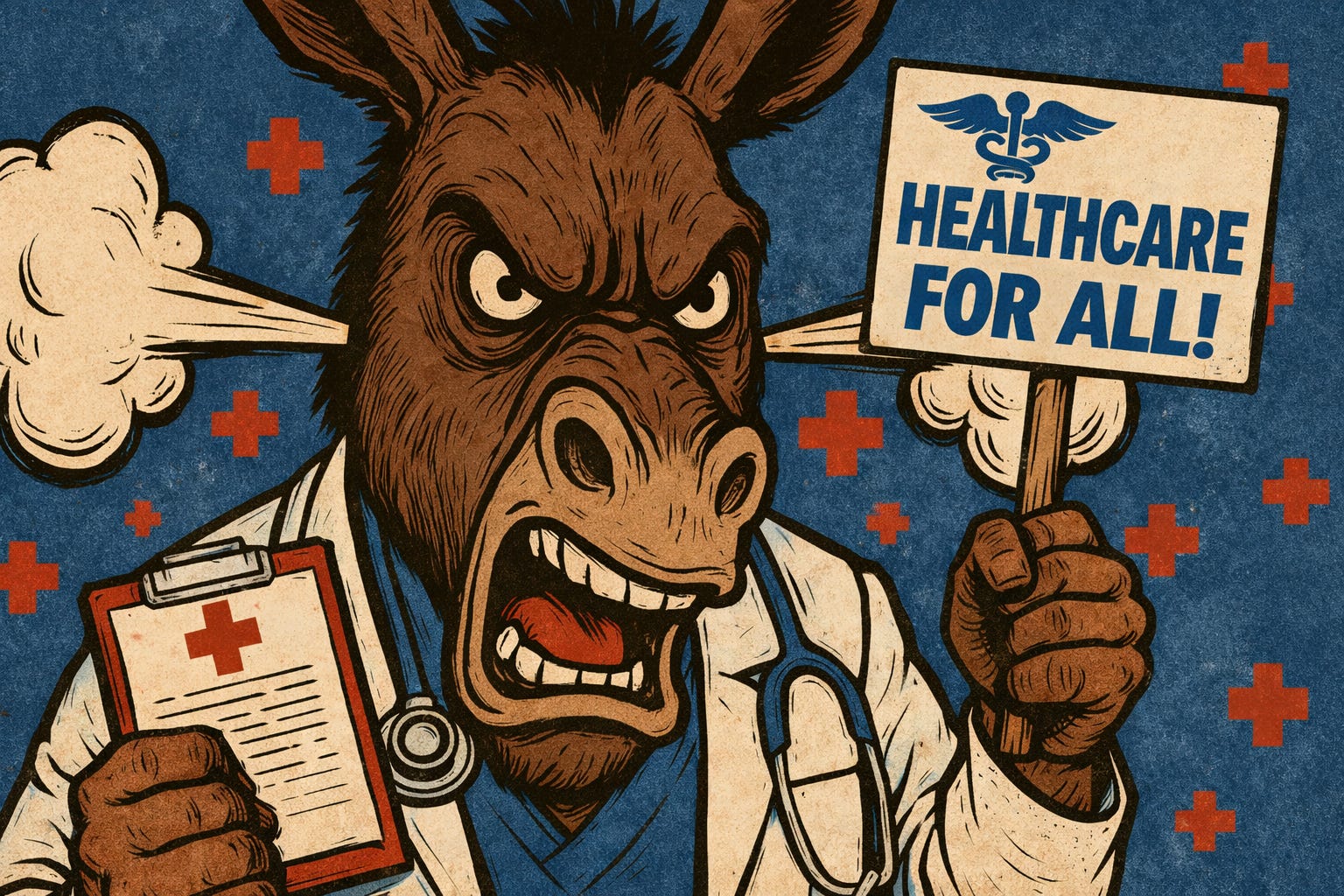
It Is Not an Unpopular Position
Recent national polling shows roughly 64 to 66 percent of Americans believe the federal government should ensure that everyone has healthcare coverage. About 65 percent of likely voters say they support a Medicare for All style national health insurance program when asked directly.
Even when you break it down by party, support is not fringe. Large majorities of Democrats support it. Strong majorities of independents support it. Even close to half of Republicans express support for some version of national health insurance when described plainly.
Where Americans tend to divide is not on whether everyone should be covered, but on how the system should be structured.
A government run model typically means a single public insurer or national plan that collects taxes or payroll contributions and pays providers directly, like Medicare expanded to everyone or a Taiwan style system.
A private based model usually keeps multiple insurers in place, but under tighter rules, subsidies, and mandates to guarantee coverage, like Germany’s nonprofit sickness funds or a heavily regulated ACA framework.
In other words, the disagreement is often about administration and structure, not about the moral principle of universal coverage itself.
But the core principle that everyone should have coverage is not controversial.
So why are Democratic candidates acting like it is?
We Stopped Fighting After the ACA
After the Affordable Care Act, something shifted.
With the public option was stripped out, it was felt this was as far as we could go. Democrats declared victory and quietly moved on and for some reason, and that was the end of the serious national conversation.
Almost twenty years later, we still do not have a serious national push from congressional or statewide candidates. Lots of talk about lowering cost but not real solutions. Just milquetoast campaign jargon to get votes.
But, the healthcare is still expensive. Premiums are going up and are still crushing families. And medical security is still tied to people’s job.
We wanted healthcare for all and what we have is a fight shifting premium costs a little this way and that way. Meanwhile the system is getting more corrupted.
And candidates are still talking in vague paragraphs about “lowering costs.”
I have been to 40 states. There is not a single place in this country where people are not worried about healthcare.
Parents worry about premiums.
Workers worry about losing insurance if they lose their job.
Families with chronic conditions worry about coverage gaps.
There is nothing scarier than thinking that if you get sick, you might go broke.
In a developed country, that should not be normal.
Healthcare should be a basic human right.
The Cost Argument Is Misframed
Every time this conversation happens, someone says: “If you had a heart attack, where would you want to be treated? The United States! Duh!”
And they are right.
If you need a liver transplant, a lung transplant, advanced oncology treatment, cutting edge surgical innovation, the United States leads in research and development. We produce some of the most advanced medical breakthroughs in the world.
But that is not what is crushing everyday Americans.
The vast majority of people drowning in medical bills are not getting experimental nanotech procedures.
Workers and employers (if the employers even offers insurance) are paying HUGE monthly premiums for the ability to have access IF they need it.
Stitches. Broken legs. Blood work. Annual checkups. Diabetes medication. Antibiotics that have existed for decades. Routine screenings. Primary care visits. Chronic condition management.
This is 100 year old medicine.
And we are pricing it like it is proprietary aerospace engineering.
Start With Basic Healthcare for Everyone
Here is the argument I am making.
Separate the frontier from the foundation.
Keep funding research. Keep pushing innovation. Keep leading in breakthrough medicine. But basic healthcare services should be zero cost.
Zero cost family physicians.
Zero cost annual exams.
Zero cost routine blood panels.
Zero cost management of chronic disease.
Zero cost essential medications that have existed for decades.
You should not need thousands of dollars in premiums just to monitor your vitals.
You should not need to put a broken leg on a credit card.
You should not avoid seeing a doctor because you are afraid of the bill.
We can design a system where foundational care is guaranteed, while advanced elective or cutting edge procedures are structured differently.
The World Is Not Dying Under Universal Systems
Japan ($4,600–$5,000 per capita) operates a mandatory social insurance model with regulated pricing and universal participation.
Taiwan ($2,500 per capita) runs a single payer national insurance program with centralized claims processing and digital integration (which is excellent BTW. I lived there for 2 years).
Germany ($8,000 per capita) uses regulated nonprofit sickness funds.
France ($6,000 per capita) has national insurance with broad provider choice.
Brazil ($1,700 per capita) constitutionally guarantees healthcare as a right through a tax funded public system.
Different models. Same principle.
Universal coverage.
These countries generally spend FAAARRRRR less per capita on healthcare than the United States. The United States spends well over $15,000 per person annually on healthcare, far more than any other developed nation.
Yet our outcomes are not leading the world.
Life expectancy in the United States hovers in the mid to high 70s. Many peer nations are in the low to mid 80s.
And the most troubling number is not total lifespan.
It is health span.
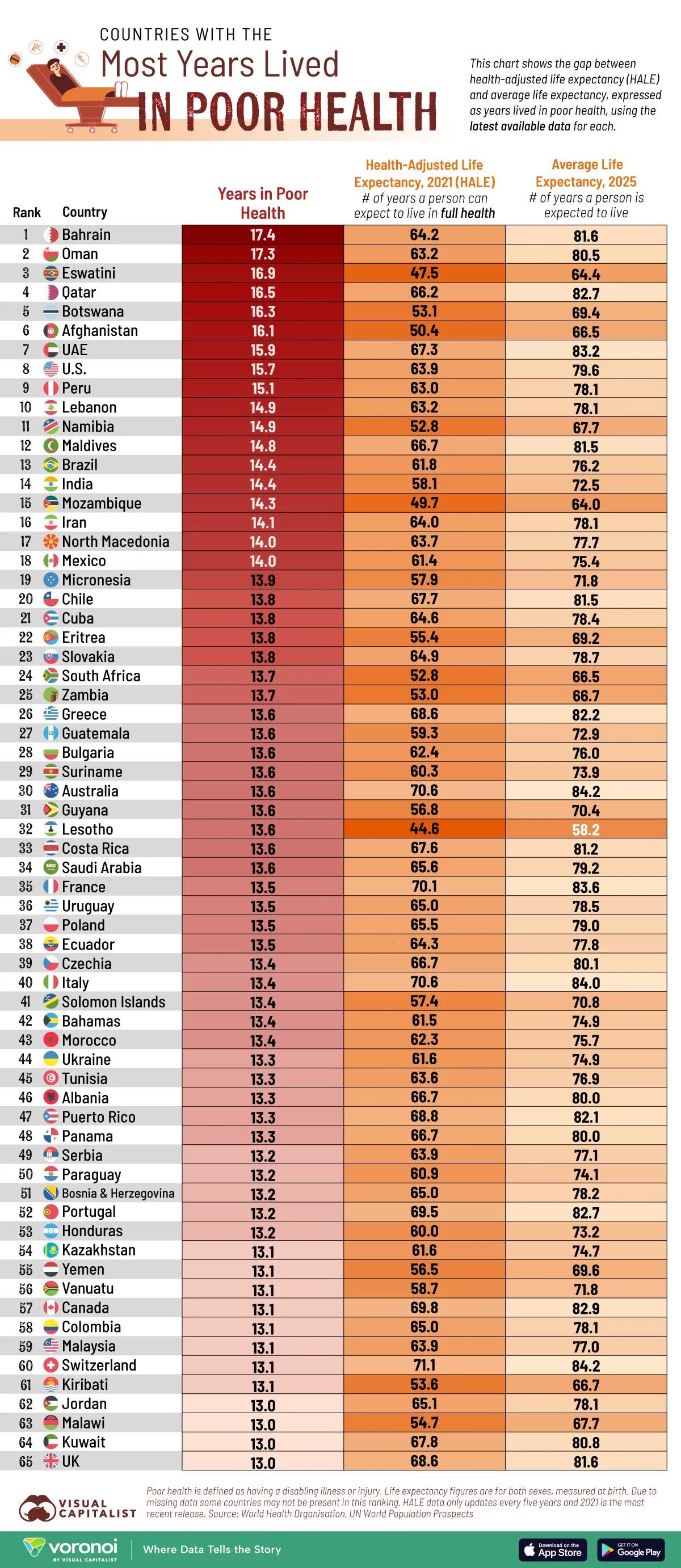
Americans spend on average more than 15 years in poor health before death ( see chart below). The average American experiences only about 63 years in good health.
Think about that. It blew my mind and saddened me when I heard it.
If life expectancy is around 76 years, and good health ends around 63, that means more than a decade of diminished mobility, chronic illness, and reduced quality of life.
That is not because we lack experimental medical breakthroughs.
That is because we underinvest in prevention, routine care, and early intervention.
Yes, Personal Responsibility Matters
We also need to talk about food. About synthetic additives. About misleading labeling. About a culture that normalizes sedentary behavior.
Get out and walk.
Lift weights.
Stretch.
Eat vegetables and fruit.
Cook at home.
Individual responsibility matters.
But you need individual responsibility and structural access.
If basic healthcare is priced out of reach, you cannot blame people for not catching problems early.
Stop the Political Theater
Democrats, stop with the consultant language.
Stop hedging your votes.
Stop trying to triangulate every issue into a safe middle paragraph.
Say what you believe.
If you believe healthcare is a right, say it.
If you believe basic healthcare should be free and accessible, say it.
If you believe families should never have to worry about the cost of prevention and primary care, say it….
And fight for it!
If you lose a race fighting for something that improves people’s lives, so be it.
But what is the point of winning elections and never moving the ball? And, lets ask… have we moved the ball? Bold ideas move the ball because people are yearning for them.
Healthcare for all is broadly popular.
And if Republicans ever decide to message seriously on accessible healthcare, it will be extremely popular and they will control the conversation.
Do not lose another widely supported policy because you were afraid to speak clearly.
Run on it! Say it with me!
Healthcare for all.
Stay Angry.
The article correctly diagnoses that US healthcare is insanely expensive with mediocre-to-poor population health metrics, but falsely promises that "healthcare for all" (single-payer) is the simple moral/economic slam-dunk solution — when evidence shows it would mainly expand access and shift costs to taxes, while leaving the dominant drivers of bad HALE (lifestyle, guns, drugs, inequality) untouched and the cost explosion only partially tamed. It’s feel-good progressive messaging, not serious policy analysis.
I'll start with concerns on the supporting HALE chart which is highly misleading like most charts aimed at trivializing things for people who only want to look at a chart, as well as catering to a preconceived results. The HALE chart misleads by anchoring on outdated 2021 pandemic lows (HALE ~63–64, poor-health years >15), exaggerating the gap and ignoring the 2024 rebound to LE 79 with improving HALE; it overstates the years-in-poor-health figure beyond evidence (real ~12 years pre-COVID), and falsely pins nearly all blame on the lack of universal/for-profit healthcare while minimizing dominant roles of obesity, substance use, violence, and social factors that persist across systems and explain much of the US disadvantage versus peers.