

Hey everyone, before we get started, please consider becoming a paid subscriber. Your support will help us double down on conversations like this and help get things done in Columbus.
Hey, my fellow angry Democrats. After this week’s historic election, I sat down with my friend, State Representative Eric Synenberg, to talk about what comes next.
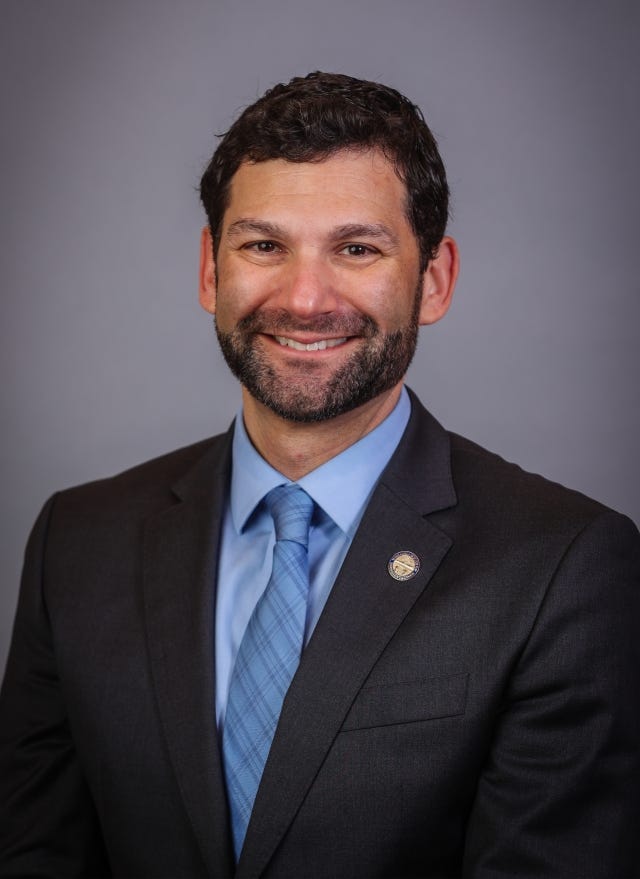
Eric is an attorney and former Beachwood City Council member who first won election to the Ohio House in 2024 with 79.2% of the vote. This week, he won reelection with approximately 83.7%, according to unofficial returns.
He represents Ohio’s 21st House District: Beachwood, Euclid, Lyndhurst, South Euclid, University Heights, and part of Cleveland, including Collinwood. He is also a Jewish American and a member of the Ohio Jewish Caucus.
Before we even get into the election conversation, he wanted to give Collinwood some appreciation.
People hear Beachwood and make assumptions about his district, but the communities he represents cover a wide range of incomes and experiences.
Then we got into the question facing Democrats across Ohio: You’ve won. What are you going to do with it?
What Were Voters Telling Us?
Matt: Do you think this was a mandate for Democratic policies, or a rejection of Trump and the Republican Party? What did voters tell you?
Eric: We have to go by data and outcomes. Trump won in 2024. Independents and Republicans felt he should get a second term, and he won. We’re not a party of election deniers.
I personally believe his second term has been the worst presidency in modern times, if not the history of our country. His second presidency was different from his first from day one, in the way he tried to fundamentally change our country.
Look at DOGE, the major changes to the federal government, tariffs, and the big budget bill. There are consequences that have already come down and consequences that will continue next year, particularly around healthcare and SNAP.
I think voters realized how bad Trump is and how few members of his party stood up to him. This result was a year in the making.
Matt: You saw this coming before this election?
Eric: I knew this was going to be a good year for Democrats on election night in 2025. We saw Democrats winning school board, city council, township trustee, and village council races in suburban areas that had historically been Republican.
We were all surprised by what happened this week, but the basis for it was already there.
We still don’t know everything about where the electorate is politically. Are they more Republican or more Democratic? We know they don’t like Trump and this current Republican Party.
What Changes When Republicans Can’t Override the Governor?
Matt: Republicans still control the legislature, but they can no longer override a Democratic governor’s veto on their own. What does that mean?
Eric: Before, they could override it. That hasn’t happened constantly. In the almost two years I’ve been there, it happened once, on the property-tax legislation. But the threat was always there.
The more important part, in my opinion, is that in a two-party system, if you’re being objective, fair, and reasonable, you should want that pendulum to keep swinging back and forth.
Think about the Ohio Supreme Court. We should want a court that’s closely divided, where sometimes Republicans have the majority and sometimes Democrats do. When it’s overwhelmingly one-sided, people going before the court feel like they already know which way their case is going to go. That’s not fair.
The same principle applies to the legislature. One party being in power for decades isn’t healthy. Even if Democrats were the ones in power for 20 years, I would say the same thing.
So yes, we’re in a much healthier place as a democracy now than we were last week. But we still have to see what comes out of it. I hope we’ll see that healthier balance reflected in the legislation that gets passed.
What Can You Deliver in the First 100 Days?
Matt: People on my Facebook page are asking about funding schools, the voucher program, healthcare, and SNAP. What can you realistically deliver in the first 100 days?
Eric: We need more time. Give us 200 days.
Matt: Okay, we’ll give you 200 days. First negotiation done. haha
Eric: I say that because the state operating budget is our most important document. It prioritizes everything for the following two-year cycle, and it has to pass by June 30.
That’s when we’ll really know how the funding priorities have changed. Have we gone back to the Fair School Funding Plan? Do we have a fairer tax system?
Our income-tax system is skewed to favor wealthier Ohioans. We should return to a progressive income-tax structure.
Matt: The argument for tax cuts is that people keep more money and spend it. Does the state recover some of that through sales taxes?
Eric: Without the numbers in front of me, I can’t say.
But the state is in a solid financial position. We get monthly and annual reports, and typically the state brings in more than its projections. We also have the rainy-day fund.
The point is, we can afford the Fair School Funding Plan. Returning to a more progressive income-tax structure is one part of that.
What Happens to Families Using Vouchers?
Matt: A lot of families have been using vouchers for several years. They’ve made decisions about where their children go to school. Would you advocate eliminating the program? What happens to those families?
Eric: I don’t believe in radical change, one way or the other.
First, we’re still dealing with a Republican-controlled legislature. But even if we could do it, even if Democrats won all 99 House seats, I would say: Let’s make changes or phase it out over years. Don’t just totally cut it.
There are reforms that I believe even advocates for the voucher program would concede on.
Matt: But now you have Amy Acton, and she has line-item veto power. Republicans will have to negotiate. Doesn’t that create the possibility for substantial changes?
Eric: My concern is more on the Fair School Funding side, on the public-school side, than totally cutting vouchers. I wouldn’t anticipate ending the voucher program overnight.
We need to increase the state’s support for public schools. There are different ways to start changing vouchers, too.
We have a bill pending that would prevent families making more than $500,000 a year from receiving them. Currently, even at that income, families can still receive money.
And remember, public districts still have responsibilities for students attending private schools, including transportation. We’re subsidizing these schools while public schools continue carrying those obligations.
Do We Still Want Fair Maps After Winning?
Matt: Democrats just gained seats under these maps. Why mess with a good thing? Would you still support changing them?
Eric: Yes. I support a constitutional amendment and an independent commission so this is actually done fairly.
I personally heard Amy Acton say several times on the campaign trail that supporting another redistricting effort would be a priority.
I want it on the ballot in 2027.
Matt: Could that produce new districts for 2028?
Eric: I don’t believe it would get done in time for new districts in 2028. Whether it could happen before the next census cycle depends on how the amendment is written. I don’t know what that language will look like yet.
Matt: Republicans will point to Democratic states and say gerrymandering goes both ways.
Eric: And it does. But just because another state does it the wrong way doesn’t mean we should do it to balance things out.
An independent commission should draw the lines.
You’re also never going to have 99 competitive House districts. Some communities are overwhelmingly Democratic, and others are overwhelmingly Republican.
But even after a very good election for Democrats, there is still work to be done.
What Should Ohio’s Democrats Do in Washington?
Matt: Ohio is sending more Democrats to Congress. What do you want them to do to help Ohio and help you do your job?
Eric: Look at the Problem Solvers Caucus, which includes Republicans and Democrats. There are commonsense policy ideas and solutions that should be implemented but haven’t been because Washington is so partisan.
Let’s find things we can actually get done. Look at how many of those proposals became law in previous Congresses, and let’s improve on that.
There’s also appropriations. We support applications from cities, nonprofit groups, and other organizations seeking federal money. That’s one way we work together.
But the biggest issue is affordability.
Matt: What does addressing affordability look like to you?
Eric: I tend to look more at incomes than just expenses. Prices have gone up, especially over the last several years. Gas, groceries, construction materials.
But if you’re making a million dollars a year, you can absorb that. The fundamental issue is income inequality and the gap between the average worker and the people at the top.
For lower-income and middle-class families, life has become too hard. This is not sustainable.
Is the answer the minimum wage? More relief for people at the lower end? Something has to give.
The biggest thing I want from Congress is to reverse the changes in the big budget bill: healthcare, SNAP, the coverage changes, and the additional paperwork people will have to deal with.
That would be my most important message to Ohio’s congressional Democrats.
Where Is the Line Between Criticism and Antisemitism?

Matt: You recently strongly criticized a “friend’s” post saying “Fuck Israel.” Tell about how that crossed the line.
Eric: This was a high school and college friend. I saw it and thought: This is beyond the pale. This is not acceptable.
People don’t always realize how that language comes across to Jewish people. Our religion, identity, history, and trauma are connected to Israel.
To me, that statement goes beyond criticizing the government.
Matt: Then how should people criticize what is happening in Israel and Gaza? How do you have that conversation without making our Jewish neighbors feel attacked?
Eric: Name the individuals. Criticize the current Israeli government.
It’s like having a conversation about Trump and American politics without being anti-American. There’s a way to do it.
I’m not defending everything Israel has done in its history or modern history. I think continued settlement expansion in the West Bank is unconscionable.
Some of the things Netanyahu, Ben-Gvir, and Smotrich have done are abhorrent. I don’t believe those actions represent what Israel or Jewish values should be.
Matt: On the other side, do you also see a rise in Islamophobia?
Eric: One hundred percent. It’s undeniable, and it’s wrong. Period.
I also want to see Muslim public figures condemn extremists acting in their religion’s name. I have no problem criticizing people on my side, and I want to see that willingness from others.
Those are separate issues. Islamophobia should be condemned, and public figures should also be willing to condemn bad actors within their own communities.
How Do Voters Hold You Accountable?
Matt: Democrats have the opportunity now. We’ve talked about school funding, the budget, and redistricting. How should people hold you accountable if those promises aren’t fulfilled?
Eric: We’re back before voters in two years, and statewide officials are back in four. That’s the accountability.
We spend all this time talking about where the electorate is and what’s popular. Every two and four years, we actually find out.
If the Fair School Funding Plan doesn’t get reimplemented, that’s not good. We won’t have the same support from teachers that we had this time.
Matt: So voters get to judge whether you did the job, and you have to answer for it at the next election.
Eric: Yes.
Democrats have more power, a budget negotiation ahead, and promises people will remember.
Great Interview guys
Oh and regards the financial security inequity issue, one way I think this could realistically start to be addressed is to use that reinstatement of a more progressive income tax to offset allowing sliding scale buy-in to Medicaid for people who otherwise don't qualify. My aged 87 & 76 years old inlaws on their garment factory pension plus Social Security are just over the income max for Medicaid, which has been placing an unsustainable load on my three-generation household as their health declines, including my FIL’s 2022 cancer diagnosis that has not killed him but the ongoing treatment logistics are really hard on our household to shoulder alone, and I know it is so much worse for families with elder care needs who don't share a roof and have a not-mainstream-employed highly compent midlife adult with daytime availablity.
I also worry about my sons getting trapped in jobs that exploit them for the wealthy head of the company's gain while leaving the younger generation caged into that employment situation once they age out of being able to be covered by their parents' insurance (if their parents HAVE health insurance that will cover them) instead of branching out and trying to build their own business with their talents. My eldest is in law school after College Credit Plus paid for his B.A. in Organizational Leadership and my secondborn has an accounting degree paid for by CCP. I don't want them trapped working in firms that exploit them instead of being able to start their own thing or do consulting because they need access to health insurance for themselves and hopefully someday my grandchildren (unless they’ve not updated me on a very new relationship, they are both single, which is another reason I really want to be coordinating community gatherings in the hopes they will meet a good life partner through that! Both of them very much want to be solid family men and fathers as core identities, not just career men… they have been raised with concepts from Robert Putnam and David Brooks and Terry Real and William B. Irvine and Ward Farnsworth… they know that there is more to a Good Life than vocational time, and I very much want them connecting with age peers who cultivate that mindset as well… but so many of them are getting ground to burnt out dust by Hustle Culture Grindset that does not respect their basic humanity and needs as members of a highly social species, and it constantly triggers sadness within me to watch that from the sidelines feeling helpless about it. Giving them a way out through being able to buy in to Medicaid (which would also help shore up the financial sustainability of rural hospitals) is something that feels do-able to improve things for them so they can free up the mental energy for civic and community engagement.
Also, I am absolutely down for showing up to sustain and boost College Credit Plus. I currently have two participating sons (Lincoln, a high school junior who already has his Associates at Tri-C with upper-division coursework in progress at CSU, and 8th grader Ulysses who has completed 9 college credits with 13 more in progress and 13 scheduled for spring term at Tri-C). We are trying to start a nonprofit to provide social support for other kids who are dealing with the social awkwardness of being academically ahead of their age peers and life experience outliers with their college classmates, but it is a slow roll with how much I have to do with my time and other resources being stretched nearly to the breaking point (which is why I haven't been putting articles on my own Substack pub in the last many months).