

Commentary by Laura Rodriguez-Carbone
The night after Trump put an octagon on sacred ground, the Senate confirmed a judge and went home. The House was out of town. This is what our Democratic opposition looks like.

I’ve been sitting with something since Sunday night and I’d like to take a moment to explain it to you.
Sunday was Flag Day, and Donald Trump converted the South Lawn of the White House into a UFC octagon.
He staged seven professional fights on grounds paid for by 250 years of American blood on the holiday that honors the flag those people died under.
The Armed Forces Joint Chorus sang the National Anthem.
Honor Guards stood at the Lincoln Memorial as props for the fighters’ entrance.
The closed captioning was sponsored by TrumpCoins.com, marketed during the National Anthem, at the White House.

The optics of that fight mean more in the context of what this administration wants you to believe about your role, and your rights, as Americans. It was the systematic conversion of national symbols into personal property, conducted in plain sight, designed to make you feel like a guest at something you already own. The point of all of it was to make you forget that lawn or that House even belongs to you.
The desecration that happened Sunday night is endless. But perhaps more unsettling to me is the lack of Democratic response to it at all.
Now, I’ve heard the argument. I’ve made it myself, honestly. The math isn’t there. Impeachment requires a House majority Democrats don’t have. Removal requires two-thirds of the Senate. You don’t win votes you don’t have.
But I’d be misreading something important if I chalked what happened up to the math. The math explains why Democrats can’t remove Trump this week. But it doesn’t explain the silence or why the most powerful legislative minority in the world — which has the right to take the floor, to build the public record, to make the case day after day until the political cost of silence on the other side exceeds the cost of action — is scheduling routine judicial confirmations the morning after the president staged a birthday fight card on the people’s front lawn.
That silence has an explanation. It’s just not one the party wants to admit to.
My perspective comes from direct experience inside the Democratic Party: as a congressional candidate in Ohio’s 7th District, as a three-term local party representative in my county, and as someone who has seen how party structures operate from the inside.
What I learned in that campaign, and what I learn more deeply every week I spend reporting this newsletter — is that the Democratic Party’s silence is not a product of powerlessness. It is a product of a donor class that has made a calculation that sustained disruption is bad for business, and a party structure so corrupted by corporate money that it has accepted that calculation as its operating premise.
The Difference Between Powerlessness and Refusal
Let me tell you what fighting from the minority actually looks like. Because, the history is unambiguous on this.
In 1857, the Supreme Court handed down Dred Scott v. Sandford — one of the most shameful decisions in the Court’s history — holding that Black people were not citizens under the Constitution and that Congress had no authority to prohibit slavery in the federal territories. The Republican Party was then a minority coalition. The math wasn’t there. The situation looked impossible. But, they refused to accept it.
They built their case in public, year after year, election after election, treating an unjust ruling not as a permanent condition to be managed but as a moral emergency to be fought. They didn’t wait for favorable math. They built the math. They ratified the 13th, 14th, and 15th Amendments and superseded Dred Scott entirely.
Congress has done this before and since. A 1991 amendment to Title VII overruled more than a dozen Supreme Court decisions in a single piece of legislation. The Lilly Ledbetter Fair Pay Act — the first bill Barack Obama signed into law — overturned a Supreme Court decision simply by rewriting the statute, because Democrats spent years building public pressure around an unjust ruling rather than accepting it as permanent.
But the precedent that matters most right now is not a Supreme Court override.
Its August 7, 1974.
On that day, three senior Republican leaders — Senator Barry Goldwater, Senate Republican Leader Hugh Scott, and House Republican Leader John Rhodes — walked into the Oval Office and told Richard Nixon he had no more than 15 votes for acquittal in a Senate trial. Nixon resigned the next day.

That meeting didn’t happen because Republicans spontaneously developed a conscience. It happened because Democrats spent two years building a case so relentless and so publicly documented that the political cost of continuing to defend Nixon exceeded the cost of abandoning him.
They didn’t wait for Republicans to feel shame. They made shame unavoidable. They built the Goldwater coalition through the grinding, daily, undeniable accumulation of the public record.
That is the model. Not a fundraising email. Not a work period. That.
Outrage Is Not a Strategy
In April, more than 70 Democratic lawmakers called for impeachment or the 25th Amendment after Trump threatened to wipe out a civilization. Senators Murphy, Markey, and Kim said plainly the president should be removed.
Then the Senate scheduled a judicial confirmation and the House went home. That is what happens when a party fights in bursts rather than sustained campaigns.
When outrage is treated as a fundraising moment rather than the beginning of a long accountability project.
When the donor class — which funds the candidates and shapes what the party can and cannot say — decides the moment has passed and it’s time to return to normal operations.
Normal operations.
While a man who calls dead soldiers losers stages birthday parties on the people’s front lawn.
While the VA loses 40,000 employees.
While 1.2 million veterans lose their provider.
While the East Wing is replaced with a ballroom and the South Lawn gets an octagon.
Normal operations.
What I keep coming back to is this:
The Democratic Party has the tools to fight.
It has the history.
It has the constitutional mandate.
It has the floor.
What it does not have — what the insiders who run it have systematically ensured it doesn’t have — is the will to use those tools in a way that genuinely disrupts the people who pay for the party.
That is the problem! Not the math. Not the rules. Not the structural constraints of minority status.
The problem is that the insiders who run the Democratic Party have decided that a certain level of Trump is manageable — preferable, even, to the kind of sustained confrontation that might threaten existing donor relationships, existing power arrangements, the existing understanding of who this party serves and what it is actually for.
My family has sent someone to fight in every war this country has ever had. Every one! Going back to the Revolution. What they were owed for that — what every military family was owed — was a government that takes seriously its obligation to fight for them. A party that treats their sacrifice as more than a backdrop for a pay-per-view event and more than a subject line in a fundraising email.
Today the Senate confirmed a judge.
The House went home.
The South Lawn still has an octagon on it.
The UFC fight last night and the empty Senate floor today are not two separate stories. They are the same story. They are both about what happens when power goes unchecked — when one party acts without limits because the other has decided, at the donor level, that a certain level of restraint is the safer bet.
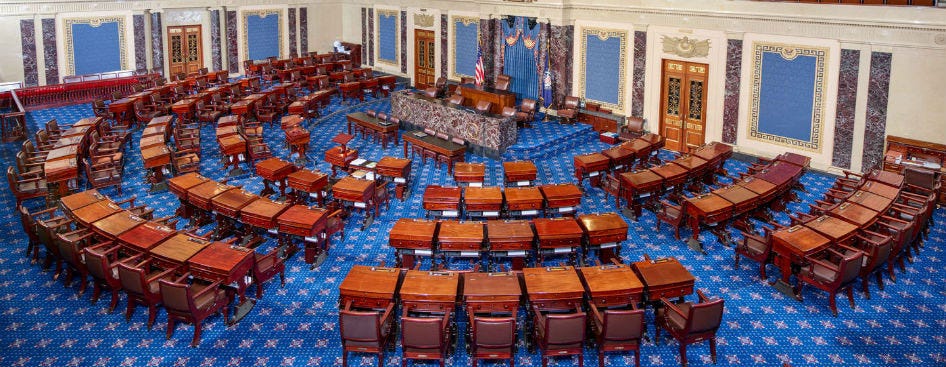
We need floor speeches every day. About the unconstitutional war in Iran. About $410 billion in impounded taxpayer money. About the illegal detention of American citizens. About 1.2 million veterans without a VA provider. About what happened to the East Wing. About what happened on the South Lawn on Flag Day.
We need the Goldwater coalition — the Republicans whose political survival no longer depends on enabling this president, built through daily, documented, relentless public accountability that makes silence on the other side unsustainable.
We need a Democratic Party that understands what Barry Goldwater understood in 1974: you don’t wait for the math to be right.
You make it right.
And..
Stay Angry
Opinion Disclaimer: This essay reflects the personal views of its author. Opinions published by The Angry Democrat are intended to encourage debate and discussion, and do not necessarily represent the views of the publication, its editors, contributors, or affiliated projects.
Thank you Laura for writing this and explaining that how our democracy is on the edge of collapsing and unfortunately the majority of people are being complicit and misled. We keep settling for new lows. And it’s disheartening to see how there are people who think Democrats as government lovers, versus people who believe in a government that protects our democracy and everyone’s rights - not the few. Without a government it’s anarchy and chaos.
The White house lawn is not "sacred ground" unless you are a democrat who worships government.