

This is a thought experiment about political power.
Elon Musk has reportedly become the world’s first trillionaire after SpaceX’s public-market rise, with Forbes estimating his net worth at about $1.1 trillion and other reports placing it closer to $1.3 trillion. Most of that wealth is not cash. It is tied up in equity, companies, and market value.
But even with that caveat, the scale is unprecedented.
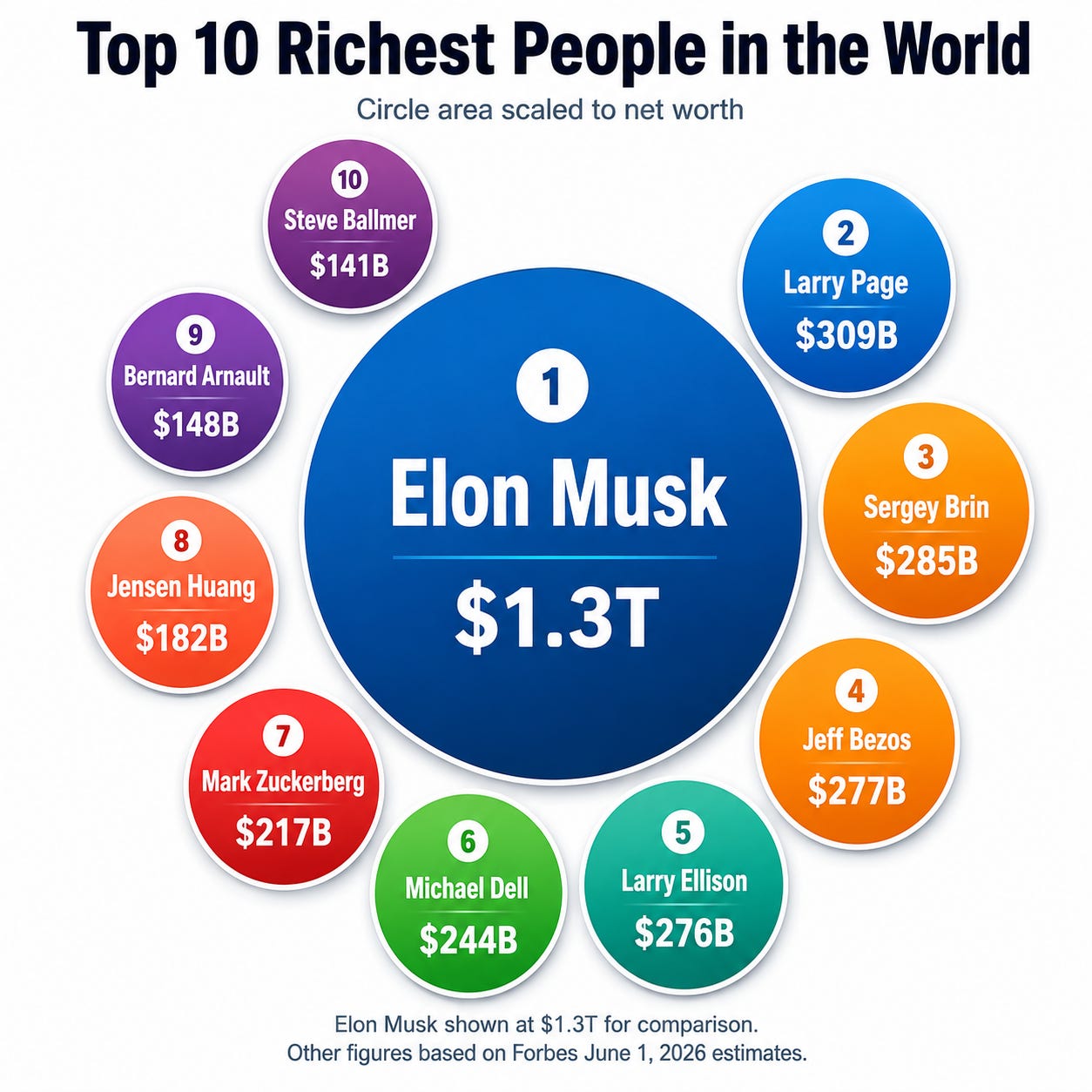
The political question is not whether Musk has $1.3 trillion sitting in a bank account.
The political question is what someone with that much wealth can finance, influence, and build.
In 2024, Musk spent roughly $277 million supporting Donald Trump and other Republican candidates, making him the largest individual donor of the election cycle. That was treated as historic, because it was historic.
But compared with trillionaire-scale wealth, $277 million is like a Netflix subscription to us.
The Old Billionaire Model Was Strategic Spending
Before this, we understood billionaire politics as targeted influence.
George Soros. Michael Bloomberg. Miriam Adelson. Ken Griffin. Jeff Yass. Timothy Mellon. Reid Hoffman. Tom Steyer. Sheldon Adelson when he was alive.
These people could spend enormous sums. They could fund Super PACs, ballot initiatives, media campaigns, presidential runs, Senate races, and ideological infrastructure. But even they had to choose.
They had to pick races.
They had to pick candidates.
They had to pick moments.
A billionaire worth $10 billion who spends $250 million has spent 2.5 percent of their fortune. A billionaire worth $2 billion who spends $250 million has spent 12.5 percent of their fortune. Even for the extremely rich, those are real allocations.
That is why major donors usually operate strategically. They choose a presidential race, a Senate race, a few House races, a ballot issue, a state Supreme Court race, a think tank, a legal fund, or a media project.
They buy influence by selection.
Musk’s scale changes that.
The New Model Is Structural Power
Take only $300 billion. Just the .3 in a $1.3 trillion fortune.
Not the full trillion.
If $300 billion were parked in safe yield at 4 percent, it would generate $12 billion a year.
That is $1 billion a month.
That is about $230 million a week.
That is about $33 million a day.
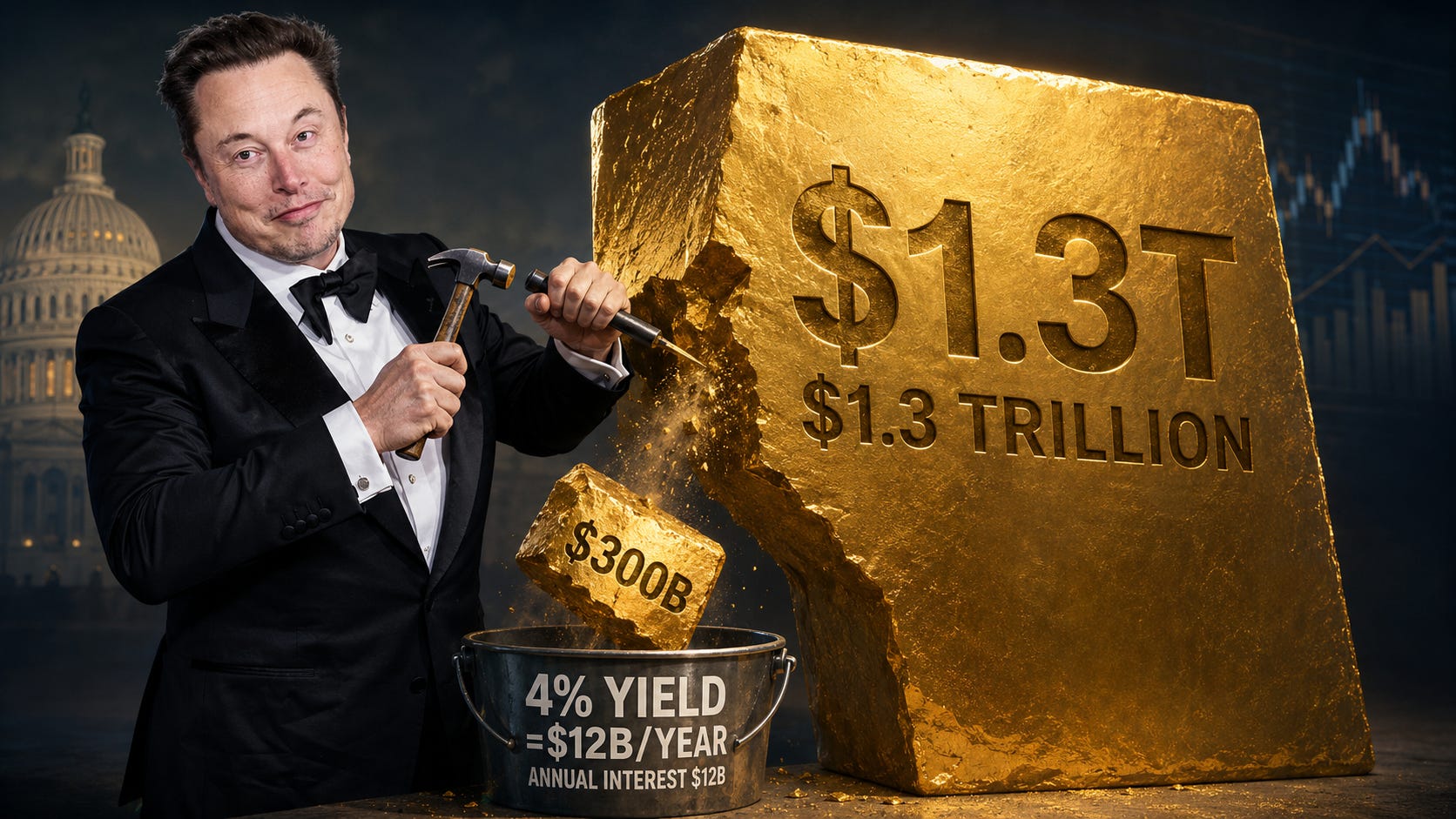
That interest stream alone is more than enough to outspend every traditional mega-donor in American politics year after year.
And the $300 billion principal would remain intact.
This is where the political danger begins. A donor at this scale does not have to decide whether to influence the presidential race or the Senate map or the House map or state legislatures or mayoral races or school boards.
He can theoretically build a permanent political machine across all of them.
What a National Political Machine Could Cost
There is no clean official price tag for every meaningful election in America. Federal races are tracked more clearly than state and local races. Local elections vary wildly. Some races cost almost nothing. Others cost millions. Money does not guarantee victory.
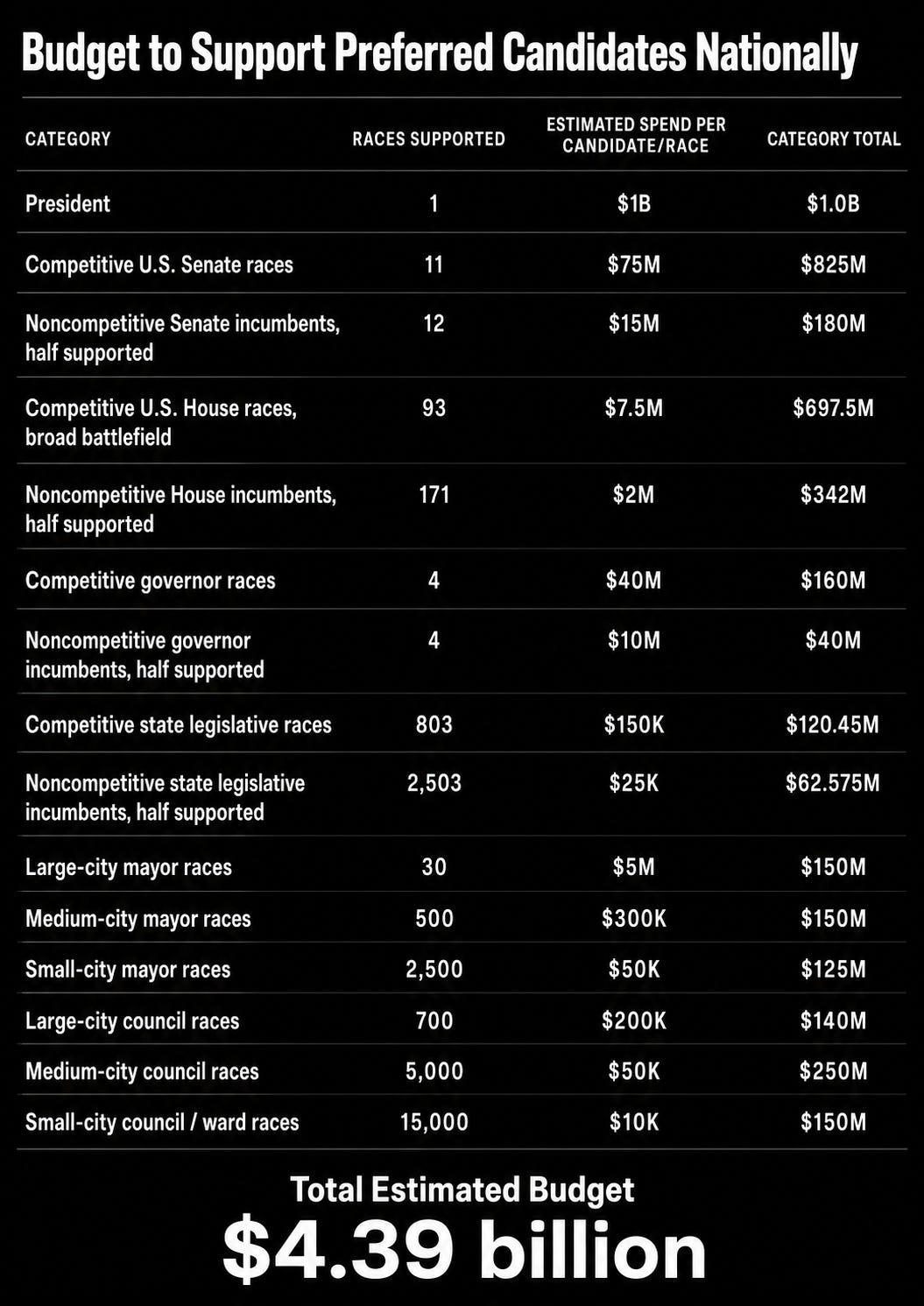
But as a thought experiment, let’s say a national political operation costs about $4.4 billion a year.
That could include major support for presidential politics, competitive Senate races, House races, governor races, state legislative races, mayoral races, major city council races, ballot initiatives, local offices, candidate recruitment, polling, field operations, digital ads, opposition research, legal infrastructure, data operations, media buys, and independent expenditures.
Now please note we are funding almost every race totally across the nation. Not just federal. EVERY RACE.
That is an enormous amount of money.
For almost anyone else, it is impossible.
For Musk, under this model, it is less than half the annual interest on $300 billion.
He could spend $4.4 billion a year on politics and still have about $7.6 billion in annual interest left over.
Without touching the principal.
That is the difference between billionaire influence and trillionaire political capacity.
This Is Bigger Than Buying Ads
The danger is not just television ads.
That is the old way to think about political money.
With enough money, a private citizen can fund the whole ecosystem around elections. Candidate pipelines. Local slates. Consultants. Pollsters. Legal challenges. Ballot access fights. Opposition research. Field programs. Media platforms. Influencer networks. Data firms. Think tanks. Model legislation. Academic centers. Issue nonprofits. Lawsuits. Primary challengers. Party infrastructure. Local news alternatives.
You do not just buy one election.
You build the machinery that decides which candidates run, which issues get attention, which narratives dominate, which lawmakers get rewarded, and which politicians get punished.
At that point, money is not just campaign spending.
It is political infrastructure.
Part 2: How They Closed the Courts

Before the 1970s, American voters had a reasonable claim on three protections against political capture.
Citizens United Built the Opening
This is why campaign finance law matters.
The Supreme Court’s Citizens United decision opened the door for corporations and other outside groups to spend unlimited money on elections through independent expenditures. Super PACs and outside groups cannot legally coordinate with candidates, but they can spend massive sums shaping the political environment around them.
That system already gave billionaires enormous power.
But a trillionaire stretches the system into something else entirely.
The law was already dangerous when billionaires could dump tens or hundreds of millions into elections. Now imagine someone who could spend billions every cycle from interest alone and keep doing it forever.
That is not normal donor politics.
That is a private political treasury.
The Comparison to Other Donors Is the Whole Point
This is why the comparison to other political billionaires matters.
Michael Bloomberg can spend hundreds of millions. He did it.
Tom Steyer can spend hundreds of millions. He did it.
Miriam Adelson, Ken Griffin, Jeff Yass, Timothy Mellon, Reid Hoffman, George Soros, and others can shape politics. They have.
But they still operate inside limits.
They have to choose.
They have to prioritize.
They have to decide where their money has the most leverage.
Musk could operate differently. If he chose to make politics a priority, he could fund presidential races, Senate races, House races, governors, state legislatures, mayoral races, school boards, ballot initiatives, legal networks, media networks, and ideological institutions at the same time.
That is what makes this unprecedented.
It is not just that he is richer than other billionaires.
It is that his excess wealth can generate enough annual cash flow to make political spending permanent.
Not a donation.
Not a cycle.
For-Ev-Er
The Leftover Money Shows the Absurdity
And here is the part that makes the scale almost impossible to process.
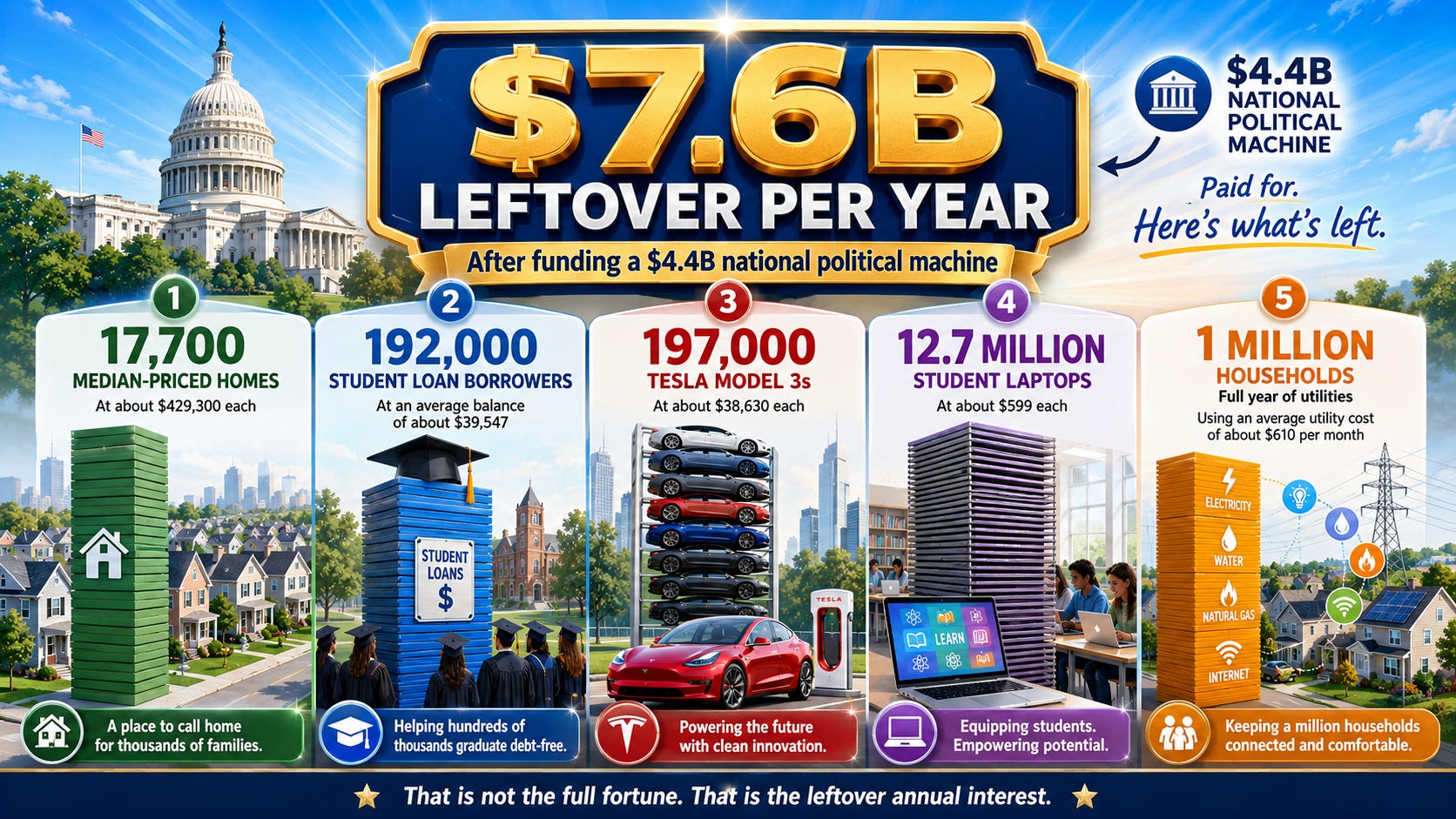
In this model, after spending $4.4 billion a year on national political influence, the leftover interest alone would still be about $7.6 billion a year.
That leftover money could buy roughly 17,700 median-priced homes. Per year.
It could pay off average federal student loan balances for roughly 192,000 borrowers. Per Year
It could buy about 197,000 Tesla Model 3s. Per Year
It could buy about 12.7 million student laptops. Per Year
It could cover a full year of utilities for roughly 1 million households. Per Year
Again, that is not the fortune.
That is not the $300 billion.
That is not even the full annual interest.
That is the leftover interest after already funding a massive political machine.
That is the scale we are dealing with.
The Democratic Question
I am not saying Elon Musk will do this.
I am not saying he should not be allowed to build companies, create value, or become wealthy.
I am not saying we should seize everything because someone got too rich.
That is not the point.
The point is that American democracy has never had to deal with one private citizen holding this much potential political capacity.
Governments have budgets, elections, oversight, agencies, courts, and public accountability. Parties have voters, donors, committees, and internal fights. Public companies have boards, shareholders, disclosures, and legal duties.
A private citizen with sovereign-scale wealth does not operate under the same constraints.
And if that person can use the annual return on a fraction of his wealth to fund a permanent national political machine, then we are no longer talking about ordinary campaign spending. We are not even talking about Citizens United scale spending.
We are talking about private power at democratic scale.
The question is not whether Elon Musk is good or bad.
The question is what guardrails do we need to protect our elections and democracy.
That is this level of wealth. Not influence. But,Dominance.