


Spoiler Warning
I just got back from seeing Christopher Nolan’s adaptation of The Odyssey, and I have a lot to say about it.
This review contains spoilers. If you have not seen the movie, close this article, go watch it, and come back. I do not want to hear anybody complaining that I spoiled it for them.
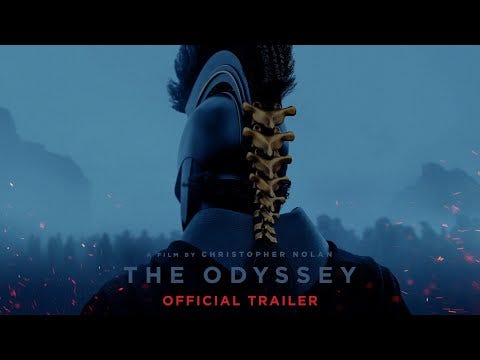
I would also recommend learning the basic story of The Odyssey before watching the movie. You do not need to read Homer’s entire epic, but a quick overview will make the characters, mythology, and structure much easier to follow.
I am going to do three things here:
First, explain the basic story.
Second, talk about the political backlash surrounding the movie.
Finally, explain why I think Nolan’s The Odyssey is a 9 out of 10 epic about war, masculinity, addiction, leadership, and what happens when the norms holding a society together begin to collapse.
What Is The Odyssey?
The Odyssey is Homer’s ancient Greek epic about Odysseus, king of Ithaca, and his attempt to return home after the Trojan War.
Odysseus is married to Penelope, and they have a son named Telemachus. He leaves Ithaca to fight at Troy when Telemachus is still an infant. The war lasts ten years, and Odysseus’s journey home takes another ten. By the time he returns, he has been gone for twenty years.
Odysseus is not the biggest or strongest warrior in Greek mythology. His strength is his mind. He is a strategist, a manipulator, a liar when necessary, and the man traditionally credited with devising the Trojan Horse.
Christopher Nolan’s movie expands beyond the events of Homer’s Odyssey to show the end of the Trojan War. Greek soldiers hide inside the horse while Sinon, played by Elliot Page, helps deceive the Trojans into believing it is an offering. The Trojans bring it through the city’s walls, allowing the Greeks to attack Troy from inside.
But winning the war is only the beginning of Odysseus’s real story.
Back in Ithaca, Penelope has spent twenty years protecting her family and holding together what remains of Odysseus’s household. Telemachus has grown into a young man without his father. Suitors have flooded into their home, consuming their food, abusing their hospitality, corrupting people around them, and pressuring Penelope to choose a new husband.
The suitors are not merely obnoxious guests. They are exploiting xenia, the sacred Greek law of hospitality associated with Zeus. People were expected to welcome strangers and treat guests properly because they never knew when a god might arrive in disguise.
The suitors take that sacred obligation and weaponize it. They use a custom meant to create trust as permission to consume Odysseus’s household from within.
Meanwhile, Odysseus is trying to return home through gods, monsters, temptations, grief, bad decisions, and the consequences of war. His journey is not only physical. It is mental, emotional, spiritual, and strategic. He is not simply trying to reach Ithaca. He is trying to figure out whether the man who left Ithaca twenty years earlier still exists.
The Movie Was Declared Woke Before Anyone Saw It
The political backlash started months before the movie was released.
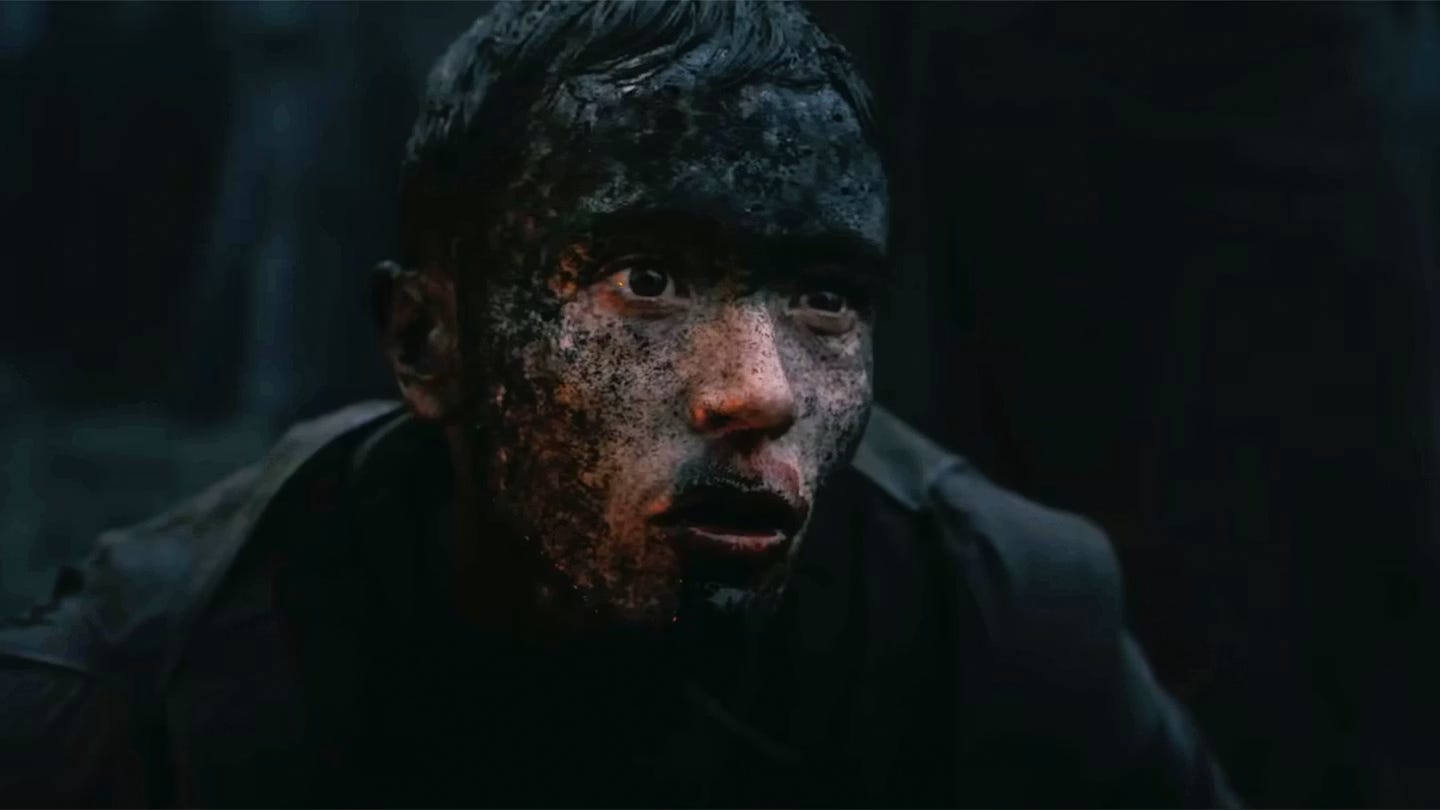
People attacked Elliot Page’s casting, often while falsely claiming he was playing Achilles or some massive Spartan warrior. Page actually plays Sinon, a smaller and more vulnerable figure whose importance comes from deception and sacrifice, not physical dominance.
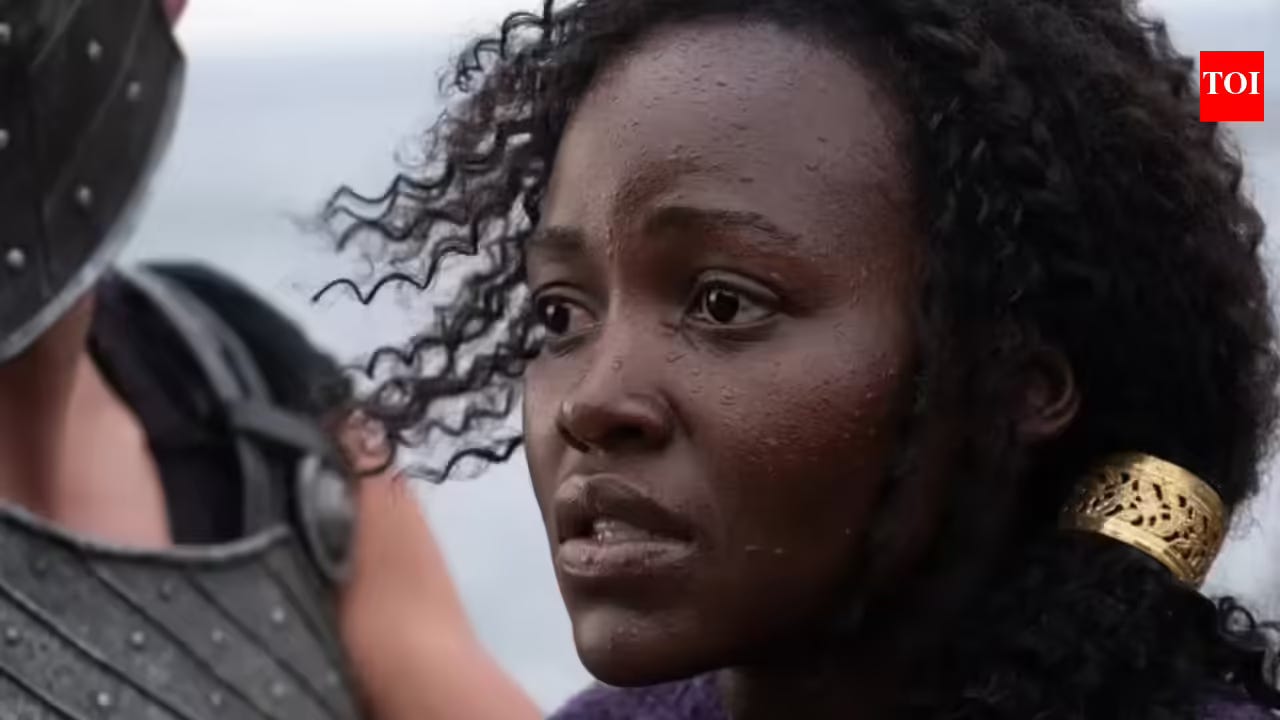
Lupita Nyong’o’s casting as Helen of Troy created even more outrage. She is Black, rather than the blonde, white version of Helen that many people have come to expect from Western paintings and previous movies.
Suddenly, half the internet became experts on Bronze Age Greece. People were debating armor, ships, ethnicity, masculinity, historical accuracy, Greek mythology, and the supposed destruction of Western civilization.
The backlash reached the point where people were saying Nolan had lost the plot. They claimed he had sold out to woke Hollywood, intentionally disrespected Western culture, and made casting decisions to appease some imaginary DEI committee at the Academy Awards.
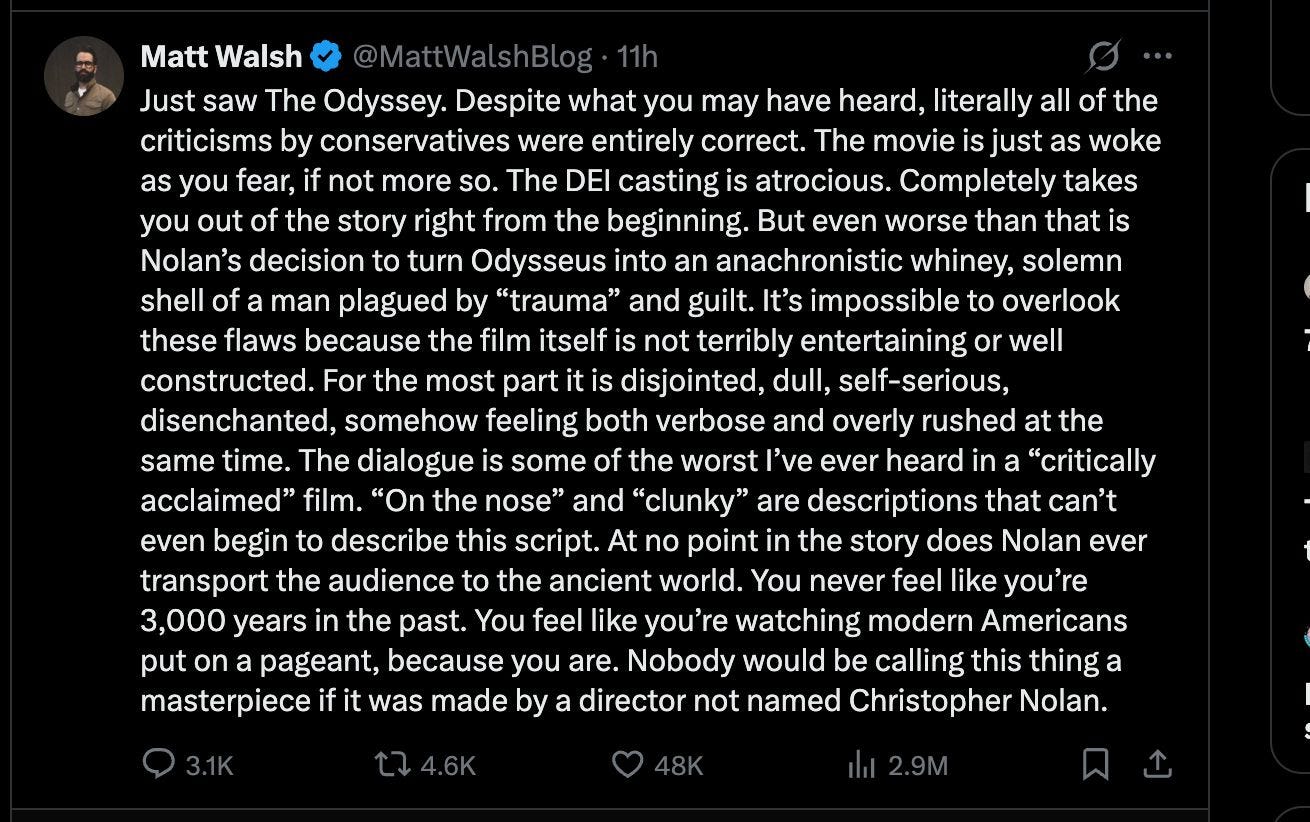
Matt Walsh joined the pile-on before the movie was released and continued afterward. He called the casting “atrocious” and described Odysseus as an “anachronistic whiney, solemn shell of a man” plagued by trauma and guilt. According to Walsh, Nolan had taken one of history’s great warriors and transformed him into a modern victim.
Honestly, some of it almost got to me.
I watched the videos. I read the arguments. I listened to people confidently explain why this movie was going to be a disaster. I went into the theater wondering whether Christopher Nolan had finally made a massive mistake.
He did not.
Christopher Nolan Understood the Assignment
This movie is absolutely epic.
Is the cast diverse? Yes.
Does that damage the story? No. Actually, it might be more accurate.
The ancient Mediterranean was not an isolated neighborhood where nobody ever encountered people from somewhere else. It was a center of trade, migration, conquest, slavery, commerce, and travel. More importantly, this is a mythological adaptation involving gods, monsters, prophecies, and divine intervention.
Casting still has to make sense within a story. I do not believe every actor automatically fits every role. Physicality matters when the story requires physicality.
But that is precisely why Page’s casting works. Sinon is not presented as an unstoppable warrior beating men twice his size. He is smaller, vulnerable, expendable, and essential to Odysseus’s plan. The character demonstrates that wars are not won only through strength. They are also won through deception, sacrifice, strategy, and the willingness to use human beings as pieces on a board.
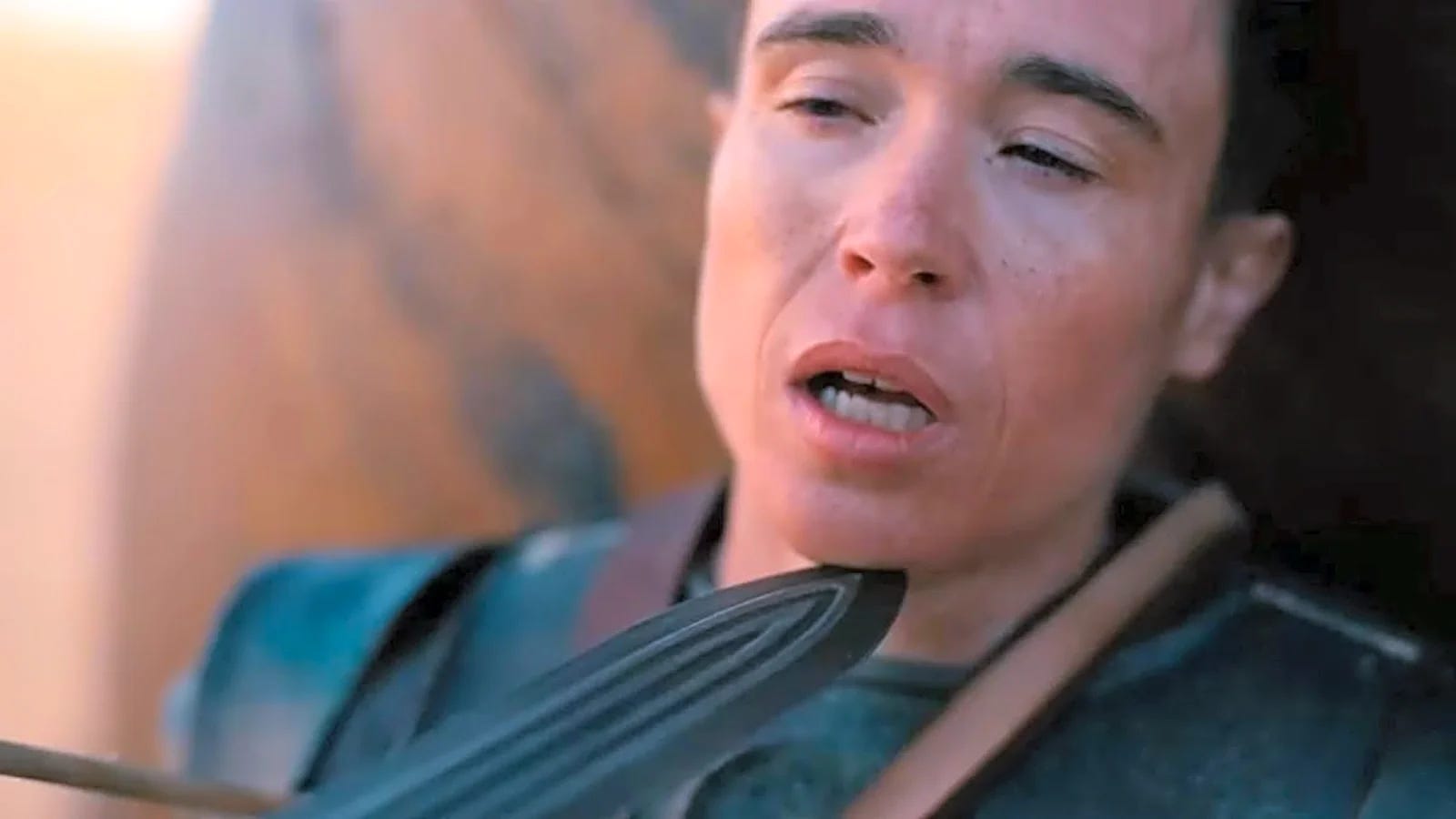
The scenes inside the Trojan Horse are brutal. The men are packed together, drowning as the tide rises, pissing and shitting on one another, waiting for the slightest opportunity to escape and open the gates.
There is nothing glamorous about it. Nolan does not present war as a beautiful procession of muscular men marching heroically into battle. He shows what victory costs and what leaders sometimes ask other people to endure in order to achieve it.
Nyong’o’s Helen does not destroy the story either. Her casting changes nothing about the deception, betrayal, heartbreak, or consequences surrounding Troy. Her relatively limited role also becomes important to Odysseus because her experience helps him think through how he might return to Ithaca without immediately revealing himself.
This Is a Story About Masculinity
I do not understand the argument that showing Odysseus wrestling with trauma somehow demasculates him.
If anything, that is what makes his masculinity believable.
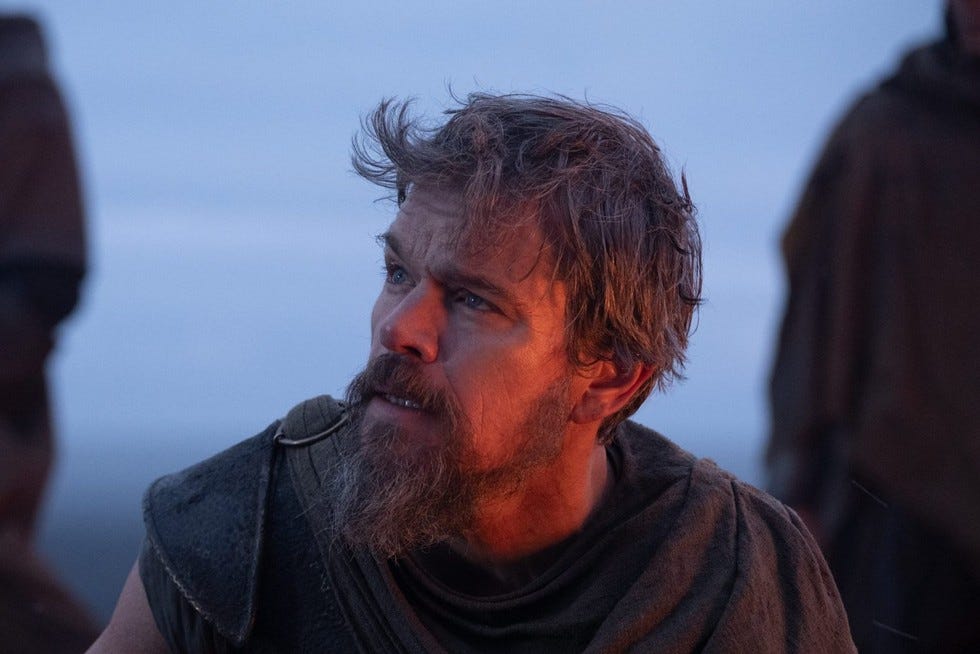
This is not an Arnold Schwarzenegger movie where the hero kills everyone, delivers a one-liner, and walks away untouched. Odysseus spends ten years at war and another ten trying to return home. He watches men die. He sends some of them to their deaths. He makes impossible choices, loses people he loves, and carries the responsibility of leadership long after the glory of victory disappears.
That changes him.
Strength is not the absence of grief, guilt, doubt, or fear. Strength is carrying those things without allowing them to completely destroy you. It is finding a reason to continue when the mission that once defined you is over and the person you were before the war no longer exists.
That is the deeper question behind Odysseus’s journey. Winning the war does not mean he knows how to come home. Victory gives him glory, but it does not give him peace. He still has to decide whether he wants to remain a warrior forever or return to being a husband, father, and king.
That is not a weak man. That is a man being forced to confront the full consequences of what he has done and what has been done to him.
Leadership Does Not Mean Control
The movie also understands something important about leadership: being responsible for people does not mean you can control them.
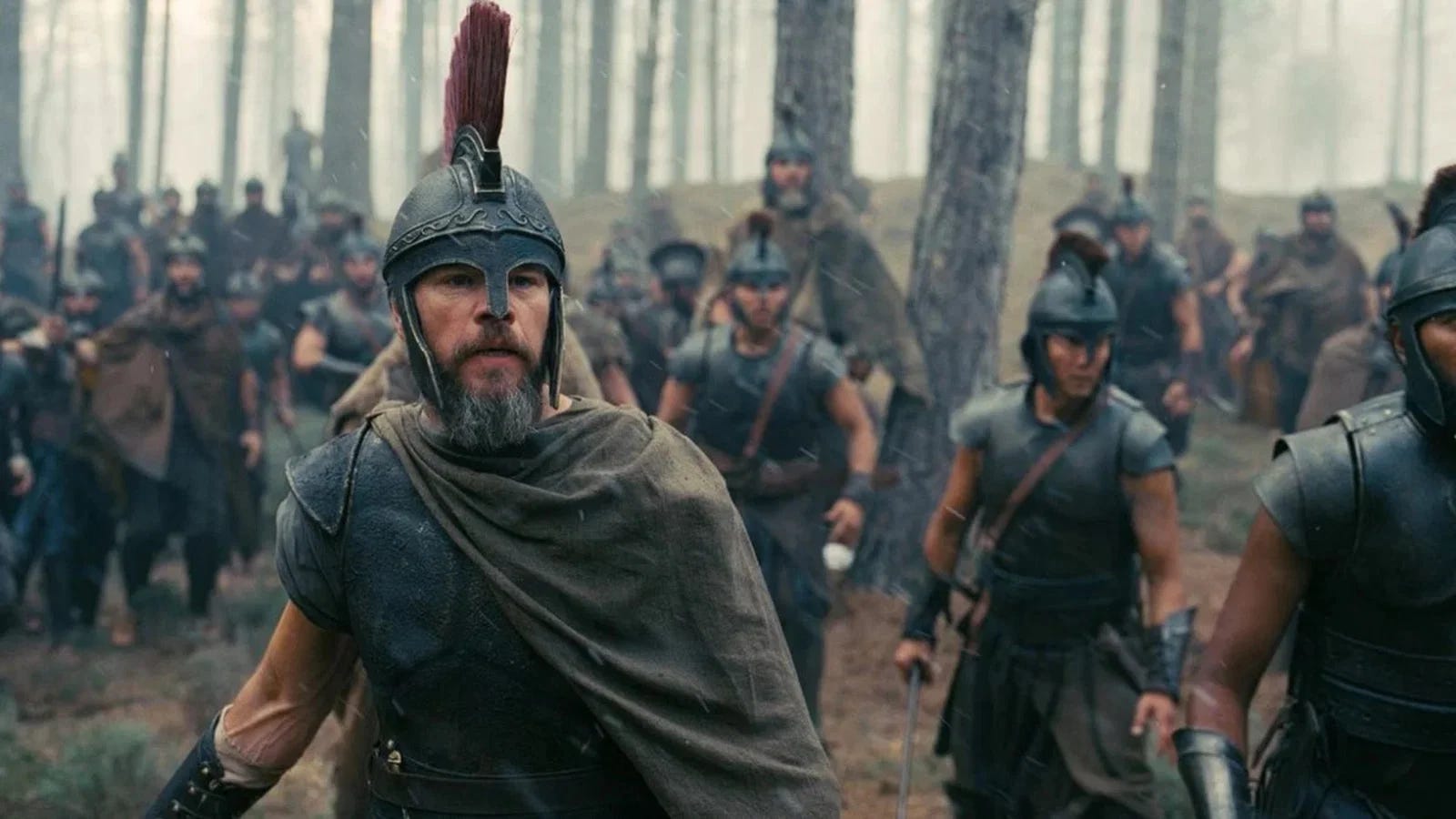
Odysseus can warn his men. He can plan for them. He can try to protect them. He can understand the consequences better than they do. But he cannot make every decision for them.
His men slaughter the sacred cattle of Helios after being explicitly warned not to touch them. Odysseus does not choose that outcome, but he still has to live with the consequences.
That is one of the hardest parts of leadership. You can know the danger. You can explain it clearly. You can see exactly where a decision will lead, and people can still make it anyway.
Foreknowledge is not control.
Odysseus also has to decide who will be placed in danger and who may have to die. Leaders can pretend every person will come home, but that is not true. Sometimes every available choice is terrible. Sometimes there is no heroic answer that leaves everyone alive and morally clean.
The scenes involving the Underworld and the people Odysseus lost are powerful because they force him to confront the human cost behind his own choices. History may remember the victory. He remembers the faces.
Glory is temporary. The burden is not.
Addiction, Comfort, and the Temptation to Stop Moving
The movie also made me think about addiction.
The lotus and Calypso are separate parts of Odysseus’s journey, but both represent different versions of the temptation to stop moving forward. The lotus offers forgetfulness. Calypso offers comfort, pleasure, and escape.

After everything Odysseus has endured, that temptation makes complete sense.
It made me think about soldiers who return from war and drink too much, use drugs, or find some other way to numb themselves. Not because they are weak, but because forgetting can feel easier than living with the people they lost and the choices they made.
Addiction can become its own island. You are no longer trapped by a monster or a god. You are trapped by the comfort of not having to remember.
Odysseus cannot return home until he is willing to leave that comfort and face his past. He has to remember his family, accept what happened to his crew, and resume the journey knowing that returning home will not erase what came before.
He cannot become the person he was before the war. He can only decide what kind of person he will be after it.
We Are Being Fed Our Opinions
The response to this movie made me think about something larger than The Odyssey.
We are being given our opinions before we are given the facts.
We see a clip, headline, screenshot, meme, AI-generated image, or reaction video. Someone packages an argument into a sound bite, and people repeat it to prove they are informed and on the correct team.
I see it constantly on Substack and Facebook. People respond to something I wrote with an argument that has almost nothing to do with what I said because they are not responding to me. They are responding with a prepackaged set of talking points somebody else gave them.
It almost worked on me with this movie.
The outrage was repeated so confidently and so often that I entered the theater wondering whether the movie might be an intentional attack on Western culture. Millions of people reached conclusions about the film before they had watched it or even knew which characters the actors were playing.
Sometimes I think that we are living in a simulation and that some massive artificial intelligence took control of the algorithms around the COVID era. I do not know if there is one person or force controlling it. But I do know what the incentives are producing.
The algorithms reward anger, certainty, humiliation, tribalism, and the quickest possible reaction. They do not reward thoughtfulness, restraint, curiosity, or admitting that you do not have enough information yet.
We are living in a post-truth society where the person who tells the most emotionally satisfying story often beats the person who has the facts.
The reaction to The Odyssey allowed me to watch that process unfold on a compressed timeline. A narrative was created. People repeated it. The movie came out. The narrative was contradicted, and many people simply refused to reconsider it.
Admitting you were wrong is apparently no longer an option. Shit even Ben Shapiro liked it!
When Norms Collapse, Darkness Gets In
The most political part of The Odyssey may not be its casting. It may be what the story says about the collapse of norms.
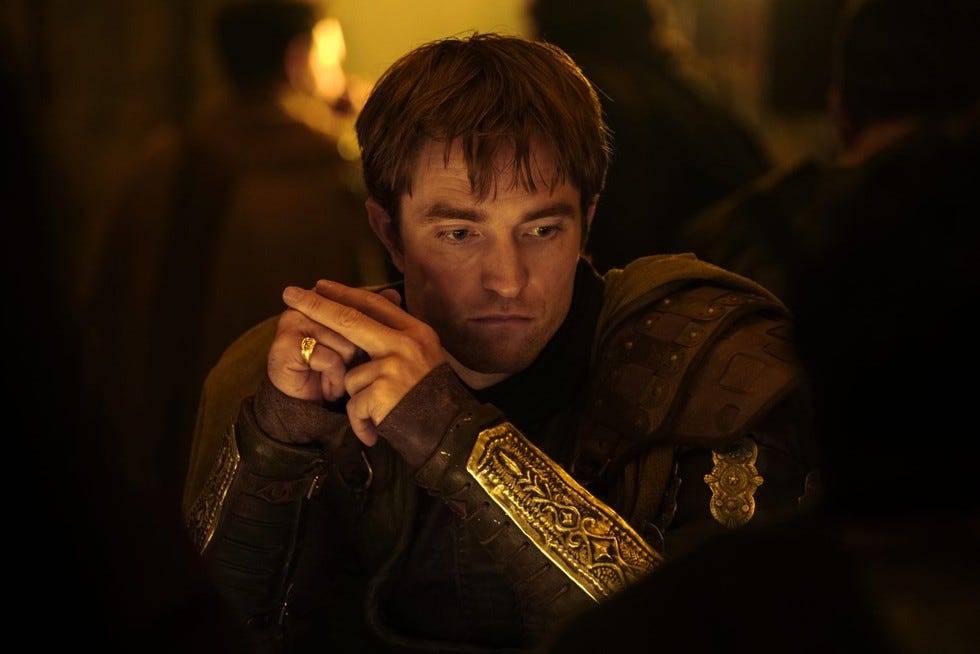
Odysseus is gone for twenty years, ten years fighting at Troy and ten years trying to return. The darkness that spreads during that absence is not caused only by war, monsters, tragedy, and the anger of the gods.
It is also caused by people abandoning the laws and customs that hold society together.
The suitors understand the rules of hospitality. They exploit those rules while violating their purpose. They technically arrive as guests, but then consume the household, threaten Telemachus, pressure Penelope, corrupt the servants, and turn hospitality into occupation.
That is what makes their behavior so corrosive. They are not attacking the system from outside. They are hollowing it out from within.
A functioning society cannot survive through written law alone. There must also be shared standards about honesty, dignity, restraint, loyalty, hospitality, and acceptable behavior. There will always be things people can legally do that still destroy trust and weaken the culture around them.
In Homer’s world, those standards are connected to Zeus and the gods. In another culture, they might be described as religious or biblical principles. But you do not have to believe in Zeus or belong to any religion to understand why they are necessary.
Over the past decade, we have watched social media push our culture toward the lowest possible denominator. The most dishonest, cruel, humiliating, degenerate, and attention-seeking behavior gets rewarded. The person willing to break the norm gets the attention, and everyone else begins lowering their own standards because they do not want to compete at a disadvantage.
Then comes the whataboutism.
Why should we tell the truth when the other side lies? Why should we follow the rules when they break them? Why should we maintain standards when they have already stooped lower?
Eventually, nobody is defending the norm. Everyone is only explaining why the other side forced them to abandon it.
That is how a culture collapses. Not necessarily through one dramatic event, but through millions of smaller choices where people decide that truth is optional and rules only matter when they can be used against someone else.
The consequences eventually reach everyone. That is the warning running beneath The Odyssey. When shared rules disappear, brute strength, deception, revenge, and violence rush in to replace them.
My Review
I give Christopher Nolan’s The Odyssey a 9 out of 10.
It is not perfect. Every movie has flaws if you look hard enough. People will debate the historical inaccuracies, changes to Homer, characters Nolan added, elements he removed, the costumes, ships, accents, casting, and everything else.
Fine.
But I walked out thinking, this is exactly why I still pay to see a movie in a theater.
It is visually stunning, thoughtful, violent, emotional, and much deeper than the culture-war argument surrounding it. It does not demasculate Odysseus. It gives masculinity weight. It shows that being a man is not about being untouched by war, grief, or failure. Crying because you miss you family. Praying for your fellow soldiers. Struck by fear to make a wrong choice. It is about how you carry those things and whether you can still find your way home.
It is a story about leadership without complete control, victory without peace, addiction as escape, family as purpose, and the terrible cost of decisions that cannot be undone.
It is also a warning about what happens when the shared laws, customs, and expectations holding a society together become nothing more than loopholes for selfish people to exploit.
Christopher Nolan understood the assignment.
Go see it.
Stay Angry.
p.s. Read my review of Andor as well.
Andor and the Mechanics of Authoritarianism

If you haven’t watched Andor—both season one and season two—you should stop and do that.
Thanks, Matt. I guess the fact that I'm still trying to digest it a day later, speaks for the film. Yes, worth going to the theater, and splurging on imax.
I’m delighted you liked it. Good review too—-