

Something that’s been circulating lately is a conversation on Joe Rogan featuring Ben Affleck and Matt Damon, where both of them push back—hard—on the idea that AI is about to replace humans at scale the way tech companies keep promising.
What struck me wasn’t just what they said, but why they said it. Their argument lines up almost perfectly with how I’ve been thinking about AI’s actual trajectory versus the story being sold to investors, lawmakers, and the public.
This isn’t an anti-AI take.
It’s an anti-hype take.
This is The 80% / 20% Problem
One of the most important ideas they touched on is the 80/20 rule.
The first 80% of progress in almost any new venture is easy. The last 20% is brutal.
It’s easy to get competent at piano. Becoming a virtuoso takes decades.
It’s easy to start a relationship. Sustaining one through real life is the hard part.
It’s easy to launch new technology that wows people. Perfecting it is where innovation slows and costs explode.
Technology always follows this curve.
AI shot from 0 to 80 incredibly fast. It amazed everyone. It writes, listens, summarizes, generates. That phase felt magical.
Now it’s hitting the wall.
Incremental improvements are expensive, slow, and increasingly difficult.
Diminishing Returns, Exploding Costs
Ben Affleck made a point that rarely gets said out loud.
The jump from earlier AI models to more advanced ones wasn’t a 10x leap. It wasn’t even close. In his framing, newer versions might be 25% better, but at multiple times the cost.
The issue isn’t whether AI can improve.
It’s whether the economics justify the improvement.
At some point, squeezing more performance out of an already “good enough” model starts to look like trying to get juice out of a fruit that’s already been crushed, strained, and poked a hundred times.
That doesn’t mean AI stops improving.
It means improvement takes time, capital, and patience.
None of which pair well with market cycles.
Adoption Isn’t the Same as Replacement
Another thing that gets glossed over is adoption.
Most people already use some form of AI in their workflow. If they don’t, it’s often by choice. And the people who do use it know its limitations intimately.
The internet is the perfect comparison.
The internet existed for decades before it became seamless, standardized, and widely usable for commerce. Even now, there are parts of it people still haven’t adopted.
AI will follow the same path.
Widespread use does not equal total displacement.
Tools don’t erase humans. They reshape workflows.
The Self-Driving Car Reality Check
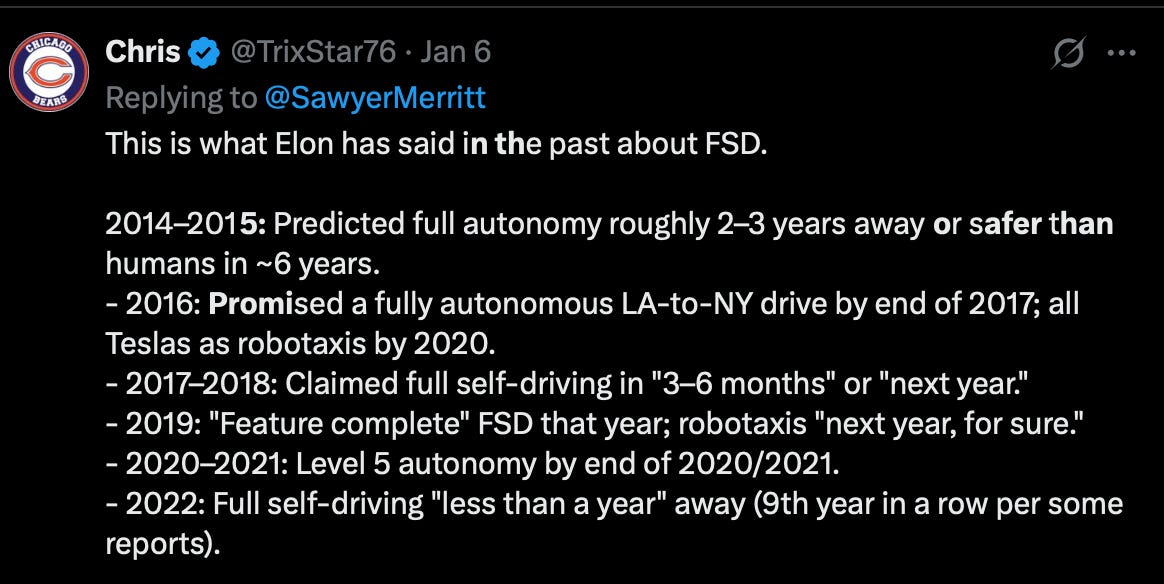
Elon Musk is the best example of why timelines matter.
I bought a Tesla in 2021 with “Full Self-Driving.” It was neither full nor self-driving.
To be fair, it’s improved significantly. But Musk has promised FSD “in two years” for over a decade.
Why?
Because refinement is harder than invention.
The last 20%, the part where systems must handle edge cases, ethics, safety, and liability, is where progress slows. And when human life is involved, speed stops mattering as much as precision.
AI will face the same reality.
Why Human Experience Still Matters
Matt Damon added something crucial here, and it cuts directly against the idea that AI can simply substitute for human creativity.
He talked about performance as lived experiences. The ability to pull from real experiences and place them, deliberately, into a moment..
Damon specifically referenced The Smashing Machine, the upcoming film starring Dwayne “The Rock” Johnson. What makes that performance work is not just lines on a page or physical presence. It’s that Johnson is able to draw from real experiences like his father’s alcoholism, his mother’s illness, the emotional weight of those moments and bring them into the role in a way audiences can feel.
You can license a likeness.
You can recreate a voice.
You can generate dialogue that sounds correct.
But knowing when to deploy emotion, why it matters in that moment, and how it connects to a shared human experience is not something you can brute-force with scale.
AI doesn’t know what it feels like to sit with uncertainty.
It doesn’t know fear as fear.
It doesn’t understand loss as something that changes you permanently.
It can describe those things.
It can remix representations of them.
But it doesn’t carry them.
Damon’s point wasn’t that AI can’t produce content. It clearly can. His point was that meaning comes from context, timing, and lived reference. From having been through something and knowing how to place it in a moment that resonates.
AI Slop vs. AI as a Creative Tool
I want to push back on the idea that AI only produces “slop,” because that argument misunderstands both technology and culture.
What’s far more likely is a split.
AI will dominate the bottom of the market. Cheap, mass entertainment will absolutely be AI-generated. Low-budget filler content will flood every platform that rewards volume over substance. Fast, disposable media will scale because it already scales. AI just makes it cheaper, faster, and more relentless. Streaming services need content libraries filled. Social platforms need infinite scroll. AI fits that incentive structure perfectly. It doesn’t need taste. It doesn’t need judgment. It just needs to be “good enough.”
At the top, serious creators will use AI as a multiplier, not a replacement. The people who already understand craft, timing, restraint, and emotional weight will use these tools to push further into that brutal last 20 percent. AI can help with drafts, iterations, structure, and exploration, but it cannot substitute for lived experience or taste. Pop music will continue to exist. So will Hans Zimmer. And AI won’t close that gap. It will widen it. Mediocrity will scale downward. Excellence will compound upward.
Fear, Hype, and Regulatory Capture
Here’s the part that doesn’t get enough attention, and it came through clearly in the transcript once you follow the incentives all the way through.
A lot of the fear around AI does not appear to be organic. It’s being amplified, curated, and repeated.
If regulation is coming, and it is, you do not want to be reacting to it. You want to be writing it.
And to write it, you need urgency.
So what do we hear, over and over?
AI will take everyone’s jobs.
AI will collapse the labor market.
AI will overload power grids.
AI will drain water supplies for data centers.
AI is an existential threat if we don’t act right now.
Those talking points didn’t emerge from nowhere. They’re being pushed into the media ecosystem deliberately, because panic accelerates legislation. Calm skepticism slows it down.
Once that fear hits a critical mass, Congress does what Congress always does when it feels outpaced by technology: it scrambles. Hearings get scheduled. Emergency frameworks get floated. Lawmakers pretend to understand the technology and insist something must be done immediately.
And then, right on cue, the same names show up in Washington.
Sam Altman
Elon Musk
Jensen Huang
Mark Elliot Zuckerberg
They are there to “help” Congress understand what regulation should look like.
This is textbook regulatory capture.
The companies with the deepest pockets, the largest legal teams, and the most political access sit in closed rooms and explain how dangerous this technology is and how only responsible, well-capitalized, mature players should be allowed to operate it.
What does that translate into…
Licensing regimes that cost millions to comply with.
Permitting processes that require armies of lawyers.
Compliance standards that only deep pockets can meet.
Reporting requirements that crush startups before they launch.
On paper, it’s about safety.
In reality, it’s about moat-building.
The end result is predictable. Innovation doesn’t stop, but it centralizes. Barriers to entry rise. Competition narrows. The same companies warning you about AI’s dangers become the only ones legally allowed to deploy it at scale.
The Takeaway
I appreciate Affleck and Damon’s take because it’s contrarian and grounded.
AI isn’t magic.
It isn’t imminent apocalypse.
And it isn’t replacing humanity in two years.
What is happening is a massive capital race, a battle for regulatory control, and a fight over who owns the future infrastructure.
Stay Angry